
- By 2030, 4G will be the most dominant backbone for IoT deployments, with Cat-1, Cat-1 bis, and Cat-4 being the most widely used technologies amid a decline in module ASPs.
- However, early signs of 4G sunset are emerging globally, with initial phase-out discussions starting around 2028 in mature markets and extending to the mid-2030s in the emerging markets.
- 5G RedCap and eRedCap will drive the next growth phase, with module prices expected to fall to 4G levels, positioning these technologies as scalable and cost-efficient successors.
Although 2G and 3G still form the backbone of the IoT ecosystem, especially in price-sensitive applications like smart metering, asset tracking, POS, and basic telematics, their low module cost and widespread network coverage make them ideal for large-scale and mass IoT deployments. However, with the rise of 4G IoT technologies such as LTE-M and NB-IoT, the market is shifting toward more efficient alternatives offering better power efficiency, scalability, and long-term support. As a result, the industry is gradually moving away from 2G and 3G, leading to the global sunset of these legacy technologies.
Sunset of Legacy Technologies
The global transition away from 2G and 3G is progressing at markedly different speeds across regions. Japan, South Korea, Australia and the US have already completed 2G shutdowns and moved early on 3G retirement, reflecting advanced network evolution and strong adoption of 4G and beyond. Europe too is moving aggressively, with most shutdowns already completed or targeted by around 2025-2030.
In China, India, and Latin America, legacy networks continue to support a substantial subscriber and IoT base, particularly in rural and cost-sensitive segments, delaying full shutdown timelines. A similar pattern is visible across Africa, where affordability constraints and limited availability of 4G keep 2G and 3G embedded in connectivity strategies. As a result, China and India are likely to phase out 2G gradually toward the end of the decade, while parts of Asia are expected to extend support into the early 2030s. Latin America is also targeting phase-outs around the early 2030s, whereas timelines in the Middle East and Africa are more extended, with legacy networks in some cases persisting into the mid-2030s.
4G Sunset and the Rise of 5G RedCap and eRedCap: The Next Phase of Transition
4G remains a critical backbone of global connectivity today, underpinning both consumer and IoT deployments with its wide coverage, affordability, and mature ecosystem. Technologies such as Cat-4, Cat-1, and Cat-1 bis continue to efficiently support a broad range of applications, particularly in price-sensitive markets. Meanwhile, the number and the coverage of 5G networks continue to expand. The adoption of newer technologies like 5G RedCap and eRedCap depends on the rollout of 5G SA networks, which has remained remarkably slow. As this evolution progresses, operators are beginning to consider the long-term phase out of 4G, with timelines closely tied to factors such as device readiness, 5G coverage, and spectrum refarming, all of which will shape the pace of the transition.
The shift toward 5G in IoT is more about long-term efficiency and scalability. RedCap and eRedCap offer comparable performance to existing 4G categories while aligning with future network evolution. As 5G SA coverage improves, these technologies will increasingly act as natural successors to 4G.
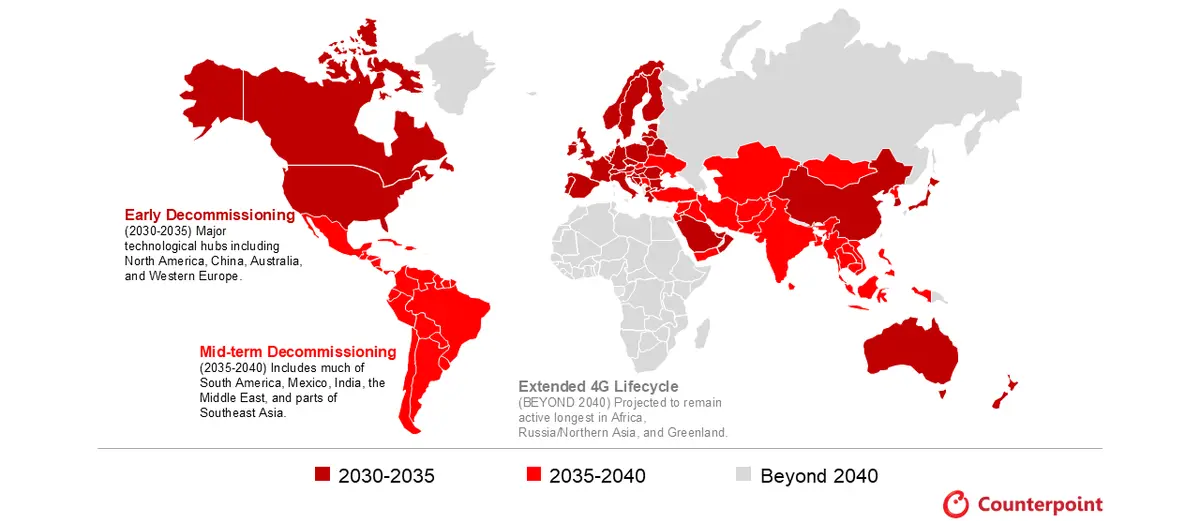
Against this backdrop, early indications of 4G sunset planning emerged across regions. In Asia, initial phase-out considerations are expected toward the end of the decade. Japan and China are likely to see early activity from around 2028-2029. North America is expected to follow a similar trajectory, with early movement emerging around 2028. In Europe, initial transition signals are expected from the late 2020s into the early 2030s. Latin America and India are likely to see shut down planning and commencement from the mid-2030s. The Middle East and Africa will likely trail, with initial phase-out considerations emerging closer to the mid-2030s.
Timeline for 4G Sunset by Region
Source: Counterpoint Research
For IoT module and device vendors, the 4G sunset will be a critical inflection point. This transition will not be a direct shift to full-scale 5G as this technology will still be too expensive for massive adoption. But it would rather adopt an intermediate technology such as 5G RedCap and eRedCap. By 2032, RedCap modules are expected to reach the ~$12 price range, while Cat-4 will be ~$11. This narrow price gap will allow 5G RedCap to replace 4G Cat-4.
Likewise, in the lower-tier segment, Cat-1 and Cat-1 bis will see continued price erosion, with ASPs expected to nearly halve by 2030, as eRedCap gains traction and begins to take share. Aligning product roadmaps with this dual transition from 4G to 5G and within 5G toward RedCap variants will be essential to remain competitive across regions, as markets are evolving at different speeds, requiring vendors to balance low-cost 4G demand with emerging 5G IoT adoption.
Conclusion
Stepping back, the evolution from 2G and 3G through to 4G and now toward 5G is not a series of abrupt shifts, but a layered and regionally nuanced transition. Legacy networks will continue to persist where they are most needed, even as 4G remains the dominant foundation for IoT today. At the same time, the momentum toward 5G is becoming increasingly structured, with RedCap and eRedCap emerging as the practical bridge between cost efficiency and next-generation capability. Together, these shifts are gradually redefining the cellular IoT landscape, not through disruption alone, but through careful coexistence and phased migration.
Looking ahead, with 6G already on the horizon for the early 2030s, the need to future-proof IoT deployments becomes even more pronounced. Many IoT devices are designed to remain in the field for a decade or longer, making technology choices today critical for long-term viability. As a result, deployments will need to be more measured and forward-looking, balancing current cost efficiencies with upgrade paths that align with evolving network capabilities. Those who can anticipate these cycles and design with longevity in mind will be best positioned to navigate the next wave of connectivity evolution.


