- Autonomous AI agents will become the next major stage of AI system architecture, as AI systems evolve from isolated model queries into persistent software systems capable of reasoning, coordinating tools, and executing tasks over extended periods of time.
- Persistent AI workloads can fundamentally reshape compute demand and GPU utilization patterns, as continuously running agents replace the short burst inference patterns typical of prompt-based interactions.
- Infrastructure, including memory hierarchy and system design, will become the defining battleground of the next AI race, since agent-based systems require sustained compute, large KV caches, and long-running context management.
- The rise of locally deployable LLMs for agent systems such as Claws will pressure high-cost cloud inference, while potentially increasing demand for AI training infrastructure as model capabilities continue to evolve.
The AI industry may be entering a new phase where autonomous systems operate continuously rather than responding only to individual prompts. These systems, often referred to as AI agents, are designed to observe their working environment, reason about tasks, and take actions over extended periods of time.
Recent announcements at NVIDIA GTC 2026 suggest that the industry is beginning to prepare for this transition. While the past few years have been defined by rapid improvements in large language models (LLMs), the next stage of AI development may depend less on benchmark scores and more on how AI systems are deployed and integrated into real-world environments.
The Rise of OpenClaw-based Agent Systems
In previous reports, we suggested that OpenClaw may represent an important architectural direction for the future of AI systems. Instead of relying entirely on hyperscale cloud infrastructure, AI capabilities may gradually move closer to users, enabling personal AI agents that can operate locally and continuously. Frameworks such as OpenClaw suggest an important architectural direction for the future of AI systems. Rather than interacting with AI through occasional prompts, users may increasingly rely on autonomous agents that operate continuously in the background.
These agents, often referred to as Claws, observe context, coordinate across tools, and execute tasks over extended periods of time. Instead of functioning as isolated model calls, they behave more like persistent software systems powered by intelligent LLMs. In this architecture, the model is no longer the entire product. Instead, it becomes one component inside a broader agent system.
An OpenClaw-based system typically integrates several layers, including reasoning models, tool orchestration, runtime environments, and compute infrastructure. Together, these layers allow agents to operate continuously rather than responding only to user prompts. In this architecture, the LLMs are no longer the entire product. Instead, it becomes one component inside a broader agent system.
The Cost Structure of Cloud Intelligence
In an agent-based architecture where AI systems may run continuously, monitor events, and execute tasks throughout the day, these costs can accumulate quickly. This creates a structural tension between capability and scalability. Cloud-scale LLMs offer greater capabilities, but they also come with an expensive cost structure. Furthermore, models that rely heavily on reasoning or extended chain-of-thought processes can incur significantly higher inference costs.
More importantly, relying heavily on cloud inference also conflicts with several core goals of personal AI systems, particularly privacy, latency, and user control. These constraints are one of the reasons why the industry is increasingly exploring architectures that combine local execution with selective cloud inference.
NVIDIA’s Claw Agent Strategy
At NVIDIA GTC 2026, NVIDIA introduced a series of technologies targeting long-running autonomous AI agents built on the OpenClaw framework, commonly referred to as Claws. Rather than focusing solely on model improvements, NVIDIA’s announcements suggest a broader strategy aimed at building the infrastructure required for agent-based AI systems.
The company introduced NemoClaw, an integrated deployment solution that allows developers to install an entire agent environment, including the OpenClaw framework, NVIDIA Nemotron models, and the OpenShell runtime, through a single command. By simplifying installation and integration, NVIDIA is effectively lowering the barrier for developers experimenting with autonomous agents.
Secure Execution for AI Agents
As AI systems move from generating responses to executing actions, security becomes a fundamental requirement. Autonomous agents may interact with APIs, local files, network services, and external software systems. To address these challenges, NVIDIA introduced OpenShell, an open-source runtime environment designed specifically for AI agents. The system provides policy-based security enforcement as well as network and tool access control. This layer effectively functions as a secure operating environment for agents, ensuring that autonomous systems can remain productive while operating within clearly defined boundaries.
Hardware for Persistent AI Systems
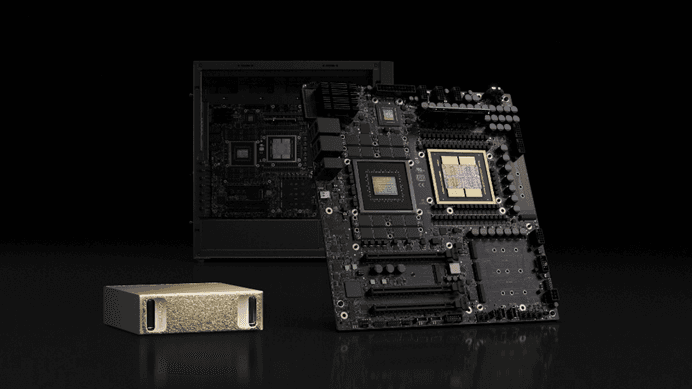
NVIDIA also introduced hardware platforms designed to support local agent development. NVIDIA DGX Spark is designed as a compact and energy-efficient platform capable of running always-on AI agents. It lowers the barrier for developers who want to experiment with persistent AI systems in local environments.
At the higher end, NVIDIA DGX Station provides a development platform capable of running frontier-level models locally. This allows developers to build and test complex agent systems without relying entirely on cloud infrastructure. These platforms highlight NVIDIA’s strategy of enabling agent development both locally and across enterprise environments.
Implications for AI Infrastructure
The transition from prompt-based interactions to autonomous agents could have several important implications for AI infrastructure. Persistent AI systems may significantly increase overall token consumption. Unlike traditional chatbot interactions that occur occasionally, autonomous agents operate continuously and may generate reasoning steps, tool calls, and contextual updates throughout the day. At the same time, persistent workloads may reshape GPU utilization patterns. Instead of short bursts of inference triggered by user prompts, agent-based systems may generate more stable and sustained compute demand.
Agent architectures may also increase the importance of memory hierarchy. Long-running agents require persistent context storage, large KV caches, and fast access to memory. As a result, memory bandwidth and capacity, whether through HBM, system memory, or storage layers, may become increasingly critical components of AI system design.
If the past phase of AI development focused primarily on scaling model size, the next phase may focus on building the infrastructure required to support persistent intelligent systems. The combination of NemoClaw, OpenShell, and new DGX platforms suggests that NVIDIA is positioning itself to provide the foundational infrastructure for this emerging paradigm.
In an OpenClaw-based architecture, the LLM is no longer the product. It becomes the reasoning engine inside a persistent autonomous system. This shift reflects a broader transition in the AI industry, from model-centric AI to system-centric AI.
Implications for Model Economics
Another potential implication is the growing role of locally deployable models in agent-based systems such as Claws. As more autonomous agents run directly on local hardware, demand for smaller but highly capable local LLMs may increase. These models are designed not to replace frontier cloud models entirely, but to handle a large portion of everyday reasoning, tool orchestration, and contextual processing within personal or enterprise environments.
If this architecture is widely adopted, it could place downward pressure on the pricing power of cloud-based inference, particularly for high-cost frontier models. When part of the workload shifts to local execution, the marginal value of cloud inference may decline for many routine tasks.
At the same time, the shift toward local agents does not necessarily reduce overall demand for AI infrastructure. As the number of autonomous systems increases, the need to train new models, improve reasoning capabilities, and optimize agent architectures could create additional demand for large-scale training compute.
In this sense, the rise of agent-based systems may redistribute AI compute demand rather than reduce it, potentially shifting some value from expensive cloud inference toward model development and training infrastructure.
Final Thought
The next AI race may not only be about building larger models. It may be about who builds the infrastructure for persistent intelligence. Once AI systems stop responding only to prompts and begin operating continuously in the background, the industry will no longer be scaling models alone. It will be scaling autonomous computation.


