

The IQ Era
The official theme at this year’s MWC in Barcelona was “The IQ Era” marking a shift from Generative AI to Agentic AI and a world of connected intelligence, where AI is woven into every network and device. If the mobile era was about connectivity and the 5G era about speed, then the IQ era is about autonomy and reasoning. Rather than just answering questions, AI agents can now execute complex tasks across multiple apps.
As the mobile industry transitions to 5G Advanced and 6G, Agentic AI is becoming the primary interface for user-device interaction. Agentic AI has become an integral part of wearable devices, such as smart glasses and watches, with native cellular connectivity becoming the norm, reducing reliance on smartphone tethering. Agentic-driven intelligent devices interpret user intent, such as recognizing a flight confirmation in an email and automatically updating the user’s calendar. These devices are being marketed not by screen resolution or camera megapixels but by their TOPS (Trillions of operations per second).
In robotics, the convergence of AI and robotics is ushering in the era of Physical AI. While early AI humanoids primarily used Generative AI to follow rigid, pre-programmed scripts, today’s robots are becoming decision-makers and use Agentic AI to reason, plan and execute multi-step goals in the physical world, while self-correcting via a closed-loop feedback system.
Agentic AI Is Redefining Network Requirements
Agentic AI is also driving the evolution of mobile networks and is fundamentally re-shaping mobile network traffic. An increasing proportion of traffic is now Agent-to-Agent (A2A), with different characteristics compared to server-to-human traffic. For example, a user’s personal agent might send several megabytes of data from a phone to an airline’s booking agent or to a hotel’s concierge agent. As a result, AI Agents are redefining network requirements, as follows:
- Traffic Symmetry – the most dramatic change is the shift from downlink-heavy traffic to more symmetrical uplink-downlink traffic patterns. Traditional 5G networks are typically designed for a 90:10 download-to-upload ratio. However, AI agents often require a 1:1 or higher ratios, i.e., they push more data to the cloud than they pull down. For example, in 2025, China Telecom identified that Agentic AI applications, such as smart glasses and industrial robots, require 5x the uplink capacity compared to 2024. As a result, uplink capacity has now become as critical as downlink capacity.
- Bursty Traffic – video streaming typically results in steady, continuous high-throughput traffic patterns. However, Agentic AI has a bursty traffic pattern. For example, an agent might be silent while waiting for a task or when thinking. When a task is initiated, it may suddenly trigger hundreds of simultaneous API calls, data retrievals, etc., creating irregular pulse traffic patterns that can overwhelm traditional congestion management algorithms.
- Deterministic Latency – the speed of reasoning for Agentic AI is often limited by the Time-to-First-Token (TTFT). For example, if an agent is controlling a drone or a surgical robot, a 50ms network delay could break the agent’s logic loop, potentially causing a task failure. This is leading to the revival of the concept of edge RAN, where the agent operates at a base station located at the edge rather than a distant data center. This provides the network with deterministic latency, i.e. a guaranteed response time that keeps the agent’s reasoning loop stable.
- GigaUplink Capability - to ensure a seamless AI experience across all environments, including at the network edge, operators must aim for a ubiquitous and reliable 1 Gbps uplink experience, i.e. GigaUplink capability, to ensure that AI Agents remain fully responsive at all times.
Strategic Network Evolution and Implementation
To meet these AI-driven demands, infrastructure vendors are developing high-performance hardware and software solutions that allow 5G networks to operate across ultra-wide frequency bands, delivering fibre-like speeds wirelessly by maximising the efficiency of the available spectrum.
Sub-3 GHz Synergy & Multi-Band Coordination
- Leveraging the propagation advantages of Sub-3 GHz spectrum for ultimate uplink coverage.
Operators need to maximise their spectrum assets across all bands, particularly their legacy Sub-3GHz spectrum. While higher TDD spectrum bands are being used to deliver 5-10 Gbps downlink speeds required for premium customer experiences, FDD Sub-3GHz spectrum is needed to extend high-speed 5G mobile broadband coverage across urban, suburban and rural regions to ensure reliable coverage. In particular, the Sub-1GHz spectrum band is vital for indoor coverage.
- Implement multi-band coordination to build a "ubiquitous large-uplink" network that ensures consistency across urban and rural settings.
Compared to wide-band TDD spectrum, FDD spectrum is limited, fragmented and consists of narrow-band channels. However, by using multi-band coordination techniques, these disparate spectrum assets can be combined to form a ubiquitous large-uplink network.
Accelerating Next-Gen Technology Adoption
- Low-band FDD Massive MIMO: enhances coverage and capacity simultaneously.
Low-band massive MIMO radios significantly boost capacity and coverage compared to conventional 4T4R radios, particularly when configured as multi-band radios. This enables operators to improve the spectrum efficiency of their existing Sub-3GHz resources whilst satisfying higher traffic demands and improving the user experience.
- Mid-band Meta Massive MIMO /8T8R: deploying advanced multi-antenna technologies to maximize spectral efficiency and significantly improve the uplink experience for edge users.
TDD multi-carrier aggregation combines spectrum from different TDD frequency bands, enabling much higher data throughput in wireless networks. By leveraging advanced multi-antenna technologies, operators can offer 5-10 Gbps fibre-like downlink speeds, as well as providing a much-improved low-latency, high-data uplink experience.
Overcoming Spectrum Fragmentation
- Utilizing GigaBand technology to achieve full-spectrum pooling of fragmented Sub-3 GHz assets.
GigaBand technology is a multi-band fusion technology that combines disparate spectrum assets into a single 100 MHz-wide FDD carrier. Using carrier aggregation and Multi-Band Serving Cell (MBSC) technology, six Sub-3GHz spectrum bands can be combined into a single carrier, which maximises spectral efficiency. This pooling creates a unified "high-speed reservoir" of bandwidth to support the bursty and data-intensive nature of Mobile AI services.
Case Study: Intelligent Ultra Pooling Uplink Technology
On May 20, 2025, China Telecom and China Unicom (Zhejiang), in partnership with Huawei, achieved a 5G uplink peak data rate of 1.1Gbps through a joint spectrum-sharing commercial test. This record-breaking performance was achieved with a 1.8GHz + 2.1GHz dual-band 8T8R base station and 95MHz of mid-band ultra-wideband spectrum. The test leveraged Uplink Carrier Aggregation (CA) and SU-MIMO technologies to maximize the FDD bandwidth and set a new benchmark for 5G network capability. Agentic AI was used to manage the network that supported other AI applications. Key features of the test included:
- Spectrum Decoupling and Pooling - instead of treating different frequency bands (such as 2.1 GHz and 3.5 GHz) separately, the system "pooled" them into a single elastic resource.
- AI-Native Orchestration – a network agent predicted signal quality in real-time shifting an AI agent's data stream between frequencies in milliseconds to ensure the "reasoning loop" of the robot or wearable never breaks.
- User-Centric Network - rather than the device following the cell tower’s rules, the network adapted its antenna beams and power specifically to follow the agent’s device.
Intelligent Ultra Pooling Uplink test
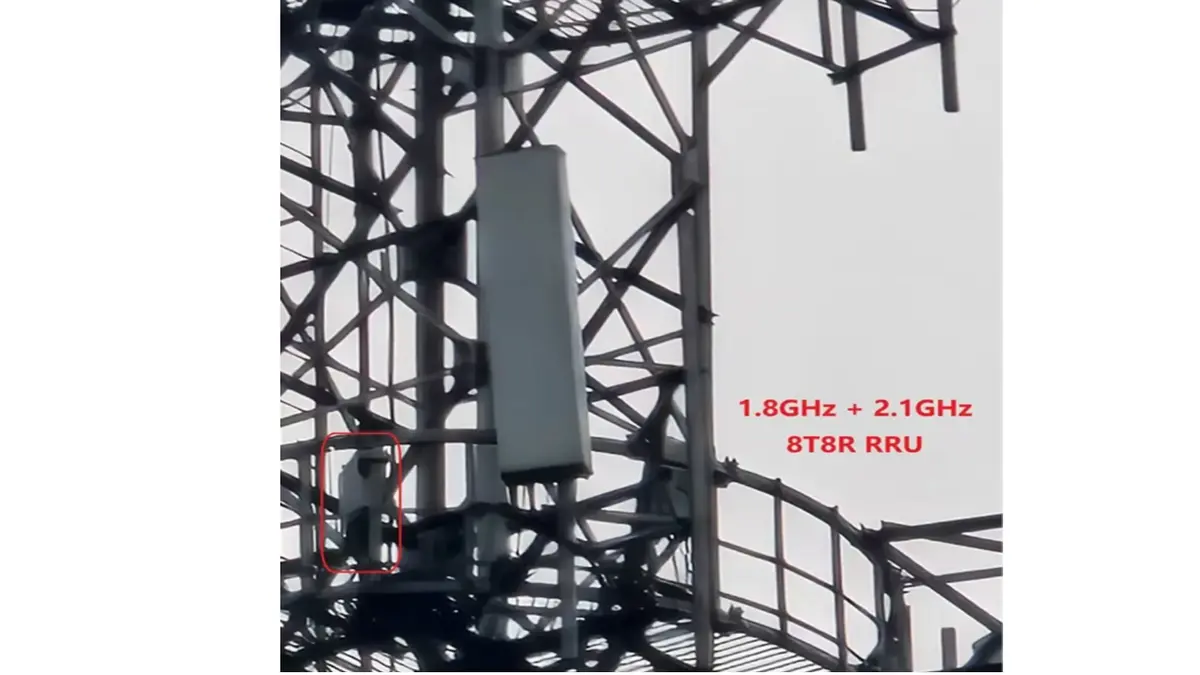
Figure 1 shows the antenna and 1.8GHz/2.1GHz dual-band 8R8R radios used in the Intelligent Ultra Pooling Uplink test.
Source: Counterpoint Research
Analyst Viewpoint
The mobile industry is shifting from providing “best-efforts” Internet to building Agentic-Native networks. Known as the mobile AI era, this transition marks a move away from server-to human traffic to agent-centric traffic. As AI agents move from text to multi-modal sensing for real-time reasoning, current 5G networks are unable to cope with traffic congestion.
To benefit from the enormous potential of Agentic AI, operators must invest in the latest network technologies, as Agentic AI has very different network traffic characteristics compared to more conventional applications, such as image and video streaming. AI infrastructure vendors are developing “AI-native” or “Agentic-Ready” radios and antennas that are designed to support the bursty and data-intensive nature of Agentic AI. First and foremost, base stations need to provide a symmetric user experience, with both uplink and downlink exceeding 1 Gbps across the full range of spectrum bands. To do this, operators must leverage their FDD Sub-3GHz spectrum to the full. Secondly, radios need to be ultra-wide bandwidth (400-600 MHz) to achieve massive throughput and enable multi-band integration, which allows operators to combine numerous narrowband frequency bands into a single wide carrier. By doing this, operators will have a pool of unified high-speed bandwidth to support bursty Agentic AI traffic.
Agentic AI is also being used to improve the performance of the RAN. For instance, operators are leveraging agentic AI to transition from human-managed networks to “intent-driven” networks. RAN agents embedded in the radio layer can now autonomously adjust beamforming and power based on the “”intent” of the AI application running on the network. As a result, operators no longer need to configure thousands of individual parameters manually.

