

The mobile connectivity landscape has witnessed remarkable evolution, fundamentally transformed the world bringing internet and broadband access first to the mainstream, and subsequently to the masses. Each generational leap has not only enhanced connectivity but has also driven the adoption of innovative technologies and services.
Transformation from 3G to 4G: The Rise of Smartphones
The transition from 3G to 4G marked a pivotal moment for the industry, propelling the widespread use of smartphones and mobile applications. Enhanced broadband capabilities under 4G enabled a dramatic increase in data speeds and reliability, making mobile internet a staple for consumers and fostering the development of a vibrant app services ecosystem.
Transformation from 4G to 5G: Cloud-Driven Content and Expanded Use Cases
The shift to 5G brought about further enhancements in broadband performance, unlocking “cloud-driven” richer content and services. This transition did not merely improve user experiences for smartphones but also laid the foundation for a more efficient and scalable end-to-end network architecture supporting an increasingly wide range of spectrum with a promise to lower cost-per-bit for CSPs. As a result, 5G enabled greater capacity and reliability, essential for supporting use cases beyond smartphones such as the Internet of Things (IoT) and connected vehicles.
The Current Phase: Artificial Intelligence Shaping Networks
The industry is shifting as network workloads and architectures evolve from supporting video, streaming, and extensive IoT to managing a rapid rise in AI token workloads. Artificial Intelligence (AI) from Generative AI to Agentic AI is already influencing how the networks’ design will evolve to support a variety of AI workloads on one end but also how these technologies will also help to automate and optimize these networks. This calls for AI for networks and Networks for AI.
Read more here: 5G Advanced: Evolution towards 6G
Some CSPs have already seen rapid growth in AI traffic on their networks, and many are not prepared for such a deluge; for instance, China's CSPs reported daily AI token consumption rising from 100 billion in early 2024 to over 30 trillion by June 2025—a 300-fold increase in 18 months.
More analysis here: AI Traffic Grows 300x
So, if the networks lack programmability for real-time sensing and decision making to accommodate such exponential AI workload growth, it will directly impact the performance and thus user experience causing churn. Additionally. If the network O&M remains static, the changing workload dynamics will strain the network affecting efficiency and scalability.
Strategic Industry Initiatives: Software-Driven Enhancements
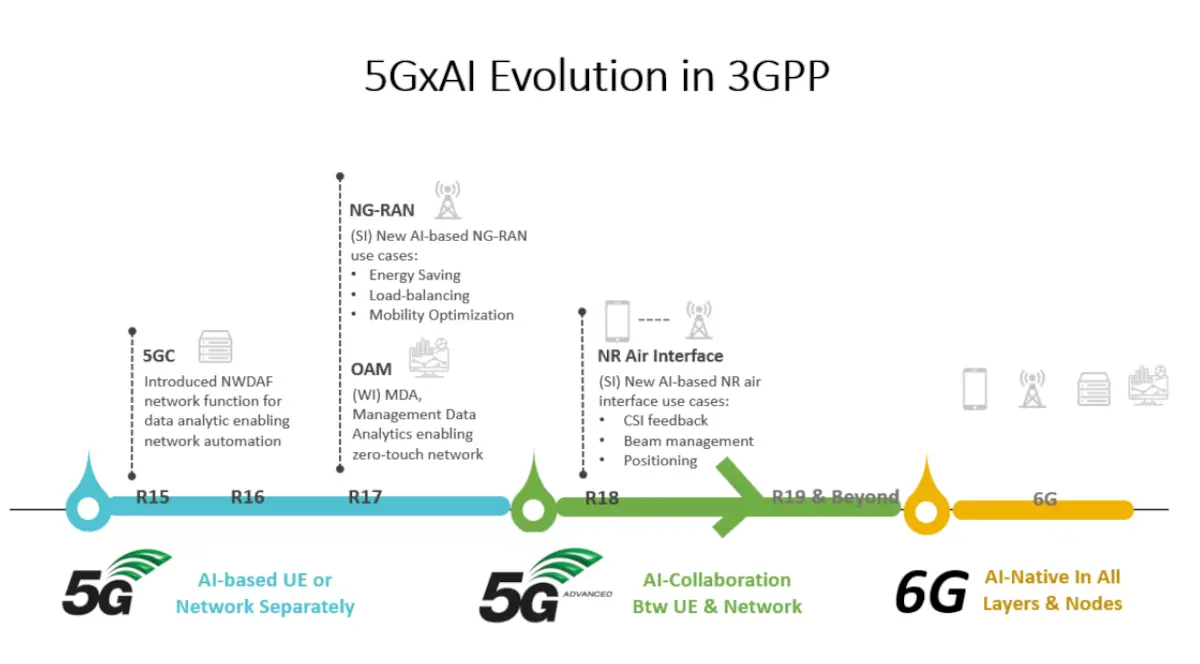
In anticipation of these new demands, industry stakeholders have proactively integrated software-driven enhancements into upcoming 3GPP releases (Rel. 18, 19, and beyond), building on the foundation established by 3GPP Rel. 15 5G New Radio (NR) deployments. These enhancements-driven specifications referred to as 5G-Advanced standard, are vital for CSPs to strengthen and expand the 5G NR platform capabilities in building a more dynamic, intelligent, and intent-driven programmable networks.
The software efforts and forward-looking work of 3GPP and network infrastructure vendors will integrate AI from Air Interface to every layer of the network to make it autonomously adaptable and secure offering guaranteed experience in a highly operationally efficient way.
IMAGE
The Impact of Software & Intent-Driven Transformation
This shift towards software-driven networks represents a critical path for CSPs to unlock greater business value. The software programmability should be both intent-driven and service-aware to not only unlock newer business models and revenue growth but also the ability to real-time automate and intelligently manage networks - saving energy costs, efficient use of resources thereby reducing OPEX.
This allows CSPs to not only offer "differentiated connectivity" but also deliver "differentiated experiences". Exposing these differentiated connectivity network APIs to developers to develop highly intelligent and efficient applications with a consistent user experience.
Consistent User Experience (UX) drives monetization across several areas: high-quality broadband (FWA, uplink-driven live broadcasting, user-generated content), low-latency applications (cloud gaming, remote driving), and critical enterprise use-cases (reliable payments in dense areas). Incorporating such intent-driven and service-aware programmability will take the 5G network to the next level, influencing CSPs to consider investing in 5G-Advanced deployment.
Read more here: Enable high-performing programmable networks with Ericsson 5G Advanced
We will be unpacking these learnings from 3GPP, CSPs & ecosystem in a series of posts in partnership with Ericsson.

