

- Global smartphone SoC shipments declined 21% YoY in Q3 2026, driven by rising memory costs, longer replacement cycles and cautious inventory management by smartphone OEMs.
- Mid and entry-price segments faced more pressure as smartphone OEMs reduced entry-level model offerings and prioritized margins, while premium SoCs proved relatively more resilient.
- Apple and Samsung were more resilient, while UNISOC, MediaTek and Qualcomm faced market-specific pressures.
- Memory prices are expected to rise another 5% QoQ in Q4 2026, while recycled memory adoption remains niche due to technical barriers.
- Smartphone SoC shipments are expected to fall 20% YoY in 2026 and another 3%-4% in 2027.
Beijing, Berlin, Buenos Aires, Fort Collins, Hong Kong, London, New Delhi, Seoul, Taipei, Tokyo – October 30, 2026
Global smartphone SoC shipments declined by 21% YoY in Q3 2026, driven by rising memory costs, longer replacement cycles and cautious inventory management by smartphone OEMs, according to Counterpoint Research’s latest Global Smartphone SoC Shipments Preliminary View report. The mid and entry-price tiers were impacted the most, as OEMs reduced the number of entry-level models and prioritized protecting profit margins. The premium segment, which was initially expected to remain resilient, was also affected, though to a lesser extent. Apple and Samsung were better positioned to weather the disruption, supported by integrated supply chains and a well-established shift toward premiumisation. UNISOC and MediaTek faced greater challenges due to their reliance on mid and low-end segments. Qualcomm also faced headwinds from Samsung’s decision to use a mix of Snapdragon 8 Elite Gen 5 and its own Exynos 2600 chipsets in the Galaxy S26 series, alongside softer sales among Chinese smartphone OEMs.
Commenting on the smartphone SoC market dynamics, Senior Analyst Shivani Parashar said, “We saw three notable flagship chipset launches in September 2026, based on TSMC’s 2nm process node: Apple’s A20 series, MediaTek’s Dimensity 9600 Pro and Qualcomm’s Snapdragon 8 Elite Gen 6 series. These launches are expected to boost premium smartphone SoC shipments in Q4 2026, although volumes are still likely to remain below Q4 2025 levels.”
Smartphone memory price growth slowed to 5%-10% in Q3 2026 compared with Q2 2026 and is expected to increase by another 5% QoQ in Q4 2026. Most memory suppliers are keeping price hikes relatively quiet, but some entry level smartphone players have started using recycled memory to keep overall bill of materials (BoM) costs under control. However, deep integration of SoCs with peripheral circuitry and RF components creates significant technical barriers to reuse, keeping adoption at a niche level.
Global Smartphone SoC Shipments Share by Vendor, Q3 2025 vs Q3 2026
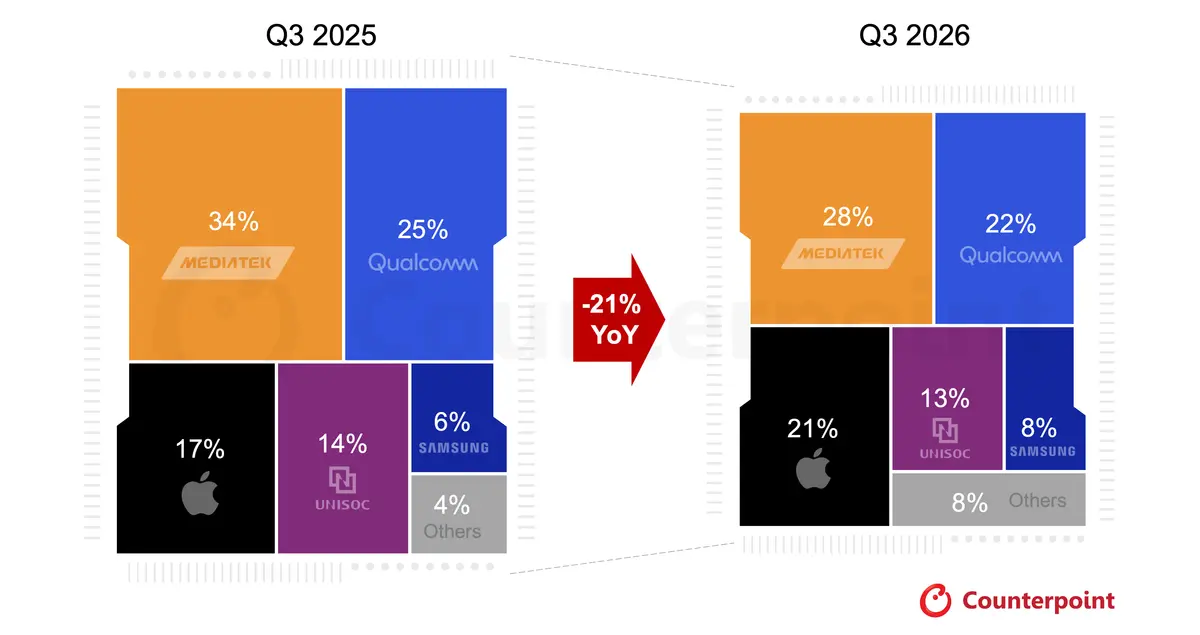
Source: Counterpoint Research Global Smartphone SoC Shipments Tracker, Q3 2026
Note: Percentages may not add to 100% due to rounding.
Commenting on the smartphone SoC market outlook, Principal Analyst Soumen Mandal said, “Global smartphone SoC shipments are expected to decline by 20% YoY in 2026 and another 3%-4% YoY in 2027. Memory prices are expected to maintain an upward trajectory, but price volatility is likely to moderate next year compared with 2026. Flagship SoCs are expected to remain broadly stable in 2027 despite higher prices due to migration to 2nm process nodes, while rising memory and component costs will continue to add to cost pressures.”
About Counterpoint Research
Counterpoint Research is a global market research firm specializing in products across the technology ecosystem. We advise a diverse range of clients – from smartphone OEMs to chipmakers and channel players to Big Tech – through our offices located in the world's major innovation hubs, manufacturing clusters and commercial centers. Our analyst team, led by seasoned experts, engages with stakeholders across the enterprise – from the C-suite to professionals in strategy, analyst relations (AR), market intelligence (MI), business intelligence (BI), product and marketing – to deliver services spanning market data, industry thought leadership and consulting. Our core areas of coverage include AI, Automotive, Consumer Electronics, Displays, eSIM, IoT, Location Platforms, Macroeconomics, Manufacturing, Networks and Infrastructure, Semiconductors, Smartphones and Wearables. Visit our Insights page to explore our publicly available market data, insights and thought leadership, and to understand our focus, meet our analysts and start a conversation.
Follow Counterpoint Research

