

- Huawei unified its RAN Agent at MWC Barcelona 2026, connecting network and business agents via the new A2A-T protocol.
- DTW 2026 backed it up with proof: OpenAN went open source with several Tier-1 operators and other industry partners.
- Huawei's focus shifted from a single solution to enabling an open ecosystem.
- What’s next?: Physical AI and AI-driven cities will test whether these ecosystems can scale beyond flagship markets.
Introduction
The AI sector has been developing agents over the last two years for various purposes, such as improving efficiency, coding, and optimizing business processes. The ultimate goal for the industry is materializing, as networks themselves are becoming agentic.
Mobile networks are evolving from being rule-based to using intelligent agents that are capable of perceiving their surroundings, drawing conclusions and inferences independently, and taking action, removing the need for humans to intervene in the process.
Huawei has resolutely embraced this transformation. In the last two years, their objective for RAN intelligent agents has shifted from “enabling” individual areas for engineers to managing entire networks of radio access nodes. Their new unified RAN agent is capable of incorporating several AI-driven functions in the radio network, thereby replacing traditional operations.
This trend reflects the broader industry transformation, as evidenced by the recent AI MWC Barcelona and DTW Ignite 2026 events. Autonomous network development has moved from conceptual debates to real-world applications, open-source initiatives, and operator-level demonstrations. Going forward, when navigating from AI-driven operations to fully autonomous radio networks, Huawei has a clear roadmap of what is in store.
Why Network Intelligence is Accelerating
Artificial intelligence is set to become an integral part of the infrastructure of the telecom network, not just an over-the-top application. In the last five years, telecom solution providers have already shared their roadmaps for AI-native networks. The focus of the industry is shifting from proofs-of-concept to commercial rollout, to finally realize benefits in terms of efficiency, performance, and energy consumption.
Two major factors are driving the shift towards AI-native networks:
1) AI workloads are changing traffic patterns in the network. Generative AI applications are introducing interactive traffic which is more sensitive to latency as compared to traditional mobile traffic. Video generation, AI assistants, and multimodal applications require a constant allocation of uplink and downlink to provide a seamless experience to the user.
2) Network operations are becoming more and more complicated with the introduction of new radios, spectrum bands, and other technologies, making it difficult to manage the network with rule-based automation.
This is where AI agents differ from traditional automation approaches.
The latter follows hard-coded logic: when congestion reaches a certain level, it enables a specific optimization workflow. With agentic networks, the paradigm is fundamentally different. The network observes and understands the system, recognizes optimization opportunities, makes choices and carries them out, and learns from the results.
Instead of referring to a pre-determined playbook, AI agents control and coordinate optimization across all areas of planning, execution, maintenance, and assurance. This allows building closed-loop systems, where networks are self-learning and self-adjusting without requiring human intervention.
The result is an entirely different approach to deploying network automation systems, which are not based on fixed rules but rather make decisions and execute them to achieve desired goals.
Huawei’s Journey: From RAN Intelligent Agents to RAN Agent
Huawei’s roadmap offers insight into how rapidly this vision is being advanced.
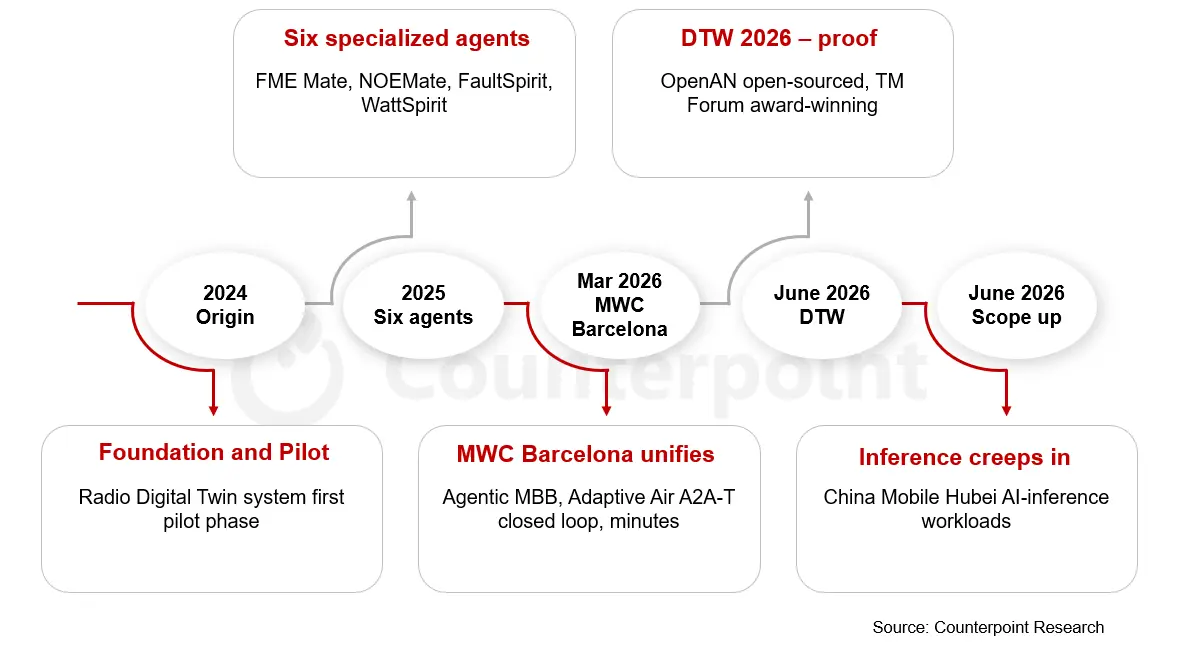
2024: The Foundations
Huawei first unveiled its RAN Intelligent Agents at the 2024 Global Analyst Summit held in Shenzhen, China. The initial architecture combined Telecom Foundation Models with a RAN Digital Twin System (RDTS) to create a virtual representation of the network, enabling AI to simulate and validate optimization strategies before implementation. At this stage, Huawei focused on augmenting network operators by improving decision-making and operational efficiency through AI-assisted workflows. The initial versions were designed to assist operators in network planning, fault diagnosis, parameter optimization, and workflow automation, with an emphasis on individual processes rather than enabling fully autonomous network operations.
2025: The Rise of Specialized Agents
Huawei’s 2025 Analyst Summit marked the next stage in the evolution of the company’s RAN Intelligent Agents. Building on the AI-assisted workflows introduced at the 2024 Analyst Summit, Huawei expanded its approach by introducing a portfolio of specialized agents for different network functions, including fault management, optimization, maintenance, and energy efficiency. FME Mate, NOE Mate, TuningSprint, FaultSpirit, and WattSpirit were showcased as part of Huawei’s intelligent agent ecosystem, designed to work together to streamline and optimize end-to-end network operations in a single domain and single scenario.
Through this architecture, Huawei envisions autonomous network powered by multiple domain-specific foundation models and intelligent agents working collaboratively, rather than relying on a single general-purpose AI model.
2026: The RAN Agent Ecosystem
At MWC Barcelona 2026, Huawei introduced a unified RAN Agent. Rather than positioning it as a standalone AI tool, the company demonstrated how its RAN Agent orchestrates multiple AI functions across the radio access network.
The architecture is built around three core components:
1. Agentic MBB for intelligent mobile broadband,
2. Adaptive AI for contextual awareness, and
3. A2A-T for inter-agent communications.
These were combined to form a closed-loop optimization framework spanning planning, execution, and assurance, with multiple agents corss domain working in tandem rather than optimizing individual domains.
In addition to introducing the unified RAN Agent, Huawei showcased how its orchestration layer can be leveraged to make network operations run faster and with less human intervention.
In addition to the RAN Agent, Huawei is also working on other AI-based solutions for autonomous networks. For example, its Agentic Core can be used to orchestrate across multiple domains, thus supporting the industry’s drive towards Autonomous Network Level 4 (AN L4), which is capable of autonomous operations with limited human intervention.
Huawei's RAN Agent Timeline: From Origins to Autonomous Inference
DTW Ignite 2026: Turning Vision into Execution
While MWC 2026 demonstrated the industry’s vision, DTW Ignite 2026 highlighted the progress already being made toward realizing it.
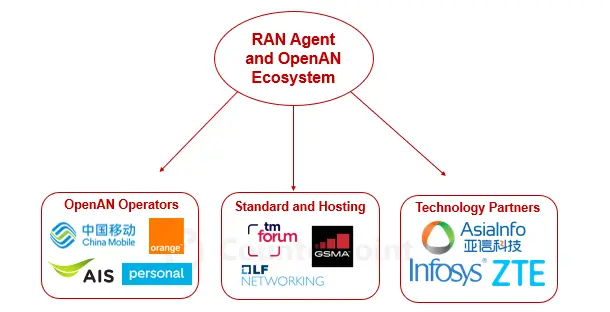
One of the key announcements at the event was the launch of OpenAN, an open-source initiative aimed at accelerating the development of autonomous networks. This project brought together operators and vendors, including China Mobile, Orange, Huawei, ZTE, AIS, Infosys, and AsiaInfo, to establish a common set of open-source building blocks for Autonomous Network Level 4 (AN L4), supported by standardized A2A-T (Agent-to-Agent for Telecom) communication. While new AI agents dominated many discussions at DTW, A2A-T may prove to be the more significant long-term development. Rather than introducing another AI capability, A2A-T addresses a more fundamental challenge: how thousands of specialized AI agents operating across the RAN, core, transport, and operations domain can communicate, exchange intent and context, coordinate decisions, and resolve conflicts in a multi-vendor environment. In many ways, it represents the coordination layer for autonomous networks, with the potential to become the interoperability framework that enables AI agents from different vendors to collaborate seamlessly at scale.
Operators also demonstrated that autonomous networks were no longer just a vision but were starting to be deployed at scale.
The TM Forum’s Autonomous Network White Paper 4.0, developed with the support of multiple operators and industry partners, suggests that the industry is transitioning from fully manual operations to AI-supervised workflows, with an increasing number of processes becoming fully autonomous.
China Mobile demonstrated that it was managing billions of network parameters as it transitions towards Level 4 autonomous networks. It also reported significant gains in operational efficiency through its AI optimization initiatives.
Industry recognition of these efforts was also seen at DTW Ignite 2026, where the A2A-T Multi-Agent Collaboration project, involving Huawei, China Mobile, and other ecosystem partners, received the Outstanding Catalyst - Attendees' Choice award.
These developments suggest that the telecom industry is entering a new phase, where the focus is shifting from individual AI applications to building the collaborative ecosystem needed to realize autonomous networks at scale.
What it Means for the Market
The telecom industry’s AI narrative has changed dramatically over the past year. The focus has shifted from demonstrating AI capabilities to delivering measurable real-world impact.
MWC set the vision, while DTW showed that operators are now starting to make the transition from experimenting with AI to actually deploying it at scale. However, there are still multiple challenges that the industry will need to address, including ensuring that operators can fully realize the benefits of multi-vendor approach as the complexity of these systems increases.
The industry still lacks standardized approaches to measuring the impact of autonomous networks, which makes it challenging to compare performance between operators. Meanwhile, governance will also become an increasingly important concern. As open-source approaches play a bigger role in the development of these systems, responsibility for ensuring interoperability, security, and reliability extending beyond any single equipment vendor becomes paramount.
Huawei’s positioning has also evolved, as the company has moved from showcasing its own AI capabilities to broader industry initiatives aimed at accelerating the adoption of autonomous networks. This shift is reflected in its support for open-source collaboration, including its contribution to the OpenAN initiative.
The next phase will be critical in determining whether the telecom industry can move beyond isolated AI applications and deliver on the promise of autonomous networks at scale.
The Road Ahead
The next wave of AI demand will not be driven solely by chatbots and AI searches. It will come from physical AI – autonomous vehicles, robotics, digital twins, and AI-driven public services that require networks that can make intelligent decisions at the edge.
This is where telcom operators have an opportunity to move beyond providing connectivity. As AI shifts into the physical world, telecom connectivity revenue will increasingly be driven by Physical AI applications, where ultra-low latency, deterministic performance, and AI-native operations become essential. Autonomous networks powered by AI agents will help operators deliver these capabilities more efficiently while unlocking new enterprise and city-scale service opportunities.
Huawei’s journey from RAN Intelligent Agents in 2024 to the unified RAN Agent in 2026 shows how quickly the industry will converge towards realizing self-driving core networks. However, the more interesting conversation is around open-source projects like OpenAN and standardization of agent-to-agent interfaces, which suggests that the entire ecosystem will move towards decentralized, distributed intelligence.
The implications of these developments go beyond telecommunications. The world’s leading AI cities will be defined not only by their fundamental models and data centres but also by their digital infrastructure, compute and connectivity ecosystems, according to Counterpoint Research's Global AI Cities Index 2025 report. The cities most prepared for the coming wave of AI applications will employ connected, autonomous, and AI-native networks to realize their visions of AI-powered transportation, healthcare, industry, and public services.
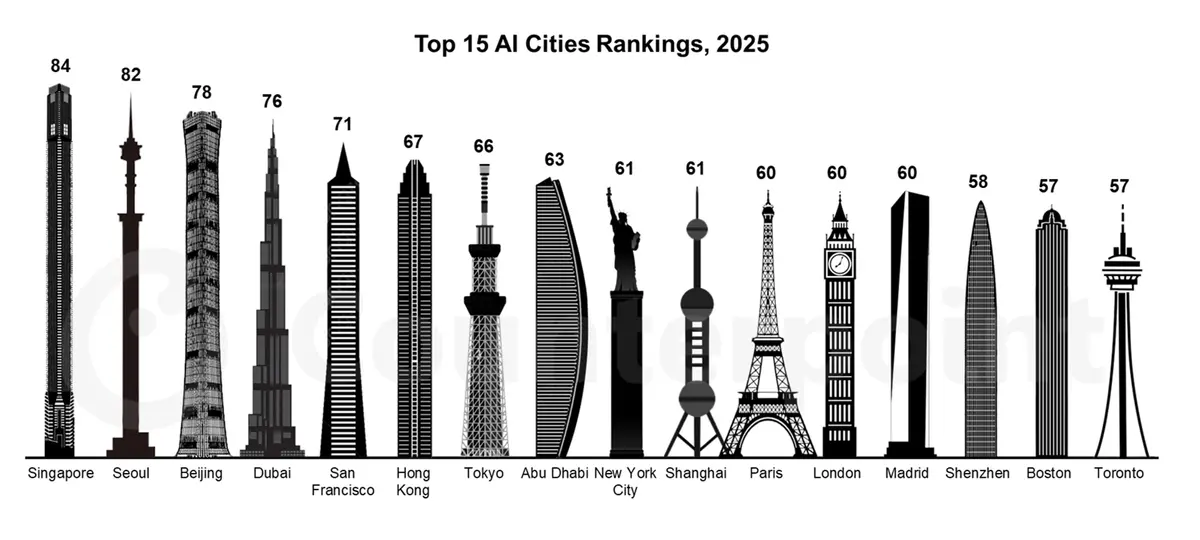
*Counterpoint Research - Scoring measures the development of AI in each city; maximum score 100
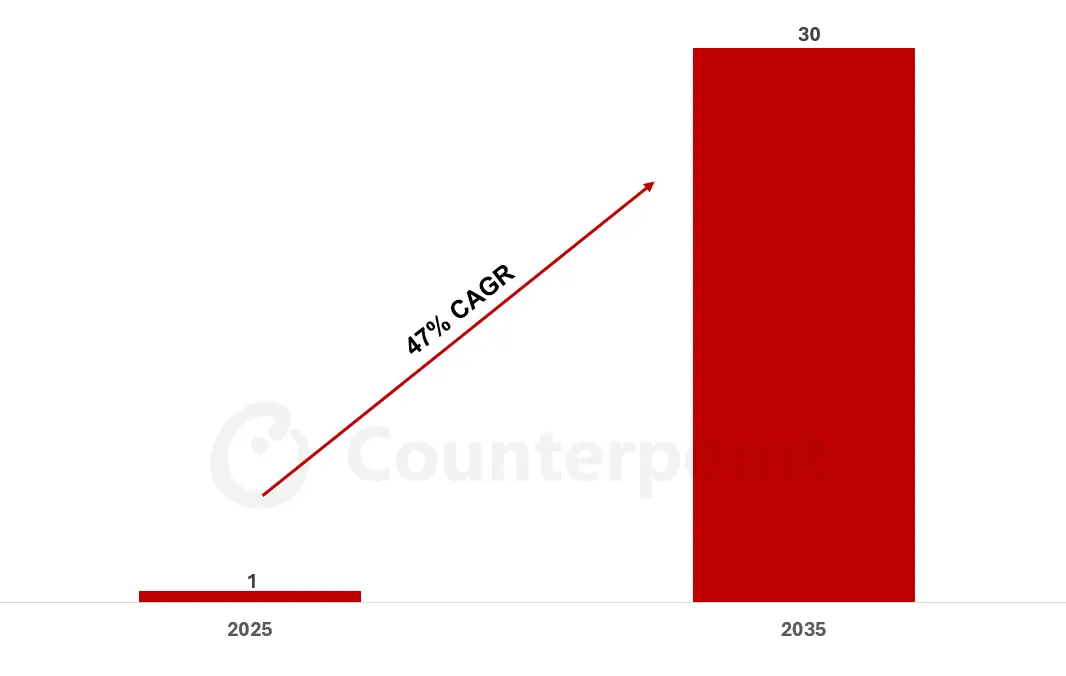
Physical AI Telco Connectivity Revenue (In $ Billion), 2025 vs 2035
For more on Huawei, please refer to the reports below:
- Huawei’s AI-Native 5G-Advanced Vision
- Huawei Gains Share on Enjoy 90 Series Momentum and Supply Chain Resilience
- Huawei’s Premium Challenge_Structural Limits and Tactical Missteps
- Huawei Vendor Profile and Analysis
- Huawei Xiaomi and vivo Lead China’s Smartphone Market with Technological Innovation
