

- The global AI video surveillance hardware market is projected to grow from $8.9 billion in 2026 to $24.6 billion in 2030, driven by demand for automated monitoring, proactive security, and growing demand for smart and operational analytics.
- AI analytics in surveillance can be deployed in three ways, with Hikvision, Dahua and Axis providing it on the camera, Avigilon providing it in a separate box, and Hanwha Vision, Bosch, Honeywell, CP Plus and others providing hybrid solutions.
- There is no single winning architecture. On-camera AI wins on latency and standalone reliability, the AI box solution wins on retrofit economics for large legacy camera setups, and hybrid designs win where workloads genuinely need to be split.
With the use of artificial intelligence (AI) increasing, one of the key decisions in deploying a video surveillance system is determining where AI processing should occur. Whether deploying a system at the city level or in a factory, options available include running AI on the camera, installing a separate box, or distributing the workload between the two. The questions that need to be addressed when deciding this location include how quickly the system will respond, how much data must cross the network, whether existing infrastructure can be retained, and how easily the system can be scaled.
At the same time, the required hardware is becoming more expensive. Driven by rising component prices and increasing demand for memory and chips from hyperscale AI data centres, the global AI video surveillance hardware market is projected to grow from $8.9 billion in 2026 to $24.6 billion in 2030. Therefore, the question of which device should handle AI processing is also an important budgeting decision for buyers.
In the following sections, we assess the three options for AI processing mentioned above across four key dimensions: location and quality of video needed for analytics, alerts during network or server disruption, feasibility of integrating AI with existing infrastructure, and scalability of analytics in places with multiple cameras.
Where Should the Surveillance Industry’s AI Brain Live?
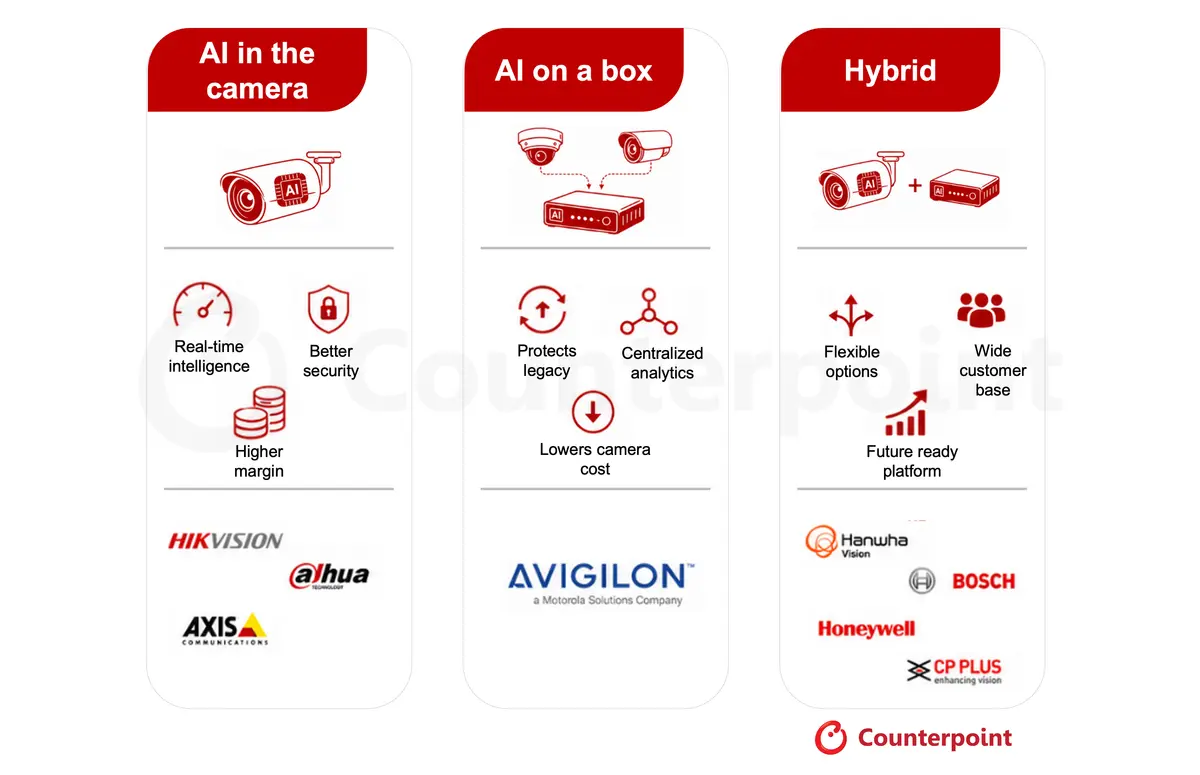
Source: Counterpoint Research
AI on the camera In on-camera AI, processing happens directly inside the camera powered by an NPU or edge processor, which analyses the feed in real time without sending the whole video to the server. The level of analytics the camera can support depends on its processing power, heat capacity and cost. This is also where the differences between manufacturers become apparent. Some of the companies develop chips themselves, which gives them control over image processing, AI models and firmware. Others differentiate on their analytics algorithms and software capabilities.
Axis Communications has been developing its ARTPEC family of chips in-house for more than 25 years. ARTPEC-9, introduced in 2024, delivers three times better video analytics performance compared to previous generations and supports AV1 video encoding, reducing bitrate by 20%. This in-house chip gives Axis control over security-related issues, hardware and software. Hanwha Vision offers a similar kind of solution with its Wisenet 9 SoC, which uses two NPUs, enabling image processing and AI analytics to run on dedicated resources instead of competing for the same. Hikvision and Dahua have built product portfolios around AI analytics capabilities. Hikvision’s Acusense technology uses deep learning to distinguish people and vehicles from other moving objects, thereby reducing false alarms and the amount of irrelevant footage needed for review or storage.
On-device processing is particularly helpful in achieving quick response times. Consider a factory where workers must wear hard industrial hats and protective vests in a hazardous area. Here, AI cameras, such as Dahua’s Wizmind explosion-proof cameras, can detect violations and raise an alert locally. Since the decision is made within the camera, data do not need to travel to a server and come back, thus reducing response time and allowing functions to continue even when the connection fails. Since the camera can analyse the original image before it compresses, it may also retain more visual details for better analysis.
However, on-camera AI has its own limits. As each camera has a limited field of view, it makes it difficult to run tasks that require multiple camera feeds, like tracking a person across an entire facility or counting visitors across several entrances. In safety environments, camera-based detection can act as a useful additional warning layer.
Edge AI box
In an Edge AI box, instead of replacing existing cameras, the customer adds a separate processing device that receives video streams, decodes them, and runs AI centrally at the site. This approach can be practical for facilities with hundreds of cameras that do not have advanced analytics, so rather than replacing the entire camera network, users can add AI capabilities to their existing infrastructure.
Motorola Solutions has developed this approach through its Avigilon portfolio. Following its acquisition of Avigilon in 2018, Motorola continued to build on the company’s AI-based video security capabilities. Avigilon’s AI appliance can run analytics, such as self-learning video analytics and appearance search, by which users can locate a person or vehicle across a site, and supports third-party cameras (ONVIF-compliant).
In 2021, Motorola introduced AI NVR and a second-generation AI NVR 2, which offers analytics to any non-analytics and third-party camera. Hanwha Vision’s AIB-800 applies the same idea at a smaller scale. Its eight-channel box is built on an NVIDIA Orin NX module that detects and classifies people, faces, vehicles and license plates through existing cameras, and seamlessly integrates with Milestone, Genetec and Wisenet Wave video management software (VMS).
This architecture is particularly suitable for hospitals, universities and manufacturing facilities, where cameras are often installed in stages, rather than under a unified installation project. Different buildings may have different camera brands and models. Replacing every device will involve significant hardware costs, new cabling, installation work and disruptions to daily operations. An edge AI box provides the best way to have a common analytics layer across compatible cameras. It simplifies video search and centralised functions. However, the number of supported channels, the complexity of analytics, and available processing capacity will determine how much a single box can handle.
Hybrid AI
Hybrid AI is not simply a combination of an AI camera and an edge box. Its real value lies in deciding which tasks should run on each device. The camera can handle time-sensitive tasks, such as detecting an object or hazard, identifying an event and raising an alert. The edge device can then process information from multiple cameras and maintain a shared database. This division of work allows organisations to retain the benefits of local processing while extending analytics beyond the capabilities of an individual camera.
Hanwha Vision illustrates how these capabilities can coexist within one surveillance deployment. The company’s X-series cameras with Wisenet 9 SoC support on-camera image processing. The company also offers AIB 800, which adds analytics to compatible conventional cameras up to eight channels. Depending on the deployment, this combination distributes processing tasks between the devices rather than relying entirely on either architecture.
For example, in a bank branch, a camera will capture a clear image of a person entering the premises, detect loitering in an ATM lobby after business hours, or identify possible camera tampering. These tasks can be handled locally in on-camera AI. For other tasks, a shared processing system works best, such as matching a person against a centrally maintained watchlist, tracking an individual from entrance to service counter, or correlating events across several cameras. Hybrid deployments thus offer a practical balance between immediate response, processing capacity, and system-wide visibility.
To conclude, there is no universally best architecture, and the choice depends on the kind of workload, evaluated against the four dimensions discussed above.