WWDC26: Apple Promises AI Step Change – Now it Has to Deliver
Apple’s 2026 WWDC was one of the most hotly anticipated events, especially with the backdrop of the previous two years of underwhelming WWDCs. In 2024, Apple introduced upgraded Siri but could not deliver. In 2025, Siri was hardly mentioned, and the event was all about Liquid Glass—Apple’s completely redesigned user interface; hence the high expectations for this event. And we believe Apple has done enough in terms of announced upgrades and features to keep it in the fight for AI relevance—but only if it can deliver what it showed at WWDC 2026.
This time, instead of announcing updates to each OS, Apple took a different route—announcing features at the platform level. This shows how AI sits above the OS and binds the entire Apple ecosystem together; therefore its importance cannot be overstated.
During the event, Apple also made its vision for AI clear. It’s not going to chase AI for the sake of it but will design features which it believes will practically benefit its customers.
New Architecture: A leap Ahead, Thanks to Google Partnership
- Apple launched its next-generation Apple Foundation Models (AFM) leveraging the technology behind Google’s Gemini and tuned to run on device as well as Private Cloud Compute. These models now have image input support allowing the passing of images alongside text for improved utilization and image generation.
- There are two on-device models:
- AFM 3 Core a 3-billion-parameter model that delivers a step-up in quality over its predecessor.
- AFM 3 Core Advanced – a 20 billion parameter model which helps supported products understand and generate speech. The model has higher accuracy for dictation, better language understanding and expressive voice. While all 20 billion parameters reside in flash storage, the model only activates 1 to 4 billion parameters at a time depending on the request complexity. However, this model is only supported on the iPhone Air, iPhone 17 Pro, iPad with M4 and later (12GB or more memory) and Mac with M3 and later (12GB and more memory).
- Together with the two on-device models there are three server-based models running on Apple Private Cloud Compute, ensuring user data is never stored or shared with anyone. These include AFM 3 Cloud, Apple Diffusion Model (ADM) 3 Cloud (Image) and AFM 4 Cloud Pro (for agent tool and complex reasoning).
Exhibit: Apple Intelligence Architecture
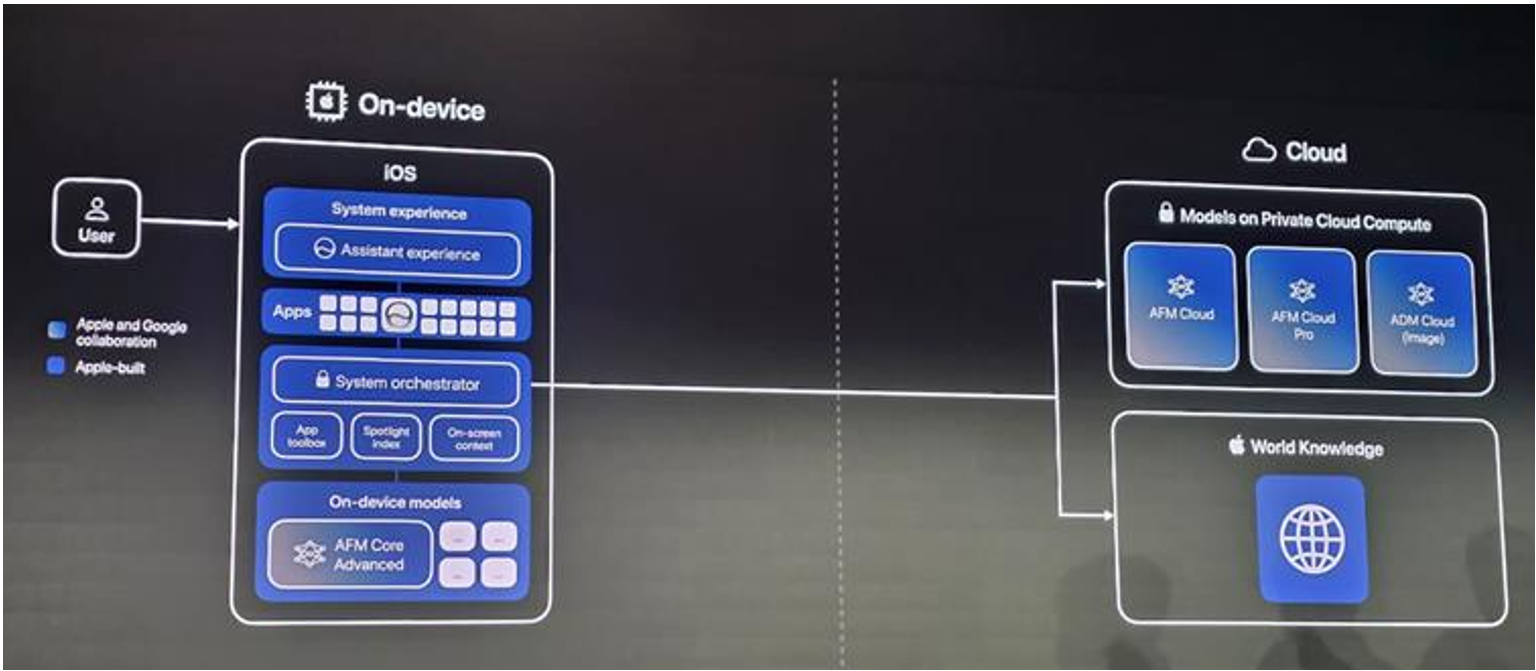
- These models are integrated deeply into the platform with system-wide capabilities including personal context, world knowledge, on screen awareness and capable of translating them to specific actions within applications. Apple Intelligence seamlessly co-ordinates between all these capabilities using a system orchestrator. This is the base architecture which unlocks the new Siri and other Apple Intelligence functionalities.
Exhibit: Apple Intelligence Architecture
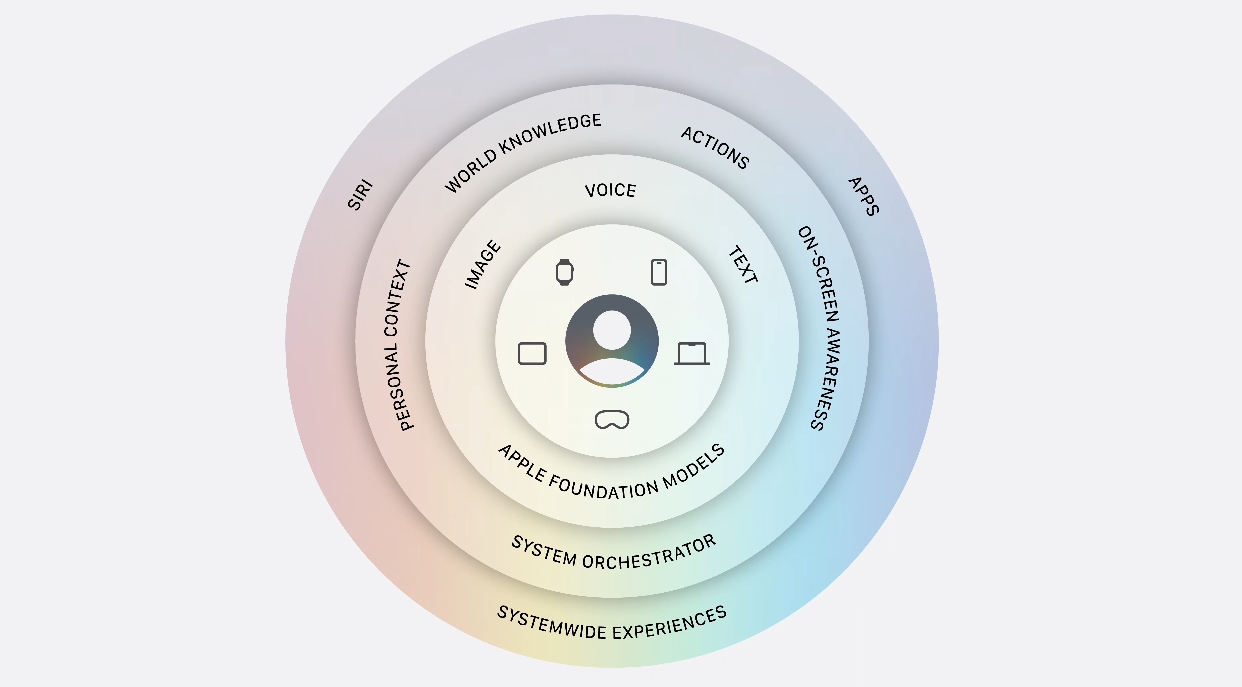
Privacy at the core of this architecture.
- According to Apple, it never stores user data and uses it only to execute requests. The data is not even accessible by Apple.
- For AFM 3 Cloud Pro, Apple worked with Google and NVIDIA to extend Private Cloud Compute to NVIDIA GPUs in Google Cloud, thus maintaining the same level of privacy as other models.
- Apple is happy for independent experts to verify their privacy claims.
Siri AI: Out of the shadows
- Thanks to the new architecture, Siri is getting its largest update since it was launched as a feature in 2011 in the iPhone 4s.
- Equipped with personal context and on-screen awareness, Siri can now perform tasks across apps. It can recall past messages, emails, conversation histories and perform multi-step tasks like pulling-up photos from a specific event, filter them to show designated family members and send the picture to contacts without the need to open any specific application.
- Additionally, Siri is also integrated into the native camera app for Visual Intelligence. The integration seems neat and easy to use based on the shared demos. Visual Intelligence also expands to Mac (via screen-selection shortcuts), iPad (integrated into screenshots), and Vision Pro (via gaze-tracking of physical or digital objects).
- The use of world knowledge, personal context, and on-screen awareness combined with app actions creates an end-to-end implementation of Siri. These are positive steps on the road to a more fully agentic Siri.
- The biggest differentiator in Siri is the cross-platform capability, backed by a firm promise of privacy. This is where Apple can leverage its vertical integration and maintain an advantage relative to more horizontal competitors.
- If iOS 27 delivers a genuinely conversational Siri as promised, the strong ongoing upgrade cycle for iPhone will continue.
- As AI builds on more personal context, the advent of Siri AI could be the ultimate Apple ecosystem lock-in. However, two of Apple’s largest markets, the EU and China, are left behind for now due to the strict regulatory environments in those jurisdictions, meaning Apple will have to find a way to navigate these hurdles to bring the advanced features to its users in these key markets.
- Another aspect is the fluid implementation of Siri in the Dynamic Island. While the smartphone industry has long been obsessed with removing the camera hole from the display, Apple has continually made use of the Dynamic Island to smartly add uniqueness and usability to the UI.
- It’s due to this neat, systemwide, privacy-focused implementation and the personal context that Siri can become the default assistant for the Apple ecosystem.
- There remains a question around Siri’s compatibility with third-party apps like WhatsApp or Spotify etc., but given the size of Apple’s user base, we expect application developers will want to incorporate the capability into their applications to a greater or lesser extent – but this also raises the question of when the upgraded capabilities will be delivered.
Child Safety: Need of the Hour
- Another important feature launched during the event was Advanced Child safety
- The age at which children now get a smartphone continues to decrease due to things like peer pressure and parental peace of mind.
- However, there is plenty of research about associated risks, including personal well-being and mental health.
- With AI, both content access and generation have become extremely easy. Increasing screen time and what a child has access to on their phones are key anxiety points for parents.
- Apple has worked towards solving this by building multiple guardrails and giving parents greater control over what their child can see, access, and even who they can talk to. New features include:
- Age gating: Parents can control app downloads and browsing for children under-18.
- Easier parental setup.
- Nudity is blurred—even on FaceTime calls. The UK Prime Minister called this week for smartphone companies to make it impossible for under-18s to be able to send and receive nude images.
The dangers of too much digital access are real and needed to be addressed by the company. These are sizable improvements and help fend-off detractors who have said Apple has not done enough. This also builds a strong value proposition for parents to choose iOS for their children, providing greater peace of mind.
Other Features: Apple Intelligence, Design, AirPods
- There are several other features Apple showcased which included updates to Safari, Image Playground and automation of building a shortcut and extension.
- AirPods also get an equalizer application in iOS.
- Liquid Glass gets a much needed slider for customizing the level of transparency.
- Faster UI, faster AirDrop and attention to other usability details.
- Vison Pro uses panoramic shots as personal immersive virtual background.
- New Passwords app can change a compromised password automatically.
Monetization on the cards
- Buried in the footnotes was: “Some features, including image generation, have daily usage limits because they rely on powerful server models. Increased access is available with most iCloud+ subscription plans, which also include Apple Intelligence support for compatible home cameras.”
- This gives some insight into Apple’s business model. It may happen that several features are included in the iCloud+ or Apple One subscription going forward. However, details will become clearer when the new capabilities are available.
Apple has done enough at WWDC 2026. The Promise now needs to be delivered.
Apple has delivered a well-rounded WWDC 2026 keynote addressing many of the doubts expressed by skeptics on its AI capabilities and privacy features. However, Apple now has a responsibility to deliver its promise to over 600 million Apple Intelligence capable iPhone, iPad and Mac devices. This time it cannot afford another delay or a less than delightful implementation. And if Apple delivers, it will be enough to keep the strong sales momentum of iPhones as well as other products.
While Apple may not have been able to deliver its AI as promised in 2024, consumers were unconcerned and Apple continued to amass record revenues thanks to a combination of brand pull, ecosystem lock-in, iPhone reliability and a strong upgrade cycle from 2021 and 2022 buyers. The WWDC announcements will help maintain the sales momentum. However, if Apple delivers on its promise, it can drive a sales uptick in some regional markets in 2027. China and Europe, which are among iPhone’s largest markets remain on the sidelines of the AI story for now. Nevertheless, we expect Apple’s iPhone revenues will grow both in 2026 and 2027.
This monthly topical report is part of Counterpoint Research Apple 360 Service, which covers Apple’s hardware and services ecosystem through the quantitative as well as qualitative aspects.
Category
Industry
Smartphone
Service
Standard
Report Type
Report
Time Period
Other
Receive our insightful weekly newsletter and stay ahead of the competition.
Author
Varun Mishra


Varun is a Principal Analyst at Counterpoint Research based out of Gurgaon. In Counterpoint, he closely tracks mobile devices and ecosystem with a focus on Apple. He started his career as a Consultant with Infosys Limited where he was able to identify strategic avenues for business growth through deep research and analysis of markets and companies in various domains. He holds a Master of Business Administration in Marketing from Institute of Management Technology, Ghaziabad and a bachelor's degree from Coventry University, UK.