Tesla to Leverage EV Experience and Chinese Partners to Ace Humanoids Market, Unlock Huge Revenue Potential
0
June 10, 2026
Tesla has a well-established supply chain around Optimus, laying a solid foundation for the mass production of Optimus V3.
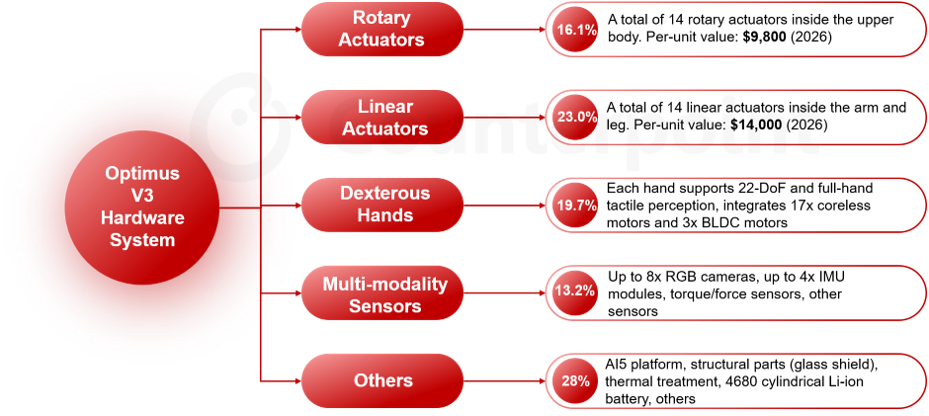
Optimus V3’s unit manufacturing cost in H2 2026 is estimated to be above $60,000, with the newly designed 22-DoF dexterous hands accounting for nearly 20% of the total BoM cost.
Tier 1 suppliers of Optimus V3 have been stepping up their production capacity in China and overseas to serve Tesla’s plan to make 20,000 Optimus robots per week in the near future.
Compared with its early EV production ramp, Tesla is expected to roll out the 100,000th Optimus in a far shorter timeframe to generate billions of dollars in incremental revenue for its major partners.
Tesla’s first production EV model, the Roadster, was released five years after the company’s founding. In the following five years, the company’s global EV shipments steadily grew to reach over 20,000 units in 2013 and over 100,000 in 2017, before accelerating to the one-million milestone in 2022. Today, with Optimus V3, its first mass production robot, set to enter the market, Tesla is shouldering high expectations once more. It will be closely watched whether Optimus can replicate the glorious growth trajectory of Tesla’s EVs and evolve into the company’s core growth engine over the next decade.
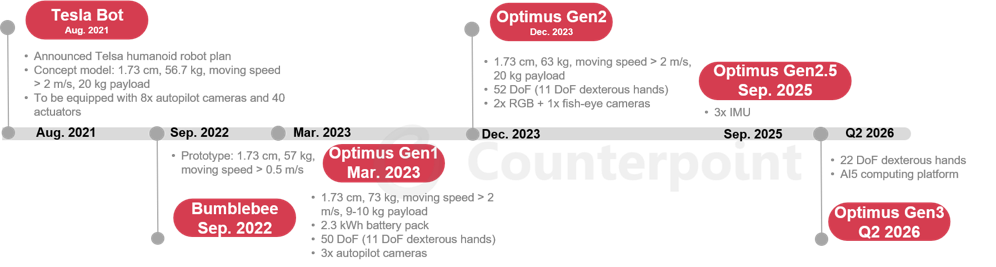
Telsa Optimus Milestones
Source: Counterpoint’s Robotics Research
Competitive edge of Tesla Optimus
Compared to the humanoid robot companies that have come up globally, Tesla holds distinctive competitive advantages in three aspects:
1. In-house platform capabilities, spanning from AI inference chips and robot-optimized neural networks to multimodal perception, drive control and power management algorithms.
a) The latest AI5 platform delivers more than 2,000 TOPS of AI computing power, enabling a vision-centric end-to-end VLA architecture.
b) Standing on the solid technology foundation around Full Self-Driving (FSD), Optimus V3’s VLA model is expected to feature industry-leading performance in multi-task generalization and understanding complex environments.
c) Moreover, leveraging the constantly evolving Grok, which ingests massive amounts of data from the X platform on a daily basis, Optimus V3 can better comprehend and interact with the physical world, supporting anthropomorphic conversation.
2. Distinctive advantage in driving the data flywheel
a) Tesla’s global EV manufacturing footprint generates rich real-world operational data to facilitate Optimus V3’s industrial deployment.
b) With Tesla restarting the Dojo 3 project, the Optimus VLA development will be empowered with sufficient computing resources.
c) The millions of FSD subscribers and hundreds of millions of X users generate massive training data to continuously optimize the vision and language models.
3. Overlap with the established EV supply chain
a) Tier 1 suppliers such as Tuopu Group, Sanhua Intelligence Control, Xusheng Group and Glory Mica are Tesla EV veterans, with years of proven partnerships. They fully back Optimus V3’s mass production plan.
b) In terms of sensing and perception components, Optimus V3 leverages Tesla’s mature camera and IMU supply chain resources.
c) In addition, Optimus V3’s power system can reuse accumulated technologies in batteries, thermal management, fast charging and power control to the fullest extent.
Chinese partners deeply involved in Optimus V3 program
Over a dozen Chinese companies have been certified to support the early production ramp of Optimus V3 as Tier 1 or Tier 2 suppliers. Tesla is expected to sign long-term agreements with major supply chain partners, encouraging them to invest in capacity expansion in advance, including the construction of overseas facilities. On this basis, Optimus V3’s build cost is closely correlated with its production scaling curve. The unit manufacturing cost is estimated to be above $60,000 for H2 2026, assuming a production volume below 10,000 units, with the newly designed 22-DoF dexterous hands accounting for nearly 20% of the total BoM cost.
Optimus V3 Hardware Cost Breakdown
Source: Counterpoint’s Robotics Research
Note: Tesla outsources the production of grippers to Lens Technology, with a unit price of approximately $300, compared with a dexterous hand valued at $6,000.
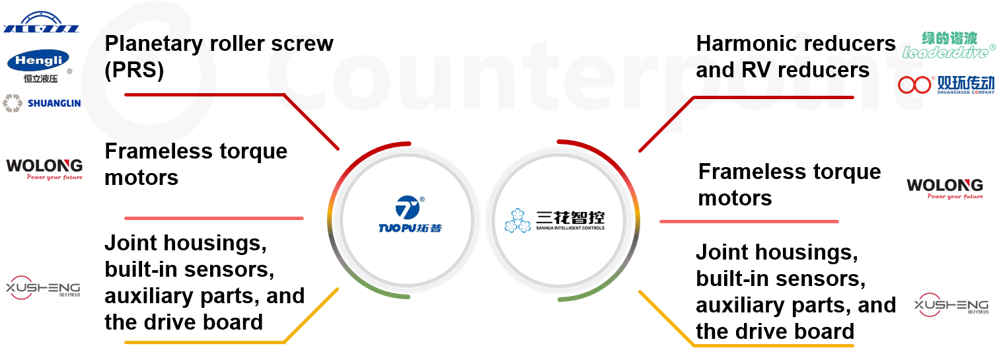
Major Suppliers of Optimus V3 Actuators
Source: Counterpoint’s Robotics Research
Tesla and Tuopu Group co-developed Optimus V3’s linear actuators, with Tuopu acting as the exclusive supplier for the complete assembly. Besides, the company is capable of producing the supporting components in-house, such as the planetary roller screw, frameless torque motor and encoders, thus occupying a high proportion of the overall BoM value of Optimus V3. As the core component of the linear actuator module, the planetary roller screw alone makes up around 40% of the modular manufacturing cost. Planetary roller screws developed by Zhejiang XCC, Hengli Hydraulic and Shuanglin have all passed Tesla’s certification.
As for rotary actuators, Sanhua serves as the major supplier of the finished modules, and applies its liquid cooling technology to optimize motor performance. The harmonic drives and RV reducers used in the rotary actuators are supplied by Leaderdrive and Shuanghuan Transmission, respectively. In addition, Wolong Electric is the primary supplier of frameless torque motors, and Xusheng Group produces the paired joint housings (Magnesium-Aluminium alloy).
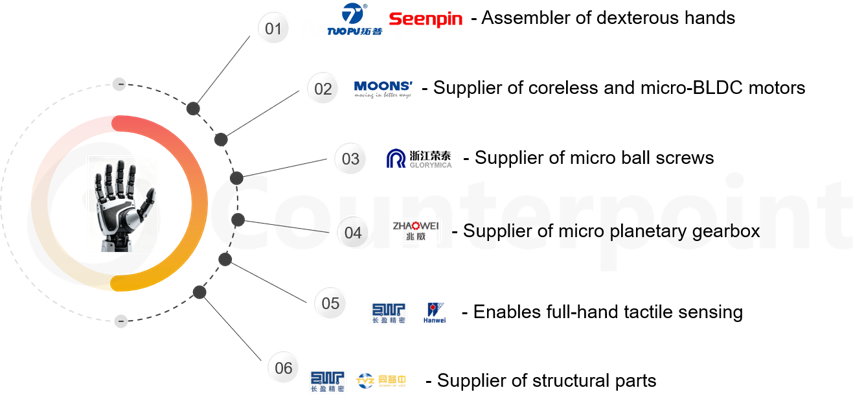
Major Suppliers of Optimus V3 Dexterous Hands
Tuopu formed a dedicated dexterous hand division in September 2024, having been cooperating with Tesla on the development of the dexterous hand for Optimus V3. Glory Mica supplies micro ball screws to Tuopu. Seenpin, a secondary supplier, leverages in-house designed differential roller screws to produce dexterous hands well-suited to Optimus’ screw-tendon hybrid approach.
MOONS’ is currently the exclusive supplier of coreless motors, while Zhaowei produces the matching planetary gearbox. EWPT not only manufactures structural components but also serves as the supplier of the fingertip sensing solution. Hanwei’s piezoresistive electronic skin enables full-hand sensing coverage.
Various actuators and the pair of high-DoF dexterous hands make up around 60% of the total BoM cost, where Tesla collaborates closely with its Chinese partners. In other respects, too, numerous Chinese vendors have broken into Optimus V3’s supply chain. For instance, with Optimus carrying forward Tesla EVs’ camera-first perception architecture, LCE supplies the required fisheye cameras, while ORBBEC’s depth vision technology will be applied in wrist-mounted camera accessories.
Other Chinese Suppliers of Optimus V3
Source: Counterpoint’s Robotics Research
Tier 1 suppliers of Optimus V3 step up capacity expansion
The supply chain of Optimus V3 is extended and developed on the basis of the mature EV ecosystem Tesla has established over the past decade. Although the current market scale of humanoid robots remains limited and it is highly uncertain whether Tesla can record a cumulative shipment of one million units over the next three years, suppliers, with their long-established partnerships, are willing to double down on the prospects of Optimus V3 and make proactive investments while actively expanding capacity in China and overseas.
Tesla has been the top EV customer of Tuopu and Sanhua, for Tuopu particularly. Tesla accounts for over one-third of Tuopu’s revenue. Against this backdrop, both companies are well-positioned to expand their long-standing partnerships with Tesla beyond EVs into the Optimus program. Tuopu and Sanhua have established independent robotics divisions, promising to align with Tesla’s production plan and build production capacity for 20,000 units of Optimus robots per week in the near future.
In FY2025, actuator sales for the humanoid robot application only accounted for less than 0.05% of Tuopu’s revenue. Nevertheless, Tuopu has developed an extensive product portfolio, spanning from assemblies of linear joints, rotary joints and dexterous hands to custom production of body structural components, foot dampers and various sensors. Its manufacturing base in Ningbo supports an annual production of 300,000 sets of actuators. Moreover, Tuopu is building dedicated production lines for the humanoid robot application at overseas facilities in Thailand (micro components such as 12/10mm motors), Mexico (large structural components) and the United States (actuator assemblies).
To cater to the needs of Optimus V3 mass production in Fremont, Sanhua will assemble rotary actuators at its plant in Mexico, home to its joint venture with Leaderdrive, leveraging the latter’s expertise in designing high-quality harmonic reducers. Besides, Sanhua is investing in dexterous hand and coreless motor development, and is poised to compete against Tuopu in developing the next-generation dexterous hand systems for Optimus.
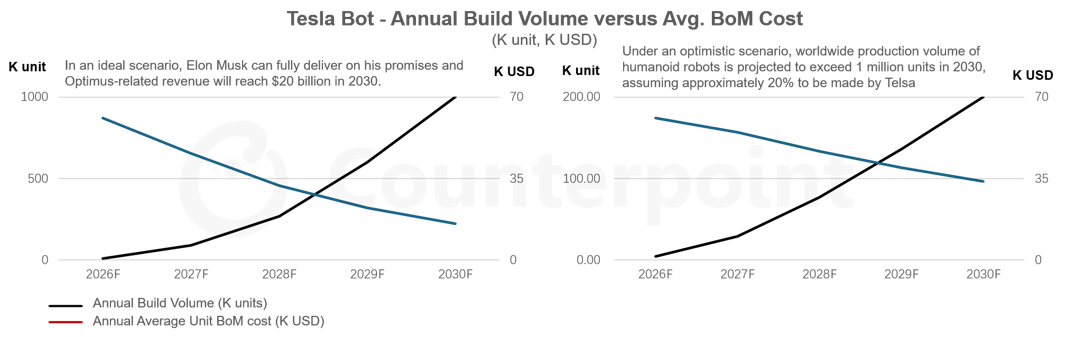
Let’s return to the question raised at the beginning. Tesla’s capacity expansion guidance to Tier 1 suppliers implies a growth trajectory driving Optimus revenue to $20 billion, equivalent to roughly 28.8% of Tesla’s FY2025 automotive segment revenue. Even if the timeline is pushed back, compared with its early EV production ramp, Tesla is expected to roll out the 100,000th Optimus in a far shorter timeframe. The scenario illustrated in the bottom-right chart can still generate billions of dollars in incremental revenue for partners such as Tuopu and Sanhua.
Assumptions of Optimus Growth Trajectory, Scale-driven Cost Reduction
Source: Counterpoint’s Robotics Research
As the commercialization of humanoid robots accelerates, Counterpoint forecasts that global humanoid shipments will exceed 50,000 units in 2026 and top 100,000 in 2027. Backed by supply chain and technological strengths, Tesla will capture a sizable market share going forward. The company’s suppliers are stepping up investments to secure new revenue streams driven by Optimus V3 capacity ramp-up in Tesla’s Fremont plants.
Category
Industry
Emerging technologies, AI
Service
Robotics, Humanoid Robotics
Report Type
Report
Time Period
Other
Receive our insightful weekly newsletter and stay ahead of the competition.
Author
Ethan Qi
Ethan is an associate director in Counterpoint‘s Greater China team, dedicated to research of smart device, semicondutor and BoM analysis, AI Robotics Research, and emerging technologies. Ethan has been working in the handset and semiconductor industry for 10+ years. Prior to joining Counterpoint Research, Ethan served Coolpad, VIA and Intel sequentially as senior technology researcher and product manager respectively.