Samsung Expands its Micro RGB Flagships for 2026
Samsung has released details of its “Micro RGB” product line for 2026, including features and pricing. The company seeks to regain momentum in a category that it once dominated but more recently has been superseded by upstart competitors TCL and Hisense.
Although Samsung calls its product line Micro RGB, at Counterpoint, we refer to this category of displays as RGB MiniLED. Samsung uses the term Micro to indicate that the LEDs used are smaller than 100µm. We use the term MicroLED to describe a direct-view LED display, and MiniLED to describe an LCD with LED backlight. For this article, I will refer to Samsung’s term Micro RGB when describing its products.
In prior articles, I have covered Samsung’s MiniLED and OLED TV lineups. Prior to 2022, Samsung had no OLED TV product line, and its Neo QLED (MiniLED) TVs were top-of-the-line. Then Samsung introduced OLED TVs, first with Samsung Display’s QD-OLED and later also including LG Display’s White OLED panels. In 2026, Samsung is introducing Micro RGB as a new flagship, with features and prices comparable to its OLED TVs; the two product lines are “co-flagships” according to Samsung.
I had a chance to view the company’s flagship TVs at a Samsung launch event for media last month, at the company’s US headquarters in New Jersey. Samsung announced two tiers of Micro RGB TV products – R95H and R85H. I viewed the R95H 85” TV. The TV has Samsung’s Glare Free Technology, an anti-reflection coating that does a fantastic job of eliminating reflections. The feature is a significant upgrade, as screen reflections can disturb an otherwise pristine picture. The R85H has a more traditional glossy screen.
I would describe the picture quality of the R95H model as superb – completely black blacks, no noticeable halo, no noticeable color fringes, brilliant highlights and vivid colors. I would be interested to see a side-by-side comparison of the R95H with Samsung’s S95H with QD-OLED panels, but I have no doubt that the R95H earns the role of a top-of-the-line display.
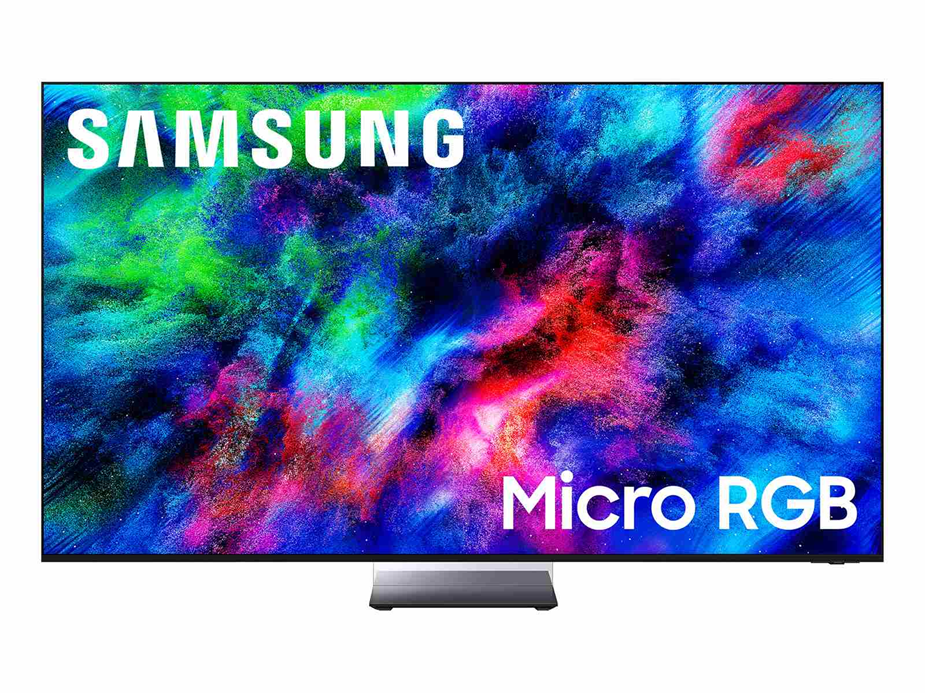
As is fitting for a flagship product, the R95H is furnished with all the bells and whistles Samsung can throw at a TV, including its Ultimate Gaming Pack and NQ4 AI Gen3 Processor, along with a premium audio package delivering Dolby Atmos sound. The TV can be paired with up to five Samsung sound devices. Unique to the Micro RGB series is the company’s Micro RGB Engine Pro video processor, which “creates stunningly sharp images with incredible detail, ensures smooth motion during fast action, produces expansive room-filling audio, and powers your favorite apps and personalized experiences”.
As announced last week, the R95H series is available in three sizes – 65”, 75” and 85”. The R85H series includes those three plus a 55” model. I was told at the launch event that the R95H product line would span from 65” to 115” and that the R85H would span from 55” to 100”. Samsung announced that last year’s 115” MR95F would be carried over in 2026, and I expect that Samsung will announce a 100” R85H product later this year.
As is customary, Samsung did not disclose the panel supplier for the Micro RGB products, but Samsung Display is no longer making LCD panels. We think that China Star is the likely supplier and the panels come from the former Samsung G8.5 fab in Suzhou.
Samsung claimed that the Micro RGB sets achieved 100% of BT-2020 color gamut, but the claim came with a footnote that said “VDE-certified ≥100% BT.2020 color area; vs. DCI-P3.” I added the emphasis at the end because I think that’s the critical qualifier in understanding the color performance.
At the NJ event, Samsung provided measurements of color gamut for the R95H, performed by an independent firm using a Konika Minolta CA-410 colorimeter. I believe this is a reliable reflection of the TV’s color performance. Samsung also provided measurements of a competitor’s product which claimed 100% BT-2020 performance. The data is shown in the following table. The calculation of % area reflects purely the area of the triangle formed by the three points.
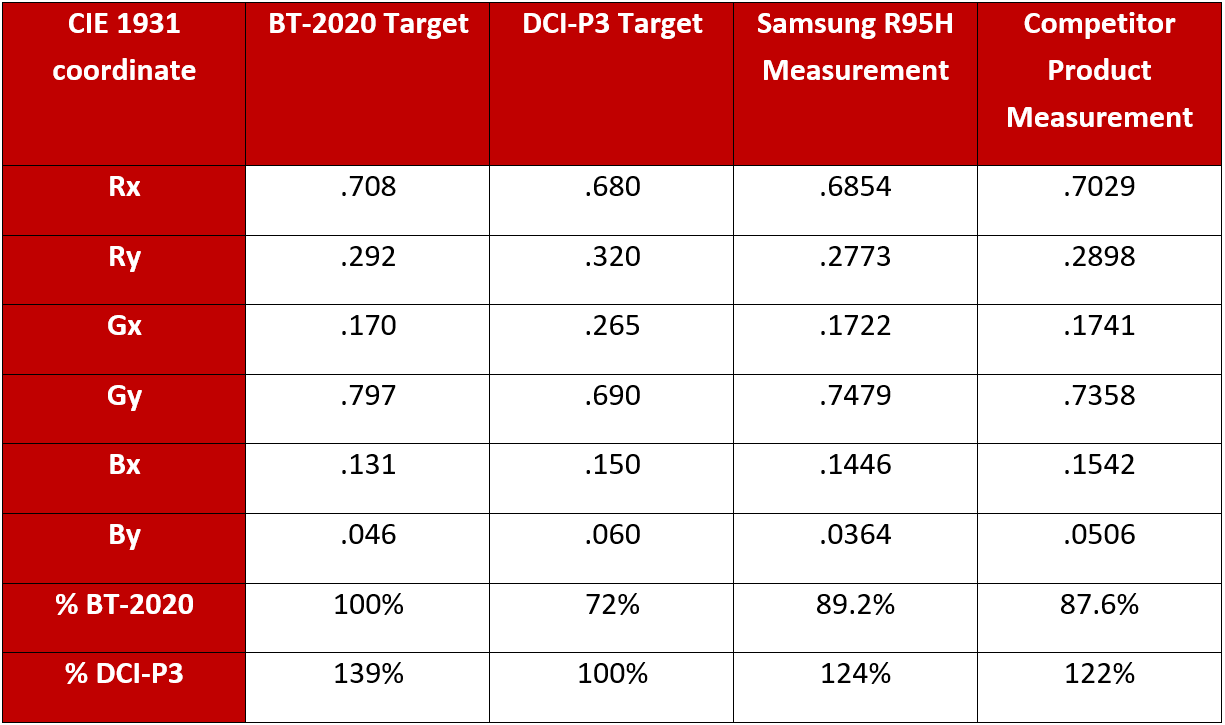
Note that the competitor’s red is better than that of the R95H; both the Rx and Ry are closer to the target. The Samsung TV outperforms in green and blue and overall. Note also that the R95H color points exceed in every direction the DCI-P3 target, even as they fall short of the BT-2020 target.
The performance appears better under the CIE 1976 format, as the BT-2020 performance of the R95H is 92.8% and that of the competitor is 91.7%, according to the calibration firm. That difference should be a reminder – when you see a figure on BT-2020 color gamut performance, find out whether it is using 1931 or 1976 coordinates.
My conclusion is that the R95H does not cover 100% of the BT-2020 color triangle as it is generally understood. If served with content mastered to BT-2020 (such content is rare), it will deliver 89% of the color gamut. If served with content mastered to DCI-P3 (almost all premium content today), it will deliver 100% of the DCI-P3 color gamut.
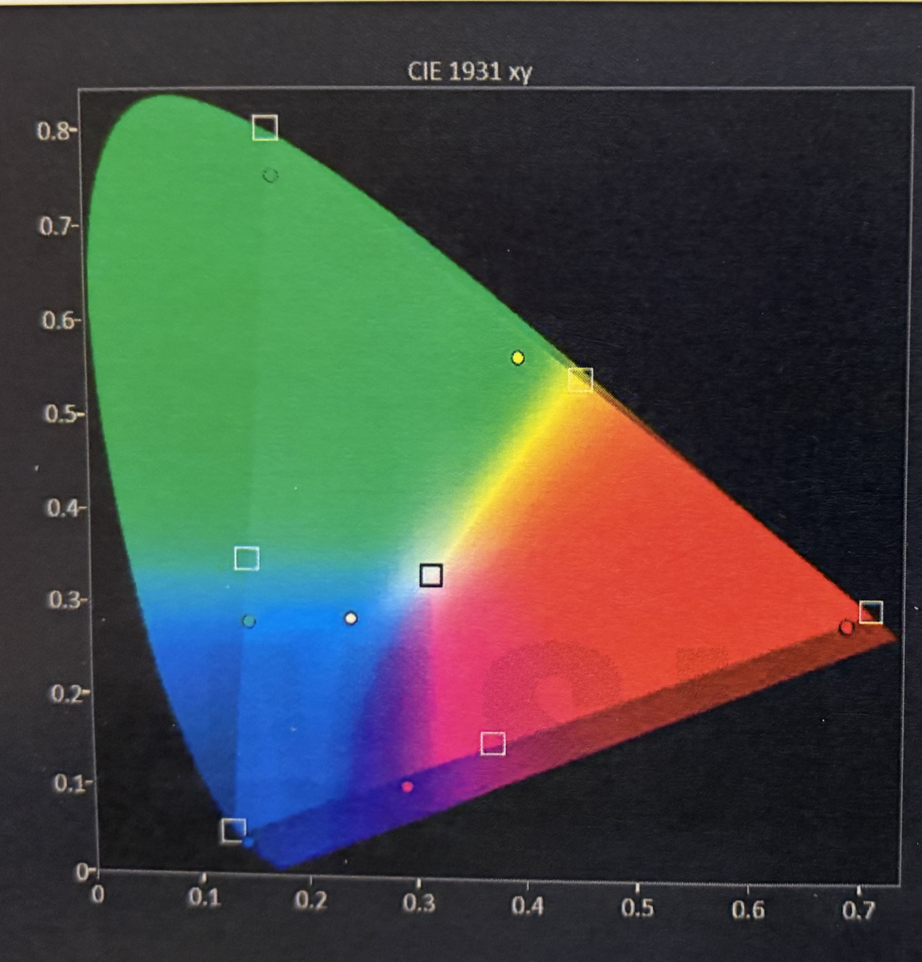
While I am not enthusiastic about Samsung’s claim for 100% of BT-2020, I can certainly attest that the Micro RGB has beautiful color performance, perhaps the best I have ever seen in a TV (I would need to see some side-by-side comparisons to be sure). I agree that the measurements confirm the R95H has a superior color gamut to its competitor.
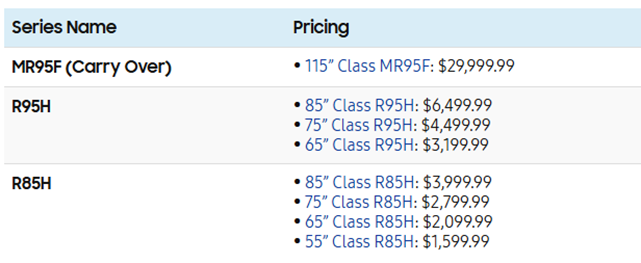
The recommended prices for these Micro RGB TVs range from $1,599 for the 55” R85H to $6,499 for the 85” R95H. Typical retail prices will be lower, and during promotions like Black Friday, they can be much lower. The suggested retail prices for these products correspond to the same prices as on similar-sized S95H and S85H OLED TVs, with the 77” OLEDs matching the 75” Micro RGB and the 83” OLEDs matching the 85” Micro RGB.
For comparison, according to Counterpoint’s Advanced TV Shipment and Forecast Report, the average 55” Samsung MiniLED TV price in 2025 was $945, while the average price across all brands was $727. The comparable figures for 65” were $1,256 for Samsung and $928 across all brands.
As we noted in our article last month, Samsung’s TV product line in 2026 includes eight distinct display technology variants. “We’re writing the next chapter in our relentless pursuit of quality and innovation,” said Shane Higby, Head of Home Entertainment at Samsung Electronics America. “Samsung Micro RGB TVs set a new standard for color and realism previously impossible in TV technology.”
Although TCL was the first company to introduce MiniLED TVs in 2019, shipments from this category of displays were negligible until Samsung launched its Neo QLED TVs in 2021. Samsung dominated the MiniLED category for three years, but in 2024 was passed by TCL and Hisense, which introduced a less-expensive lower tier at very aggressive prices. The Mainland Chinese OEMs also pushed very large TVs, 98” and larger, at unprecedentedly low prices.
Samsung aims to regain some of its MiniLED mojo in 2026, as it adds Micro RGB TVs as a third tier on top of its Neo QLED and MiniLED TVs. With a product line of 30 models ranging from 43” to 115” and from $349 to $29,999, Samsung is taking on its upstart competitors.
Category
Industry
Display
Service
Display - Others
Report Type
Report
Time Period
Other
Receive our insightful weekly newsletter and stay ahead of the competition.
Author
Bob Obrien
Robert J (Bob) O’Brien joined Counterpoint Research as part of its acquisition of DSCC, where he was Co-Founder, Principal and CFO of DSCC. Bob has decades of experience turning market and business analysis into strategic insights in the display and electronics industries. At DSCC, Bob takes the lead role in analysis of display materials, including glass and AMOLED materials, and covers developments in TV and other large-screen display applications. He is the principal author of DSCC’s AMOLED Material Report, the Advanced TV Shipment Report, and the Display Glass Report, and Bob contributes regularly to the DSCC Weekly Review.