Android Nears Half of POS Shipments in a Market That Grew Just 1% in 2025
- Global POS device shipments grew just 1% YoY in 2025, held back by rising memory prices and broader macroeconomic pressure.
- Android-based POS terminals reached around 48% of global shipments and are projected to reach 70% of global shipments by 2032, driven by an open app ecosystem and integration of payment and business applications.
- The POS industry is shifting from proprietary operating systems to Android, enabling cloud-connected, software-defined solutions and expanding business management features for merchants.
- Android SmartPOS terminals are the most exposed to memory price increases, but Android adoption is still expected to grow as merchants seek more advanced software and AI features.
Beijing, Berlin, Buenos Aires, Fort Collins, Hong Kong, London, New Delhi, Seoul, Taipei, Tokyo – August 13, 2026
Global POS device shipments grew just 1% in 2025, while rising memory prices are increasing the bill of materials for the Android terminals the industry is standardizing on. Android accounted for around 48% of POS terminals shipped in 2025 and is on track for roughly 70% of global shipments by 2032, so the platform shift is largely settled, and cost is now the variable to watch.
For decades, POS terminals ran proprietary operating systems that offered limited flexibility, long development cycles, and closed software ecosystems. However, the industry is witnessing a paradigm shift towards Android, which has emerged as the preferred operating system choice for POS terminals. Android enables software-defined, cloud-connected POS solutions with faster innovation through over-the-air updates. Its mature application ecosystem supports value-added services such as inventory management, loyalty programs, customer analytics, and workforce management, allowing merchants to transform POS devices into business management platforms. At the same time, seamless integration with digital wallets, QR-code payments, and biometric authentication, combined with a familiar user interface, improves operational efficiency while reducing employee training requirements.
According to Counterpoint Research’s latest Global POS Device Tracker & Forecast report, global POS device shipments are projected to grow at a 4% CAGR between 2025 and 2032, driven by continued economic digitalization and increasing adoption of electronic payments across countries. Android-based POS terminals are expected to account for around 70% of global shipments by 2032, growing at a 6% CAGR against 4% for the overall POS market, supported by their open application ecosystem and ability to combine payment acceptance with broader business applications on a single device. Asia-Pacific markets, particularly China, India, and Southeast Asian countries, are leading in terms of Android-based POS adoption, driven by the strong presence of Chinese POS OEMs and their Android-first product strategies.
Global POS Market Shipment by Operating System, 2025 vs 2032F
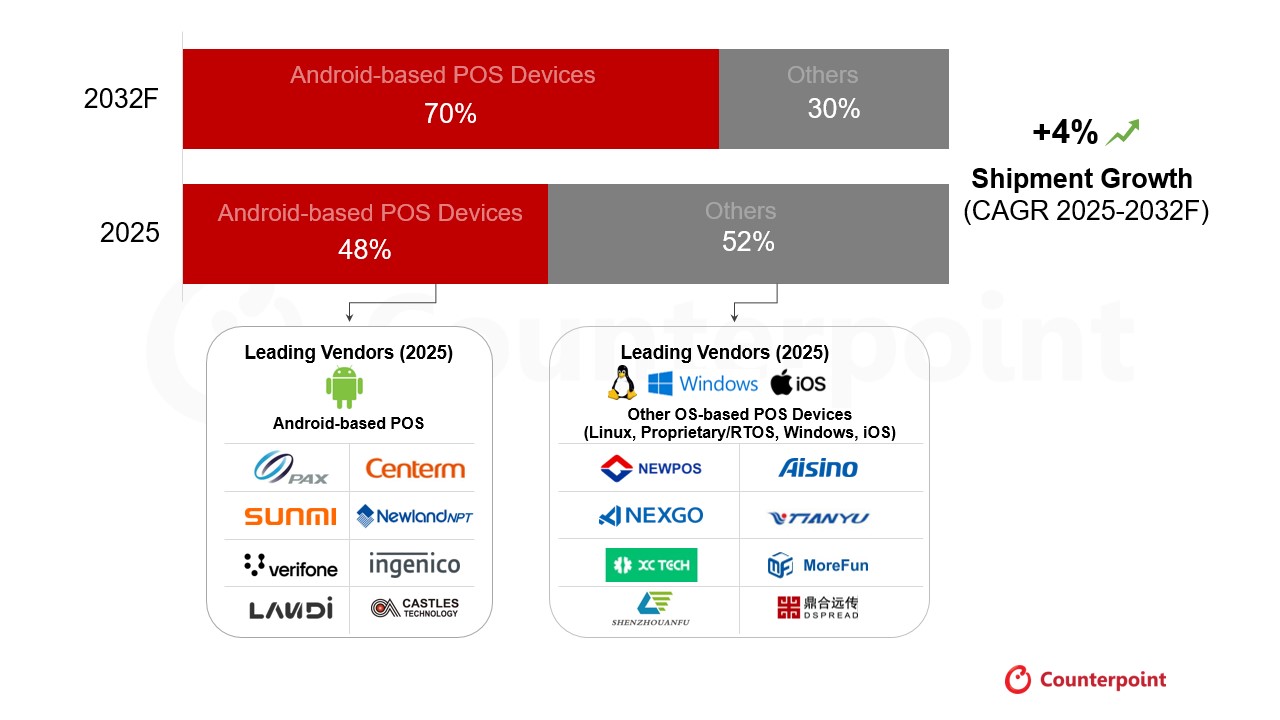
Commenting on the POS OEM landscape, Principal Analyst Tina Lu said, “Capitalizing on this trend, practically every major POS OEM now offers Android-based products in their portfolios. Around 48% of all POS terminals shipped in 2025 were Android-based, with leading vendors including PAX Technology, Centerm, Sunmi, Newland Payment Technology, Landi, Castles Technology, Ingenico and Verifone driving adoption.”
Lu added, “The open architecture and broad developer community enable POS OEMs to cut time to market for new products, integrate more easily with payment providers and enterprise software, and build vertical solutions faster. As a result, vendor-developed operating systems such as Verifone’s Secure OS/VOS2 (Engage VOS) and Ingenico’s Telium/TETRA continue to lose relevance, so specialist POS providers are focusing on unique value-adds and tailored vertical solutions to stay competitive.”
Commenting on the market dynamics, Research Director Mohit Agrawal said, “Global Point of Sale (POS) device shipments remained largely flat, growing just 1% YoY in 2025. The growth was primarily constrained by pricing pressure on memory chips and broader macroeconomic headwinds including tariffs and inflationary pressure.”
Agrawal added, “POS OEMs have been adopting various strategies to mitigate supply chain issues, such as securing safety inventories, negotiating long-term component allocations and diversifying memory sourcing wherever possible. Vendors also noted that certain high-memory configurations and customized products could experience longer lead times. As global memory costs continue to evolve, POS OEMs indicated that certain devices and configurations will be subject to price adjustments aligned with market conditions.”
The impact of memory prices varies across product categories. Android-based SmartPOS terminals are the most affected due to their higher memory requirements, resulting in higher bill-of-materials (BOM) cost increases, which put upward pressure on average selling prices. On the other hand, mPOS devices will be less affected since they require lower memory densities. Moreover, higher-priced devices such as unattended payment terminals are expected to be the least affected, as memory costs are a smaller share of the total price.
Rising memory prices are likely to increase the cost of Android SmartPOS terminals and weigh on shipments in the near term. Long-term Android adoption is expected to hold up, however, as merchants continue to prioritize software capabilities, cloud integration, and AI-enabled services.
SoftPOS, which enables off-the-shelf smartphones to become payment acceptance devices, will continue to absorb demand at the low end, but it is unlikely to displace the attended and unattended terminal base where Android SmartPOS is concentrated.
For detailed research, refer to the following reports available for subscribers:
- Global Point of Sale (POS) Market Analysis, 2026
- Global Point of Sale (POS) Device Tracker and Forecast, 2022-2032F
Counterpoint’s Global Point of Sale (POS) Device Tracker and Forecast report provides market trends and dynamics, along with valuable insights into shipments across 5+ regions, 15+ leading brands, and technologies, including 2G, 3G, 4G, 5G, and non-cellular solutions. Covering the period from 2023 to 2032, it examines the regional and technological forces reshaping the industry. Key regions analyzed include North America, Europe, Latin America, the Middle East & Africa, China, India, and the Rest of Asia-Pacific, each demonstrating unique growth patterns driven by accelerating digital payment adoption and infrastructure evolution.
About Counterpoint Research
Counterpoint Research is a global market research firm specializing in products across the technology ecosystem. We advise a diverse range of clients – from smartphone OEMs to chipmakers and channel players to Big Tech – through our offices located in the world's major innovation hubs, manufacturing clusters and commercial centers. Our analyst team, led by seasoned experts, engages with stakeholders across the enterprise – from the C-suite to professionals in strategy, analyst relations (AR), market intelligence (MI), business intelligence (BI), product and marketing – to deliver services spanning market data, industry thought leadership and consulting. Our core areas of coverage include AI, Automotive, Consumer Electronics, Displays, eSIM, IoT, Location Platforms, Macroeconomics, Manufacturing, Networks and Infrastructure, Semiconductors, Smartphones and Wearables. Visit our Insights page to explore our publicly available market data, insights and thought leadership, and to understand our focus, meet our analysts and start a conversation.
Follow Counterpoint Research
Receive our insightful weekly newsletter and stay ahead of the competition.
Author
Tina Lu


Tina has extensive consulting and analysis experience across a number of industry sectors including more than 14 years in the technology industry. Before Counterpoint, Tina spent more than 9 years in Nokia working in multiple roles and geographic regions. Tina also worked in brand and product marketing for Bestfoods-Unilever and BGH. Tina holds an MBA degree from the Thunderbird School of Global Management.
Mohit Agrawal
Mohit is responsible for tracking Digital Transformation and Internet of Things (IoT) at Counterpoint Research. He has over two decades of rich industry experience having worked with large tech companies like Accenture, Airtel, Nokia, and Microsoft in the past. Before joining Counterpoint, Mohit was the co-founder & CEO of a start-up in the competitive and market intelligence space utilizing big data and AI. He is a keen follower of the developments in devices and key internet technologies like IoT, Blockchain, AI, etc. Mohit is an engineer, MBA and a certified project management professional. He is based out of The Hague in Netherlands.