Memory Cost Surge Drives Pricing Shifts and Competitive Dynamics
- Memory prices continue to rise, prompting smartphone OEMs to pass rising costs on to consumers through price hikes on both new and legacy models.
- While such adjustments help alleviate margin compression, they are likely to weigh on shipment volumes and market share.
- Huawei appears well positioned to gain share in the China market, underpinned by its domestic supply chain advantages and relatively stable pricing strategy.
- Apple is unlikely to raise prices in the near to medium term, backed by its premium product mix and supply chain strength; instead, it is expected to absorb margin pressure, supporting further share gains.
As memory prices increase, Chinese smartphone OEMs have adopted a range of mitigation strategies, including trimming non-core hardware specifications, streamlining product portfolios, and extending refresh cycles. Despite these efforts, cost pressures have still been partially passed through to consumers. Since mid-to-late March, OPPO, vivo and HONOR have successively raised prices on selected legacy models. According to Counterpoint Research’s China weekly tracker, we observe that from the week price increases were implemented, these OEMs’ market share began to decline noticeably. This reflects a clear shift toward a “profit-first” strategy, even at the expense of market share.
China Smartphone Market Share by OEMs
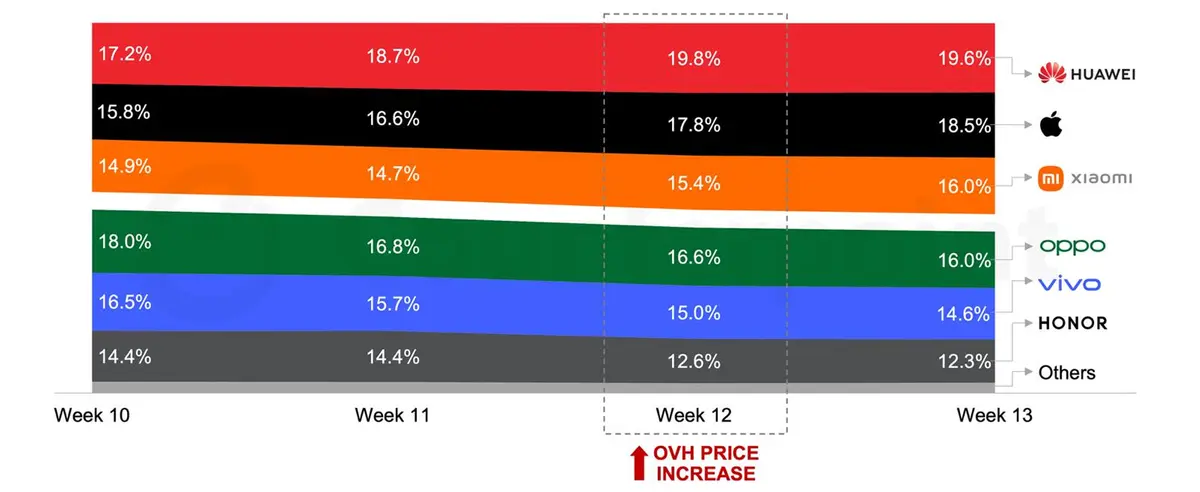
Note: OPPO includes OnePlus and realme, vivo includes iQOO.
Week 12: 20260316-20260322

The new model’s price increase is compared to the price of its previous generation.
Prices do not take national subsidies into account.
New launches are expected to be priced higher than the previous generation, particularly for higher memory variants. In contrast, Huawei has maintained stable pricing and offered promotional discounts on older models such as the Mate 80 series. Besides, the newly launched Enjoy 90 series also performed strongly, with first-week sales exceeding 235K units, supported by competitive pricing and solid product features. These factors have collectively supported Huawei’s share expansion in the domestic market, especially as peers implement price increases.
Apple is widely regarded as best positioned to navigate the memory crisis. Its premium product mix and strong supply chain management provide a structural advantage in absorbing cost pressures. We have not observed any price increases or reductions for iPhones so far. Even if memory prices remain elevated over the long term, Apple can mitigate the impact by adjusting base memory configurations or selectively increasing prices for higher-storage Pro models. In the short to medium term, however, it is more likely to absorb cost increases internally and accept some margin compression to support continued market share growth. As Chinese OEMs move mid-range models into the premium segment (above RMB 4,000) and further raise high-end prices, the price gap with iPhones is narrowing, lowering the psychological barrier for consumers to choose iPhones.
Looking ahead, the price increase of LPDDRx is expected to persist through the end of 2027. As a result, the competitive landscape in the Chinese smartphone market is likely to undergo structural adjustments this year. If memory prices stabilize or decline, the extent to which handset prices would follow will depend on whether OEMs have already established a new price anchor, as well as the industry’s ongoing shift from “extreme value-for-money” toward “value-driven pricing”. This transition ultimately reflects a broader rebalancing between profitability and long-term sustainability.
Category
Industry
Semiconductors
Service
Standard
Report Type
Report
Time Period
Other
Receive our insightful weekly newsletter and stay ahead of the competition.
Author
Shiwen Ma
Shiwen is a research analyst specializing in the smartphone market, based in Shenzhen, China. Prior to joining Counterpoint Research, Shiwen served SDIC securities as a TMT euqity analyst.
Ivan Lam
Ivan is a Senior Research Analyst at Counterpoint Research, based in Hong Kong. He has more than 15 years of experience, with a major focus on mobile and network devices. He has spent years in Southeast Asia markets working in business development, brand management, and channel management. In addition to his expertise in Southeast Asia, he is also well connected with the ODM and OEM sectors. Prior to joining Counterpoint Research, Ivan served at TCL Communication, KaiOS Technologies Inc., and Wiko Mobile, mainly leading business development, go-to-market strategy, and strategic planning. Ivan holds a Master's degree in Business Administration from the Hong Kong University of Science and Technology.