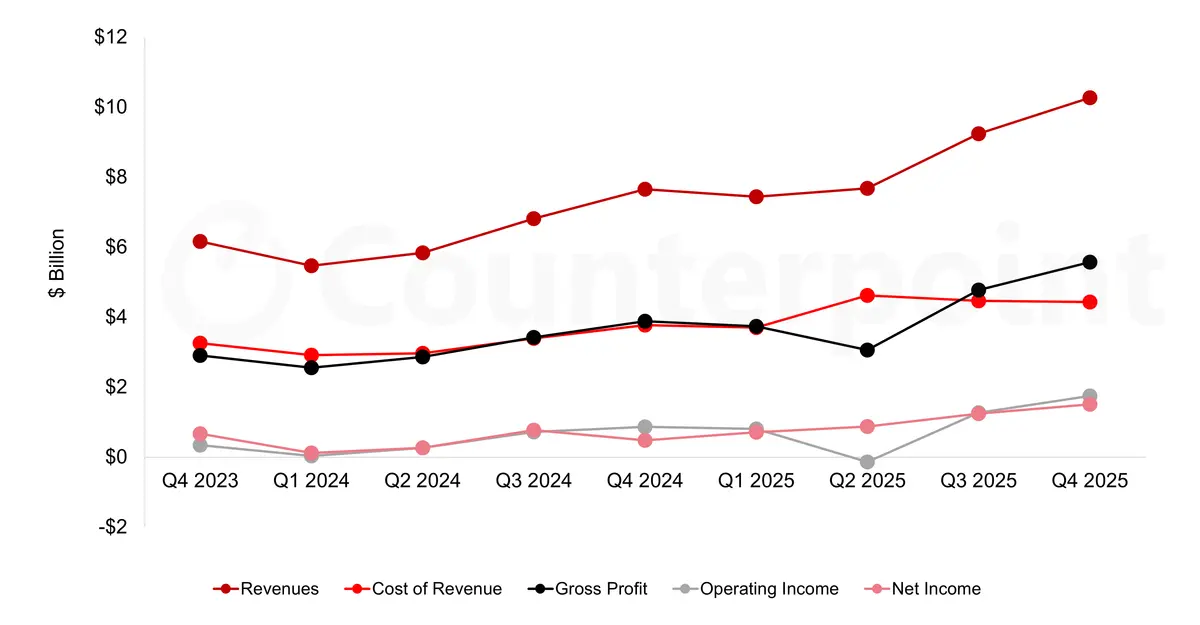
- AMD reported GAAP revenue of $10.3 billion, up 34% YoY and 11% QoQ.
- AMD also reaffirmed its multi-generation partnership with OpenAI, targeting 6 GW of Instinct GPU deployments.
- Client revenue increased 34% YoY, supported by strong demand across multiple generations of Ryzen desktop and mobile CPUs.
Advanced Micro Devices (AMD) closed 2025 on a strong note, delivering record fourth-quarter results that underscored accelerating momentum across AI, data center, and client computing. The company reported GAAP revenue of $10.3 billion, well above consensus expectations of $9.6 billion and representing 34% YoY and 11% QoQ growth.
For 2025, AMD posted $34.6 billion in revenue, up 34% YoY, driven by 32% growth in Data Center and a combined 51% increase across Client and Gaming.
AMD Income Statement Highlights, Q4 2023-Q4 2025
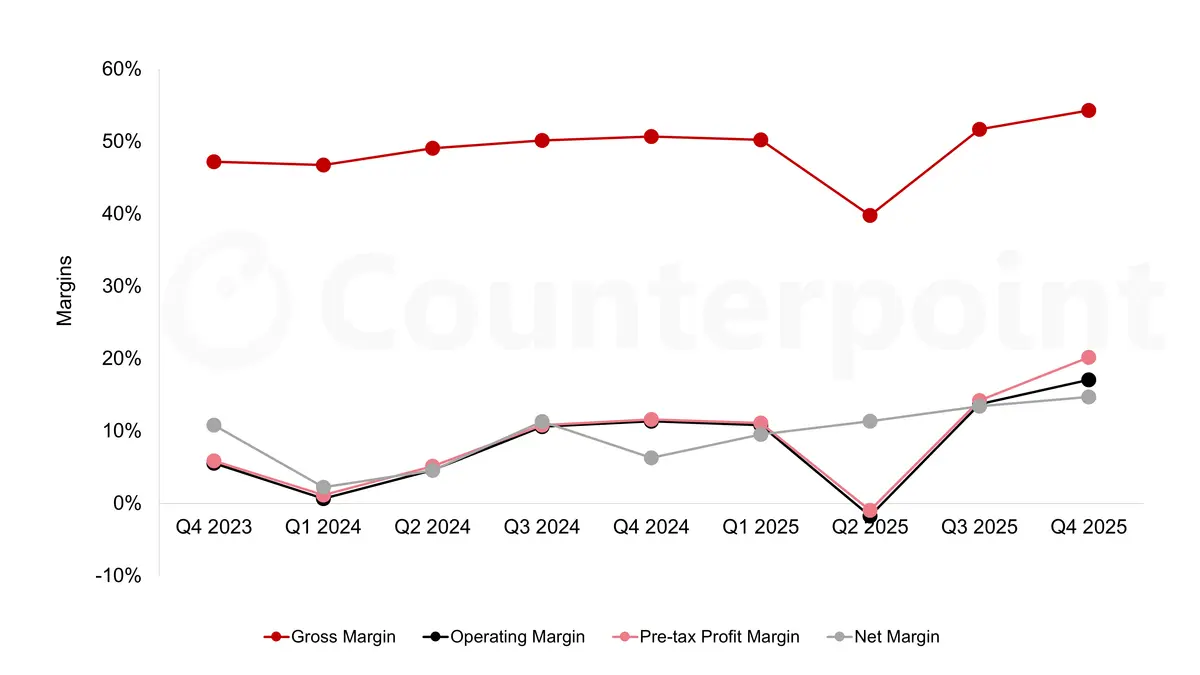
AMD Gross, Operating, Pre-tax and Net Margins, Q4 2023-Q4 2025
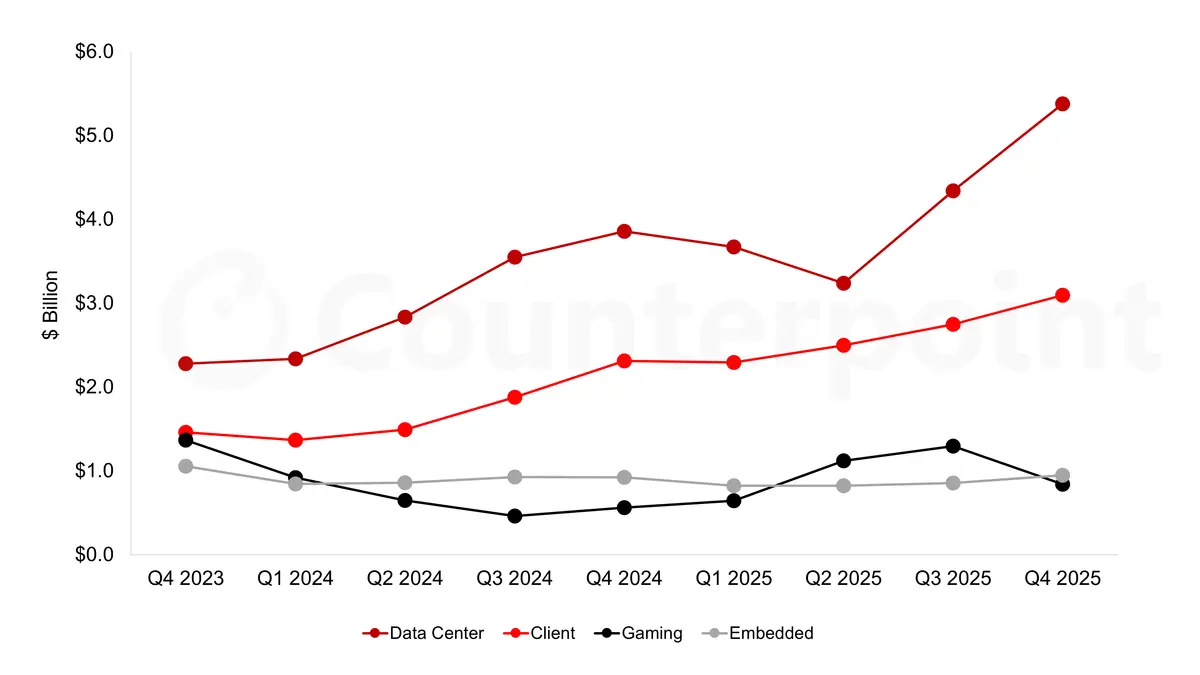
AMD Revenue by Business Segment, Q4 2023-Q4 2025
Profitability and operational discipline improve
Profitability strengthened meaningfully in the quarter. Net income surged 213% YoY to $1.5 billion, while GAAP gross margin expanded to 54.3%, aided by the release of $360 million in previously written-down MI308 inventory reserves. Excluding the reserve release and MI308 China revenue, gross margin would have been around 55%, highlighting a favorable product mix and improving cost structure.
Inventory discipline also improved, with inventory-to-COGS declining from 1.74 in Q3 to 1.69 in Q4, signaling easing inventory pressure heading into 2026.
Business segment highlights
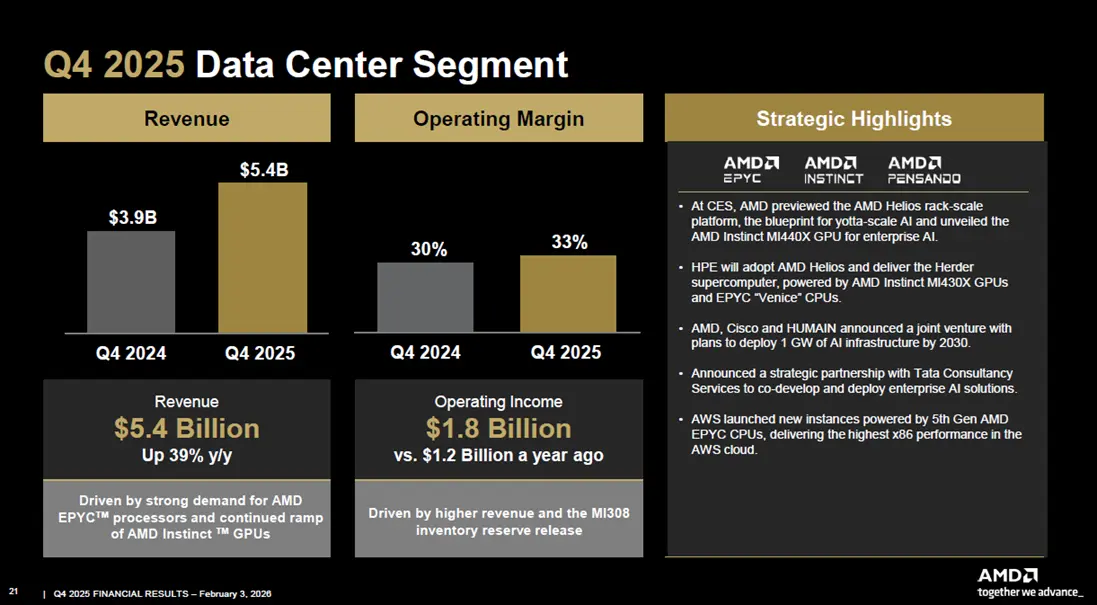
- Data Center: Revenue grew 24% QoQ and 39% YoY to $5.4 billion, driven by accelerating deployments of Instinct MI350 GPUs and continued server share gains. Adoption of 5th-gen EPYC “Turin” CPUs accelerated, accounting for more than half of total server revenue in the quarter.
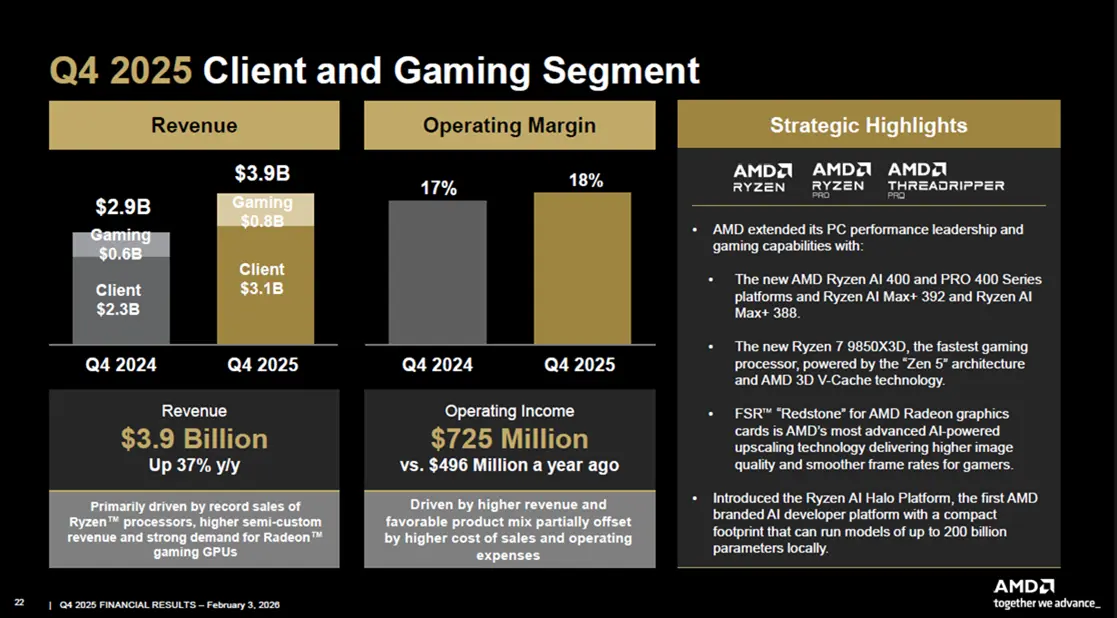
- Client: Client revenue increased by 13% QoQ and 34% YoY to $3.1 billion, supported by strong demand across multiple generations of Ryzen desktop and mobile CPUs. Desktop CPU sales hit a fourth consecutive quarterly record, with Ryzen leading bestseller lists globally through the holiday season.
- Gaming: Gaming revenue increased by 50% YoY to $0.8 billion, driven by higher semi-custom revenue and solid Radeon GPU demand, though sequential revenue declined 35% due to lower semi-custom shipments.
- Embedded: Embedded revenue increased by 11% QoQ and 3% YoY to $950 million, reflecting strengthening demand across several end markets.
AI momentum and strategic partnerships
AMD continued to deepen its AI ecosystem in Q4, announcing a strategic partnership with Tata Consultancy Services (TCS) to co-develop industry-specific AI solutions and accelerate enterprise adoption. Engagements around next-generation MI400 accelerators and the Helios platform also expanded.
Importantly, AMD reaffirmed its multi-generation partnership with OpenAI, targeting 6 GW of Instinct GPU deployments, while discussions with additional hyperscale customers for large, multi-year AI programs continue. Initial deployments are expected to begin with Helios and MI450 later in 2026.
Guidance and outlook
For Q1 2026, AMD expects revenue to be around $9.8 billion, plus or minus $300 million, including around $100 million of MI308 sales to China. At the midpoint of its guidance, revenue is expected to be up 32% YoY, driven by strong growth in its Data Center and Client and Gaming segments and modest growth in its Embedded segment. Sequentially, AMD expects revenue to be down by around 5%, driven by a seasonal decline in its Client Gaming and Embedded segments, partially offset by growth in the Data Center segment. In addition, AMD expects the first quarter non-GAAP gross margin to be around 55% and non-GAAP operating expense to be around $3.05 billion. Non-GAAP other net income is expected to be around $35 million, non-GAAP effective tax rate is expected to be 13% and the diluted share count is expected to be around 1.65 billion shares.
“AMD’s Q4 performance highlights a clear inflection point for the company,” said Associate Director David Naranjo. “Strong execution across EPYC, Ryzen and Instinct reflects both share gains and expanding addressable markets, particularly as AI deployments move from pilot phases into scaled production.”
“Beyond the headline revenue growth, AMD’s margin expansion and tighter inventory management point to a healthier operational profile,” said Research Director MS Hwang. “This positions the company well as it enters a more capital-intensive phase of AI and data center scaling.”
Wrapping up
- AMD’s Q4 results underscore a company operating with multiple growth engines firing simultaneously. Data Center remains the primary catalyst as EPYC adoption deepens and Instinct accelerators scale into hyperscale AI workloads, while Client continues to outperform on channel strength and competitive positioning. Importantly, margin expansion and improving inventory metrics suggest AMD is entering 2026 from a position of operational strength, even as geopolitical and China-related uncertainties persist.
- AMD exits 2025 with strong revenue momentum, expanding margins and a rapidly scaling AI franchise. With EPYC gaining share, Ryzen sustaining channel leadership, and Instinct moving toward multi-gigawatt deployments, AMD is well-positioned for another year of above-market growth in 2026, led by Data Center and AI acceleration.
Clients can access related reports here:
Advanced IT Display Shipment and Technology Report
Memory Tracker and Forecast Insights Report
