

- In 2025, global AR smart glasses shipments rose 98% YoY, reaching a record high in the market’s history.
- H2 2025 saw even stronger growth of 148% YoY, fueled by Rokid Glasses scaling up, launch of Meta Ray-Ban Display and new offerings from other OEMs.
- The video-centric AR smart glasses segment grew over 80% YoY in H2 2025, with leading players RayNeo, XREAL and VITURE capturing a combined 96% market share.
- The waveguide-based AR smart glasses segment surged over 600% YoY, featuring a more diverse landscape with Rokid, Meta, Even Realities, INMO, Alibaba and Meizu vying for sales and mindshare.
- We expect global AR smart glasses market growth to continue in the coming years, though recent memory price hikes and geopolitical tensions could pose challenges.
Seoul, Beijing, Berlin, Buenos Aires, Fort Collins, Hong Kong, London, New Delhi, Taipei, Tokyo – April 9, 2026
After experiencing fluctuations in recent years, the global AR smart glasses market grew 98% YoY in 2025, reaching a record high, according to Counterpoint Research’s latest Global XR (AR/VR) Headset Model Shipments Tracker report.
Global AR Glasses Market
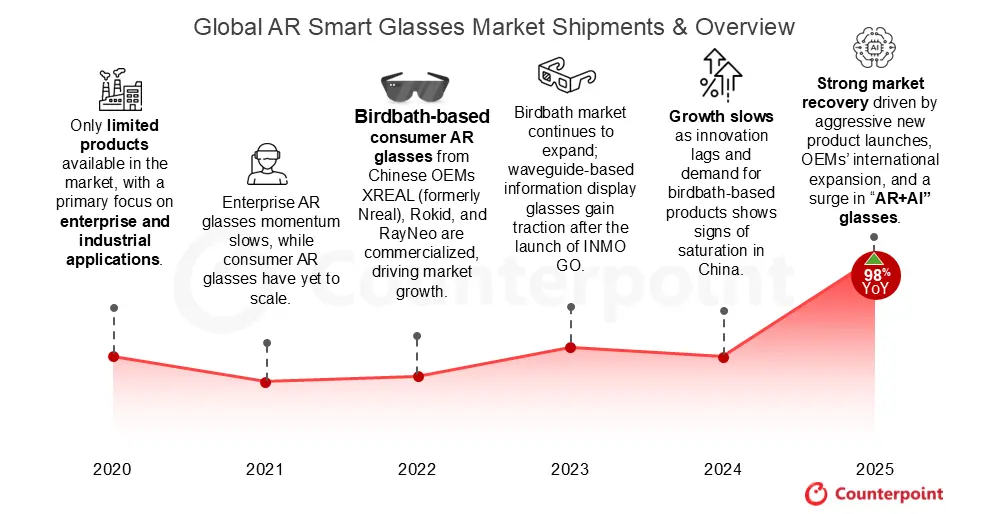
Source: Counterpoint's Global XR (AR & VR Headsets) Model Shipments Tracker, Q4 2025
In H2 2025, the market recorded a stronger YoY growth of 148%, driven by key industrial developments, including the scale-up in shipments of Rokid Glasses, launch of the Meta Ray-Ban Display, and a range of new products from RayNeo, VITURE, Even Realities, INMO and Alibaba. Amid these favorable market dynamics, both major segments expanded – video-centric AR smart glasses (typically using Birdbath or Flat Prism lenses) grew 80% YoY, while waveguide-based, information-display AR glasses surged by over 600%. As a result, the share of waveguide-based products in the total market increased to 38%, up from only 13% in H2 2024 and 19% in H1 2025.
In the video-centric AR smart glasses segment, market concentration increased, with the top three OEMs – RayNeo, XREAL and VITURE – accounting for 96% of the market in H2 2025, up from 85% in H2 2024.
- RayNeo emerged as the market leader in shipments with a 42% share, driven by a broad and diversified product portfolio, aggressive pricing strategy, and international expansion through wider retail partnerships and localized go-to-market initiatives, fueling strong growth across China, North America, Europe and Japan.
- XREAL ranked second with a 28% market share in H2 2025, driven by strong demand for the XREAL One Pro. We expect XREAL to strengthen in 2026, leveraging its partnerships with ASUS and Google and launching potentially disruptive products.
- VITURE’s shipments grew by over 200% YoY, driven by the aggressive launch of the VITURE Luma and Beast series AR glasses. The company also expanded its sales channels to further drive growth.
Market Split by Video-centric vs Waveguide-based AR Glasses, H2 2025
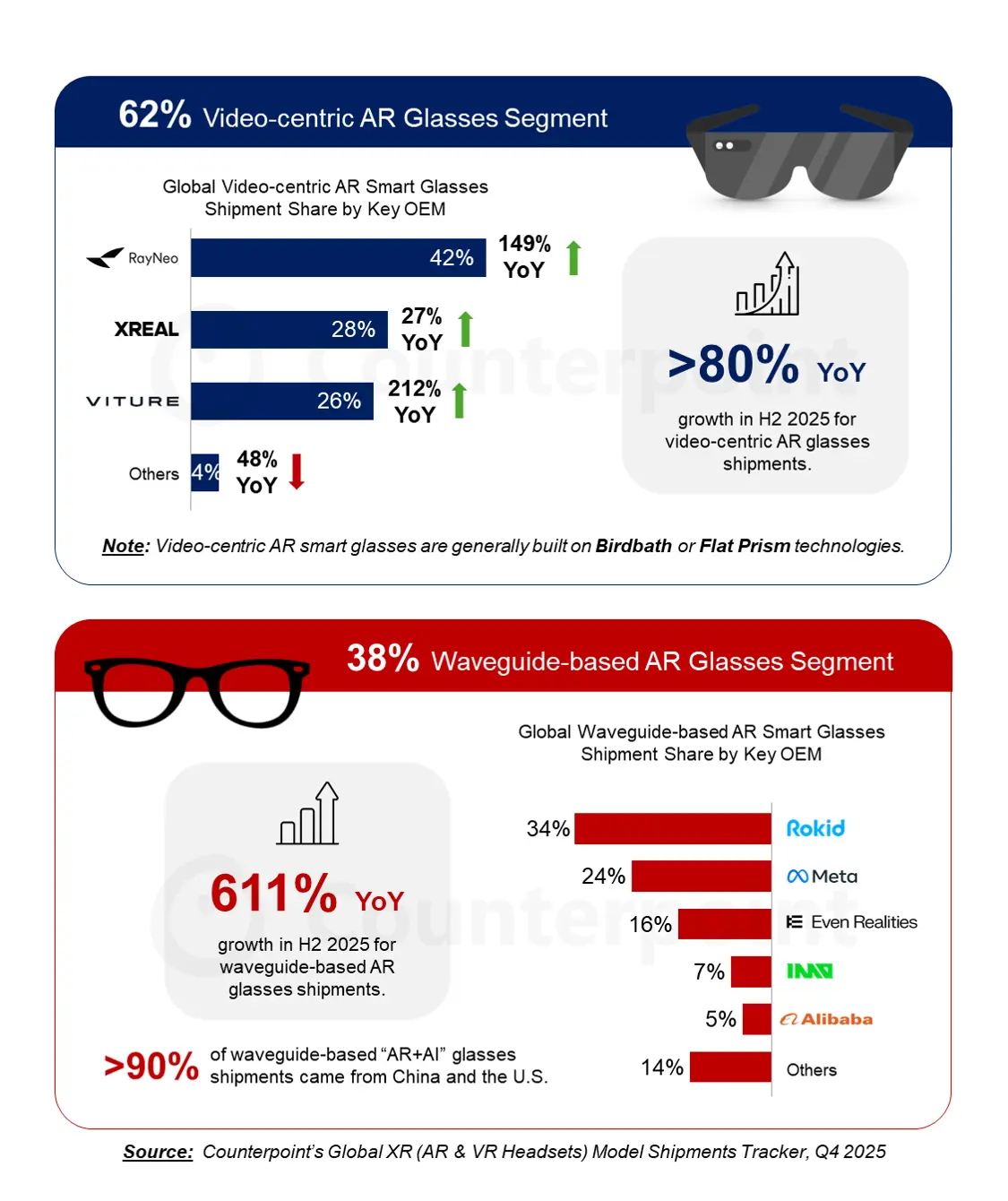
The waveguide-based AR glasses segment exhibited a distinct yet more robust competitive landscape, with companies such as Rokid, Meta, Even Realities, INMO, Alibaba and Meizu vying for market share. Most new products launched in H2 2025 focused on integrating AR and AI with real-life use cases, enabling features such as real-time translation, navigation, speech prompting and, more commonly, camera-based image recognition and encyclopedic Q&A. Since 2025, Chinese OEMs have also begun collaborating with Alibaba to introduce glass-based payment solutions. Among the key OEMs:
- Rokid emerged as the leading OEM in shipments in H2 2025, driven by strong initial sales momentum and a successful production ramp-up of Rokid Glasses, which quickly gained traction as an early entrant in the “AR+AI” glasses segment. Production scaled up significantly by the end of June 2025, with Rokid expanding beyond mainland China through telecom operators, eyewear retailers, malls and online channels to broaden regional availability.
- Meta Ray-Ban Display is the first commercialized smart glasses from Meta with a see-through display. Paired with the Meta Neural Band and deeply integrated with Meta’s mobile ecosystem and Meta AI, the glasses quickly gained popularity among tech enthusiasts. However, supply was constrained in 2025 due to the relatively low production yield of key components.
- Even Realities ranked third in the segment, capturing a 16% market share with its ultra-lightweight G1 and G2 series glasses, which feature a design resembling traditional prescription glasses.
- Chinese OEMs INMO and Alibaba followed with 7% and 5% market share, respectively.
- Alibaba launched the Quark AI Glasses S1 in Q4 2025. The product generated strong market buzz in China due to integration with Qwen AI and Alibaba’s mobile services (Amap, Alipay, Taobao, Feizhu). However, supply constraints and a relatively high price (~$671 official, ~$528 after discounts) limited shipments in 2025.
In H2 2025, AR glasses equipped with AI-capable processors, microphones, speakers, cameras and wireless connectivity – classified as “AI glasses” – represented roughly 70% of total waveguide-based AR glasses shipments, up from negligible levels a year earlier. China and the US are currently the largest markets for these devices.
We expect the upward growth momentum in the global AR smart glasses market to continue in the coming years, supported by international expansion from leading OEMs, more new entrants, and improving maturity and production yields in key display and optical components. Nevertheless, recent memory price hikes and geopolitical tensions involving the US, Israel and Iran, along with their impact on the global economy, may pose challenges.
Note: In this report, AR smart glasses refer to devices equipped with the necessary display and optical components to enable an optical see-through (OST) experience.
For a more detailed global XR (AR/VR) market analysis, please refer to this report.
For insights from our smart glasses market research, please visit this link.
About Counterpoint Research
Counterpoint Research is a global market research firm specializing in products across the technology ecosystem. We advise a diverse range of clients – from smartphone OEMs to chipmakers and channel players to Big Tech – through our offices located in the world's major innovation hubs, manufacturing clusters and commercial centers. Our analyst team, led by seasoned experts, engages with stakeholders across the enterprise – from the C-suite to professionals in strategy, analyst relations (AR), market intelligence (MI), business intelligence (BI), product and marketing – to deliver services spanning market data, industry thought leadership and consulting. Our core areas of coverage include AI, Automotive, Consumer Electronics, Displays, eSIM, IoT, Location Platforms, Macroeconomics, Manufacturing, Networks and Infrastructure, Semiconductors, Smartphones and Wearables. Visit our Insights page to explore our publicly available market data, insights and thought leadership, and to understand our focus, meet our analysts and start a conversation.


