LGD Announces FLiPP Photolithographic OLED Patterning Technology
At the International Meeting on Information Display (IMID) 2026, held in Busan, South Korea, last week, LG Display (LGD) announced that it has successfully developed an improved technology for OLED patterning without Fine Metal Masks (FMMs). LGD’s FLiPP (FMM-Less innovative Pixel Patterning), which the company described as its own proprietary technology, follows similar announcements in recent years by Japan Display, Inc (eLEAP) and Visionox (ViP). The technology allows for a dramatic increase in aperture ratio for an OLED pixel, resulting in “much greater flexibility in mass production as well as brighter panels with longer lifespan and lower power consumption”.
Following the announcement of its FLiPP technology, LG Display unveiled a 27-inch OLED panel manufactured using FLiPP at the IMID 2026 exhibition. The panel attracted significant attention from both South Korean and international audiences.
Current OLED panel manufacturing mainly uses vacuum thermal evaporation (VTE) of organic light-emitting materials and pixel patterning with an FMM. However, FMM technology faces various limitations arising from alignment accuracy, the gap between the FMM and glass substrate, Pixel Definition Layer (PDL) width, mask sagging, and other factors. These limitations make it difficult to achieve a pixel aperture ratio above 30%. As a result, FMM-based OLED panels face performance limitations in areas such as brightness, viewing angle, and lifetime.
The advantage of photolithographic patterning resides in its significantly more precise control of the material deposition. This allows for a greatly reduced buffer between the sub-pixels on the screen, allowing the sub-pixels to be substantially larger within the same overall pixel size, as demonstrated by this graphic from JDI. JDI has claimed an aperture ratio as high as 69%.
Increased Aperture Ratio from Photolithographic Patterning
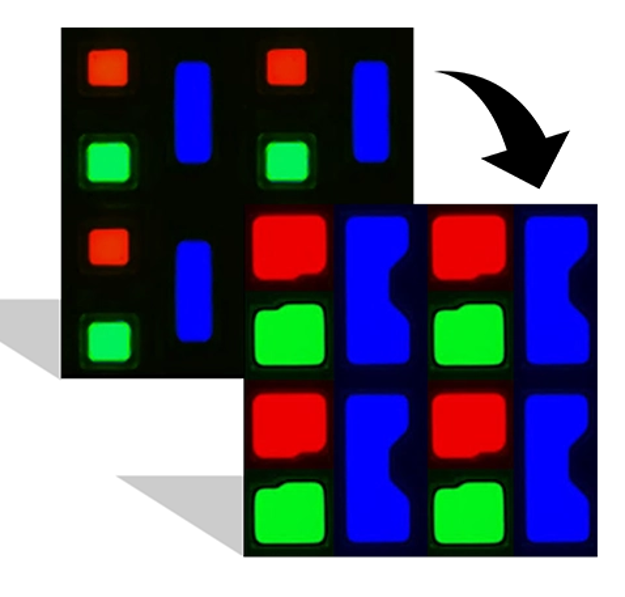
The increased aperture ratio allows a dramatic increase across multiple performance metrics. LGD claims that compared to FMM panels, “FLiPP enables displays to increase brightness by 1.6 times, extend lifespan by 2.4 times, and reduce power consumption by 13%” (emphasis added) with an increase in aperture ratio of 55%. These performance improvements are similar to the claims made by Visionox for ViP and by JDI for eLEAP.
Due to another constraint from the use of FMMs, in existing Gen 6 fabs, deposition takes place on ½ Gen 6 substrates (925 mm x 1500 mm). On the newer Gen 8.7 fabs for SDC and BOE, deposition takes place on ½ Gen 8.7 substrates (2290 mm x 1310 mm). Since it is not subject to these constraints, LGD’s FLiPP allows for OLED patterning on (full) Gen 8.5 substrates. The company claimed that “FLiPP has allowed LG Display to become the first display company to manufacture FMM-less OLEDs using 8.5th-generation mother glass as a single whole piece”. LGD claims that for OLED laptop panels, FLiPP “delivers up to 64% higher mother glass utilization efficiency”.
LGD has been working on this technology for more than a year. According to Counterpoint Research’s OLED Supply/Demand and Capital Spending Report, LGD is building a Gen 8.5 R&D line at Paju in South Korea and has started to order equipment earlier this year. That line will be only 2000 substrates per month, but LGD has substantially more Gen 8.5 capacity in South Korea and China, which is making White OLED TV and monitor panels using Open Mask deposition.
A report in South Korean media indicated that LGD plans to invest KRW 3 trillion ($2.2 billion) to build out capacity for FLiPP at its P10 facility in Paju. LGD expects to complete equipment specifications next month and place equipment orders by January 2027. However, based on our insights, we expect the expansion to take place at the P8 LCD rather than P10, with the investment expected to be less than KRW 2 trillion ($1.45 billion). The final investment decision is expected to be made following an internal review process. LGD expects to start production with IT applications such as NBPCs and monitors.
LGD’s press release indicated that it has filed trademark applications for FLiPP in “(South) Korea and key global markets”. Among intellectual property standards, a trademark is relatively easy to obtain but provides no exclusivity for technology, like in a patent. If, as would be expected, LGD obtains a trademark for FLiPP, other countries cannot use the name FLiPP, but can freely develop their own technology (such as ViP for Visionox and eLEAP for JDI).
Although photolithographic patterning promises substantial performance advantages, the manufacturing technology remains unproven at scale. Challenges include greater process complexity, particle management during non-vacuum lithography steps, and the need to protect sensitive organic materials throughout the patterning process.
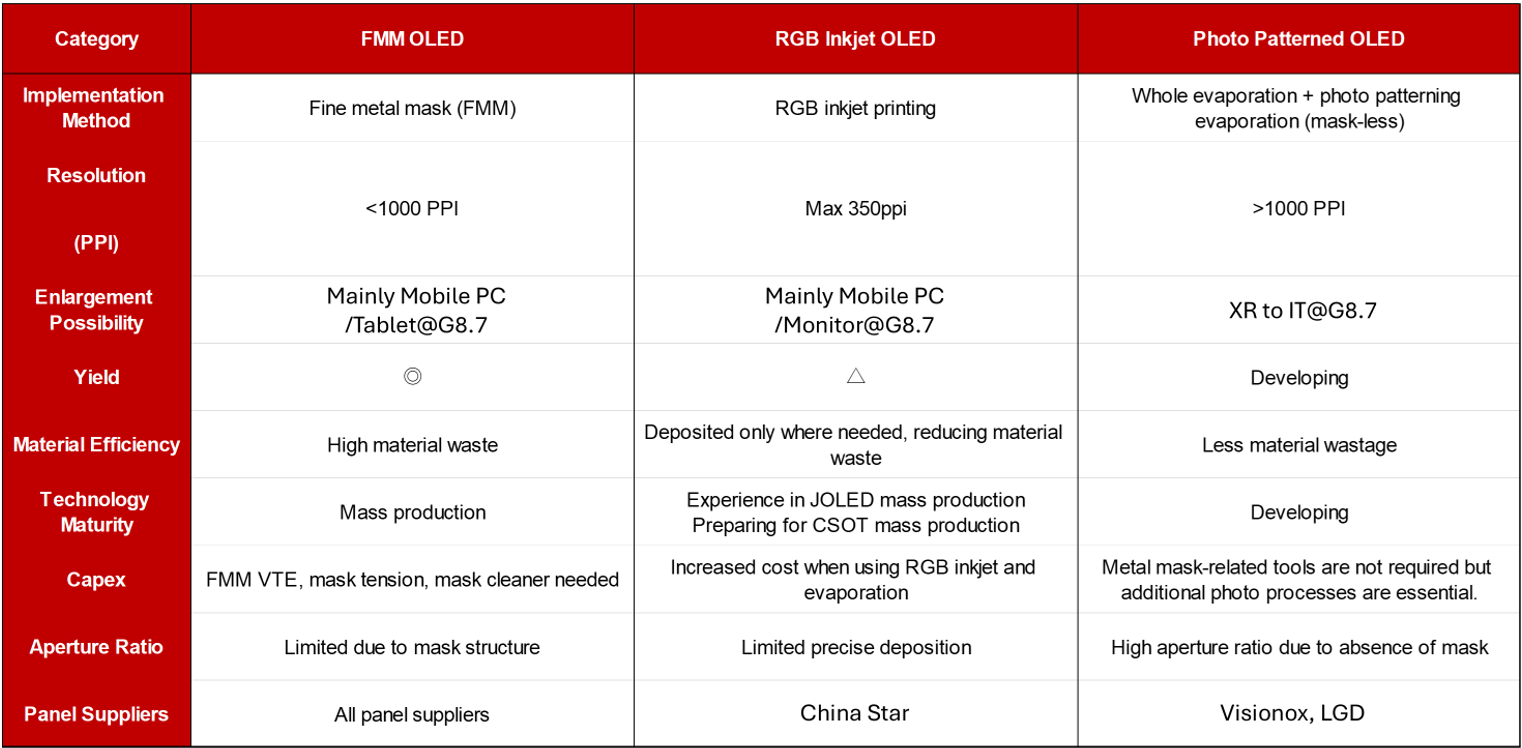
LGD’s development of FLiPP puts it in the same camp as Visionox and JDI, translating into a three-way race for supremacy in Gen 8.7 OLED. SDC and BOE have started Gen 8.7 production using the incumbent technology, while Visionox has ordered equipment for a Gen 8.7 fab employing its ViP technology. China Star has adopted a third method, inkjet printing, based on technology acquired from JOLED, and plans to ramp up a Gen 8.7 fab with IJP deposition. A comparison of these three types is shown in the graphic below.
Comparison by Evaporation Method
The battle of these three technologies will be the main topic of Yoshi Tamura’s presentation at the Finetech Japan Conference on October 1, 2026, at the Makuhari Messe.
Category
Industry
Display
Service
Standard
Report Type
Report
Time Period
Other
Receive our insightful weekly newsletter and stay ahead of the competition.
Author
Bob Obrien
Robert J (Bob) O’Brien joined Counterpoint Research as part of its acquisition of DSCC, where he was Co-Founder, Principal and CFO of DSCC. Bob has decades of experience turning market and business analysis into strategic insights in the display and electronics industries. At DSCC, Bob takes the lead role in analysis of display materials, including glass and AMOLED materials, and covers developments in TV and other large-screen display applications. He is the principal author of DSCC’s AMOLED Material Report, the Advanced TV Shipment Report, and the Display Glass Report, and Bob contributes regularly to the DSCC Weekly Review.