

- China remains the industry's growth engine, accounting for nearly 75% of global TFT input area while maintaining utilization around 85% for six consecutive quarters.
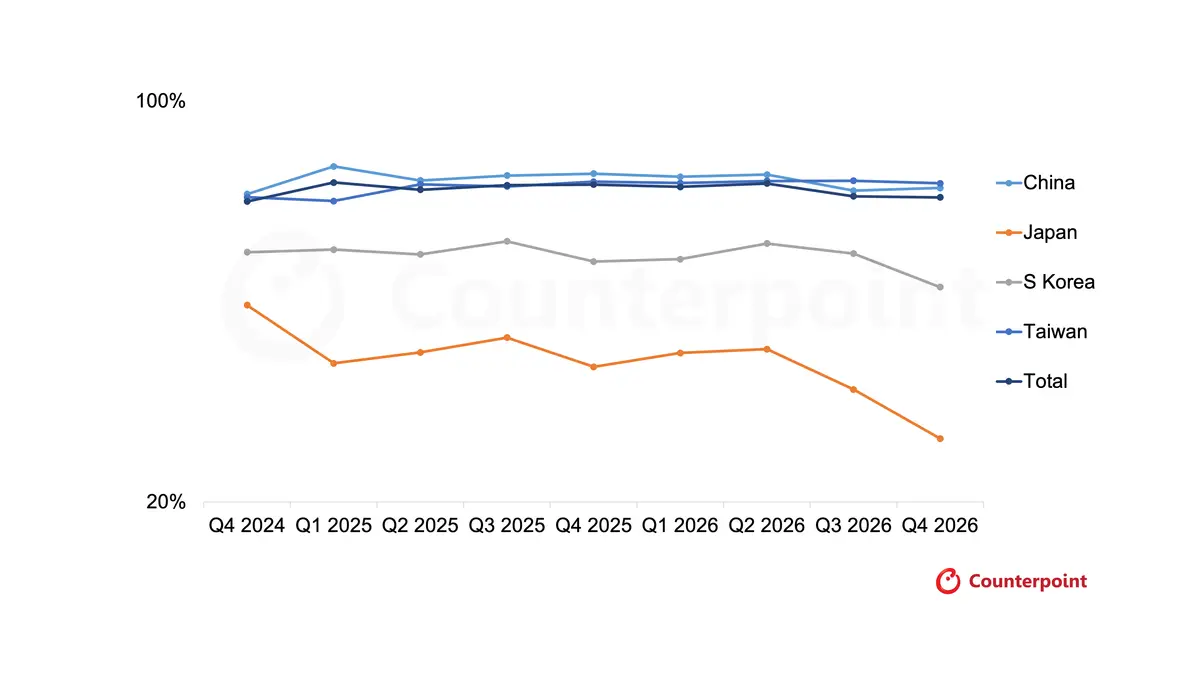
- Japan's fab utilization is projected to decline from 50% in Q2 to only 33% by Q4 2026.
- Despite maintaining technology leadership in OLED capacity, South Korean utilization remains well below Chinese levels as manufacturers continue balancing premium smartphone demand, OLED TV production and future IT OLED capacity.
- Strong flagship smartphone launches, increasing LTPO penetration and continued premiumization are allowing flexible OLED fabs to sustain high utilization levels throughout 2026.
- a-Si/Oxide remains the strongest performer with utilization above 90%, while LTPO stays elevated at ~80% on strong premium smartphone demand. However, oxide backplane utilization remains volatile amid uneven IT display demand.
The global display industry entered Q2 2026 on relatively stable footing. Overall fab utilization improved to 84%, supported by disciplined production planning and resilient demand in smartphones and premium TVs. However, the data also reveals a growing regional divergence. While China continues to dictate industry momentum, Japan and South Korea face increasingly different structural challenges, and several display technologies are entering a period of correction. Here are our key takeaways from the latest All Display Fab Utilization Report and OLED and Mobile/IT LCD Fab Utilization Report.
Fab Utilization by Region, Q4 2024 – Q4 2026(F)
China continues to anchor the global display industry
China remains the industry's growth engine, accounting for nearly 75% of global TFT input area while maintaining utilization around 85% for six consecutive quarters.
Unlike previous years where utilization fluctuated sharply with demand cycles, Chinese panel makers have demonstrated much tighter supply discipline. A modest reduction to around 82% in Q3 appears to be a deliberate move to stabilize panel pricing rather than a sign of weakening competitiveness. This reflects a maturing industry where capacity management is becoming as important as capacity expansion.
