

Huawei (including Honor) was the fastest growing brand and No. 1 in China, and OPPO and vivo’s rankings are neck and neck, with a combined market share of 42%.
Beijing, Hong Kong, Seoul, San Diego, Buenos Aires, London, New Delhi –
Nov 1st, 2018
According to the latest research from Counterpoint’s Market Pulse service, sales of smartphones in China saw no signs of recovery in Q3 2018, ending the quarter with 8% year on year decline though the market grew by 2% compared to the last quarter.
Commenting on the performance of the overall market, James Yan, Research Director said, “The sharp YoY decline in Q3 can be attributed to the generally lengthened upgrade cycle of consumers and average price increases. Fierce competition among local players in the mid-to-affordable premium market has forced key local players to continuously improve their offering and roll out advanced features that are more akin to premium level smartphones. AI-powered processors, bezel-less screens, dual or triple cameras and faster screen-unlock are some of the key selling points that smartphone OEMs have marketed aggressively in their products across different price bands.”
James Yan further added, “China is a mature market with over 95% smartphone penetration, thus it is natural that YoY growth in smartphone sales is slowing. However, China continues to see rapid growth in technology innovation. In Q3 2018, we’ve seen the smartphone market evolve to the ‘full-screen-3.0’ era with a higher penetration of bezel-less models than the global average level. Chinese OEMs are investing significant R&D resources to develop products with a ‘true infinite screen’. Innovative solutions such as pop-up cameras, under-display fingerprint sensors and 3D face recognition technologies, have been widely adopted by Chinese OEMs in their latest flagship models. Driven by the efforts of OEMs to launch products with leading technologies, the Chinese market in Q3 was slightly up compared to the second quarter. It is a positive sign for the Q4 outlook when annual ‘spotlights’ such as the Huawei Mate 20 series and the new iPhones will see sales ramp-up.”
Exhibit 1: Chinese Smartphone Market Share Q3 2018
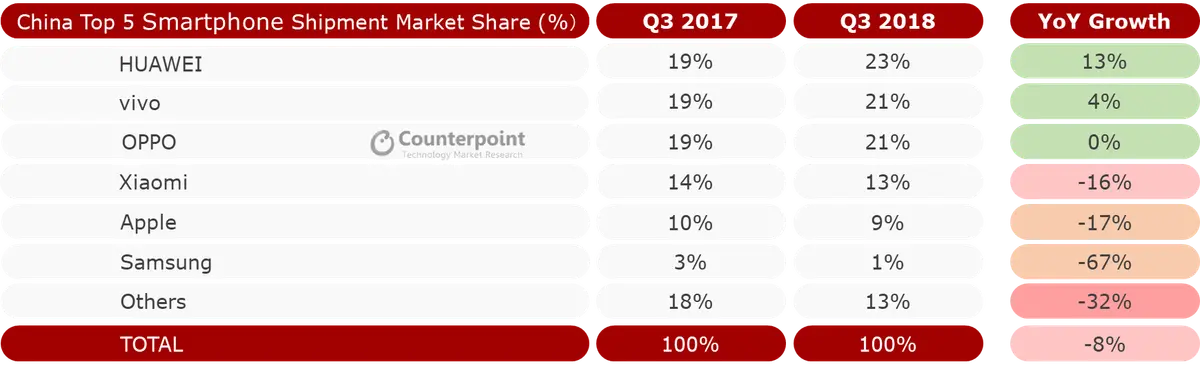
Source: Counterpoint Research Market Monitor Q3 2018
Commenting on the competitive landscape, Mengmeng Zhang, Research Analyst at Counterpoint, said, “The Chinese smartphone market is saturated with accelerated market consolidation. The competition in 2018 is almost a zero-sum game for the top five players. It is challenging however, even for the leading brands to create clear product differentiation. In Q3, only Huawei (including Honor) and vivo managed to achieve positive YoY growth among the top 5 brands.”
Commenting on the reasons behind the growth of Huawei and vivo, Flora Tang, Research Analyst at Counterpoint, highlighted, “The long-term R&D efforts of Huawei in developing and integrating cutting-edge technologies across its product portfolio have paid off. Huawei is successfully winning trust among Chinese consumers based on the quality of Huawei and Honor smartphones over its Android competitors, especially in the premium market where consumers are less sensitive to price. The YoY growth of vivo was due to its successful marketing strategy. Its flagship models have benefited from the brand’s exposure as the official sponsor for the FIFA World Cup, which helped elevate its brand image among sports fans both in China and abroad.”
Key Takeaways from Chinese Market in Q3 2018:
- The Chinese smartphone market declined by 8% YoY while going up by 2% sequentially in Q3 2018.
- The QoQ market growth was driven by heavy promotions offered by OEMs during summer holiday seasonal sales, to clear stock of older models and to make space for new product launches in Sep.
- As new technologies such as, bezel-less displays, AI-powered processors and dual cameras have penetrated into lower-tier models, the competition in China is getting increasingly fierce.
- Market consolidation is apparent in China, with the top five OEMs capturing 86% of smartphone share in Q3, increasing from less than 80% in the same period last year.
- Huawei (including Honor) was the market leader in terms of both sales volume and growth momentum in Q3, with its leadership position fixed in China, capturing 23% market share.
- Success of Huawei was not only reflected in the premium market, but also in the mid-tier market with the growth of Nova series and strong sales momentum of various models under Honor brand (e.g. Honor 10, Honor 8X, Honor Play).
- vivo with 4% YoY growth was the second best-selling brand in Q3 capturing 21% market share. Growth of vivo was driven by the continued popularity of flagship models vivo X21 and vivo NEX in the wake of the FIFA World Cup event. In addition, the sales performance of budget models under vivo Y and Z series was also strong in China.
- Smartphones sales of OPPO were flat YoY but grew 15% sequentially. The Q/Q uptick in shipments of OPPO was due to the continued sales momentum of the flagship model OPPO R15 and the popularity of budget models under the OPPO A series.
- OPPO A5, a bezel-less model with 6.2-inch notched display, 19:9 screen ratio, dual SIM slots and 4230 mAh battery, was the best-selling model in Q3 in the Chinese market, thanks to its flagship-like product design and the affordable price ticket (CNY 1,500 or US$200).
- Xiaomi smartphone sales were flat compared to last quarter but declined 6% YoY. Xiaomi was aggressive in promoting its flagship model, Mi 8, by offering various discounts during the quarter. However, due to fierce competition from Huawei, Honor, OPPO and vivo, the sales volume of Xiaomi Mi 8 fell short of expectations.
- As Xiaomi has launched the less expensive version of Mi8 (Mi 8 Lite) in September, we expect performance of Xiaomi Mi 8 Lite to surpass Mi 8 during the coming quarter.
- iPhones sales were down 17% YoY in Q3 but up 14% sequentially driven by growing demand for the new iPhones after their launch in September. The super-premium model iPhone Xs Max, the gold-colored variant especially, got immediate traction among iOS fans in China, despite the high price. This is due to the attractive design language and form factor of the new iPhones compared to the previous generation.
- We expect that the iPhone XR will stimulate upgrade demand of iPhone fans in China. iPhone XR is expected to capture a larger share of sales volume of iPhones in Q4, followed by the iPhone Xs Max and iPhone Xs.
The comprehensive and in-depth Q3 2018 Market Pulse is available for subscribing clients. Please feel free to contact us at press(at)counterpointresearch.com for further questions regarding our in-depth, latest research, insights or press enquiries.
The Market Monitor research is based on sell-through estimates based on vendor’s IR results, vendor polling triangulated with supply chain checks and secondary research.
Analyst Contacts:
James Yan闫占孟
+86 15810182576
[email protected]
Tarun Pathak
+91 9971213665
[email protected]
Mengmeng Zhang
+86 18611804269
[email protected]
Flora Tang
+852 5545 2529
[email protected]
Follow Counterpoint Research


