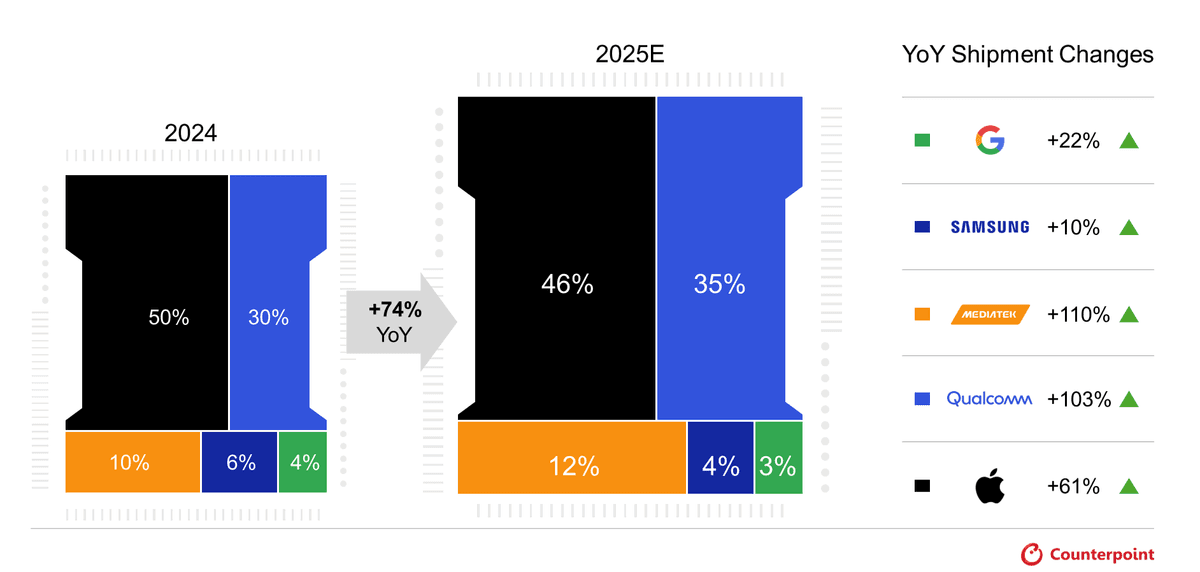
- GenAI-Smartphone-SoCs werden im Jahr 2025 35 % der weltweiten Smartphone-SoC-Lieferungen ausmachen und damit im Vergleich zum Vorjahr um 74 % wachsen.
- 88 % der im Jahr 2025 ausgelieferten SoCs für Premium-Smartphones werden über On-Device-GenAI-Fähigkeit verfügen.
- Prognosen zufolge wird sich die Zahl der Auslieferungen von GenAI-fähigen SoCs für Smartphones der Mittelklasse im Vergleich zum Vorjahr bis 2025 verdreifachen.
- Es wird erwartet, dass On-Device-GenAI-SoCs in der Smartphone-Preisklasse von 300 bis 499 US-Dollar im Jahr 2025 einen Auslieferungsanteil von 38 % erreichen werden, gegenüber 12 % im Jahr 2024.
- Premium-Smartphone-SoC-ASPs werden zunehmend durch höherwertige Semi-Inhalte vorangetrieben.
Seoul, Peking, Berlin, Buenos Aires, Fort Collins, Hongkong, London, Neu-Delhi, Taipeh, Tokio – 30. September 2025
Laut Counterpoints aktuellem Global Smartphone AP-SoC Shipment & Forecast Tracker by Model, Q2 2025 werden die Auslieferungen von GenAI-fähigen Smartphone- SoCs im Jahr 2025 voraussichtlich 35 % der weltweiten Smartphone-SoC-Auslieferungen ausmachen . Die Auslieferungen werden 2025 im Vergleich zum Vorjahr voraussichtlich um 74 % steigen, was vor allem auf die zunehmende Verfügbarkeit von GenAI-Funktionen in allen Preisklassen zurückzuführen ist. Apple wird dieses Jahr mit einem Anteil von 46 % das Segment anführen, gefolgt von Qualcomm mit 35 % und MediaTek mit 12 %.
Um seine Position zu stärken, hat Apple eine Partnerschaft mit OpenAI geschlossen , um ChatGPT in iOS, iPadOS und macOS zu integrieren und Nutzern so den Zugriff auf die Funktionen von ChatGPT zu ermöglichen. Darüber hinaus hat Apple eine Reihe generativer Modelle entwickelt, darunter ein geräteinternes Sprachmodell mit drei Milliarden Parametern und ein größeres serverbasiertes Modell, das über Private Cloud Compute auf Apple Silicon-Servern zugänglich ist.
Auf der Android-Seite bietet Qualcomm den AI Orchestrator an, der OEMs hilft, sich auf Dienste zu konzentrieren, ohne komplexe LLMs, Hardware und Software verwalten zu müssen, während das NeuroPilot-Toolkit von MediaTek die KI-Optimierung über CPUs , GPUs und NPUs hinweg ermöglicht . Sowohl Qualcomm als auch MediaTek arbeiten aktiv mit chinesischen Smartphone-OEMs zusammen, um eine effiziente Bereitstellung von GenAI-Modellen auf ihren SoCs sicherzustellen.
Globaler Smartphone On-Device GenAI SoC-Lieferanteil nach Marke
88 % der ausgelieferten Premium-SoCs werden im Jahr 2025 GenAI-fähig sein
Die Auslieferungen von GenAI-fähigen SoCs für Premium-Smartphones werden 2025 im Vergleich zum Vorjahr um 53 % steigen. 88 % der im Jahr 2025 ausgelieferten Premium-SoCs werden GenAI-fähig sein, wobei führende Hersteller diese Funktionen in ihren Produkten anbieten. Apples A19 und A19 Pro werden zusammen mit dem Snapdragon 8 Elite Gen 5 und dem Dimensity 9500 die GenAI-Einführung in Premium-Smartphones in diesem Jahr weiter vorantreiben.
Research Analyst Shivani Parashar kommentierte die globalen Premium-SoCs mit GenAI-Fähigkeit wie folgt: „Mit dem Aufkommen von GenAI in Smartphones seit 2024 hat sich der Wettlauf um leistungsfähigere KI-Recheneinheiten beschleunigt. Die Spitzen-KI-Leistung von Premium-Mobilplattformen wird voraussichtlich 2025 100 TOPS erreichen und damit fast viermal so hoch sein wie 2021. Diese zunehmende Verbreitung von GenAI in Premium-Smartphones treibt die ASPs für Premium-Smartphone-SoCs in die Höhe, da Smartphone-SoC-Marken auf fortschrittliche Knoten migrieren und mehr Halbleiterinhalte integrieren, mit erheblichen Verbesserungen bei CPUs, GPUs und NPUs, um GenAI direkt auf dem Gerät zu ermöglichen.“
Parashar fügte hinzu: „Apple ist mit seinen Chips der A-Serie weiterhin führend bei Premium-GenAI-SoCs und nutzt die Neural Engine und die enge Hardware-Software-Integration für eine hochoptimierte Leistung. Gleichzeitig ist Qualcomm mit seinen geräteinternen GenAI-Funktionen führend im Premium-Android-Markt, beginnend mit dem Snapdragon 8 Gen 3 , der sich mit seiner Hexagon AI Engine auf multimodale KI konzentriert. MediaTek startete seine geräteinterne GenAI-Offensive mit der Dimensity 9300-Serie und legte dabei den Schwerpunkt auf Big-Core-Designs, Energieeffizienz und fortschrittliche LLM-basierte Anwendungen.“
Hinweis: Mit Premium-Smartphone-SoCs sind SoCs der Apple A-Serie, der Qualcomm Snapdragon 800-Serie, der MediaTek Dimensity 9000-Serie, der Exynos 2000-Serie, der Hisilicon Kirin 9000-Serie und der Google Tensor-Serie gemeint.
Zunehmende Verbreitung von GenAI in Mittelklasse-Smartphones
Im Segment zwischen 300 und 499 US-Dollar wird sich die Zahl der Auslieferungen von GenAI-fähigen Smartphone-SoCs im Jahr 2025 voraussichtlich verdreifachen und 38 % der Gesamtmenge ausmachen. Qualcomm wird dieses Segment mit einem Auslieferungsanteil von 57 % anführen, gefolgt von MediaTek. MediaTek war mit seiner Dimensity 8000-Serie der erste Anbieter, der GenAI-fähige SoCs in dieser Preisklasse auf den Markt brachte. Qualcomm stieg später mit der Snapdragon 700-Serie ein und hat mit seinen GenAI-fähigen SoCs der Snapdragon 6-Serie auch das Segment zwischen 100 und 299 US-Dollar ins Visier genommen.
Senior Analyst Parv Sharma kommentierte die zunehmende Verbreitung von GenAI im mittleren Preissegment wie folgt : „Das Wachstum ist vor allem auf die schnellere Verbreitung von GenAI-fähigen SoCs im mittleren Segment zurückzuführen, da Smartphone-Anbieter ihren Nutzern ein verbessertes Erlebnis bieten möchten. SoC-Anbieter optimieren LLMs, damit diese auf Geräten der Mittelklasse effizient laufen. In der kommenden Zeit dürfte die Verbreitung von GenAI-fähigen SoCs weiter zunehmen, da neuere SoCs im unteren Preissegment wahrscheinlich GenAI-Funktionen bieten werden.“


