

- The focus of Physical AI is shifting from improving foundation model capabilities to expanding task and system capabilities. The evolution of the VLA and WAM paradigms, advances in egocentric and synthetic data, and the rise of Agentic architectures collectively point toward how to continuously expand robots’ reliable task coverage with higher resource efficiency.
- Agentic architectures offer a new approach to break the marginal return bottleneck of scaling up single models and homogeneous datasets. Through foundational skill composition, long-horizon planning, and corrective feedback from the environment, the scaling of complex task capabilities extends beyond end-to-end model training to system-level organization and execution.
- By integrating the Cosmos world foundation model, data processing tools, simulation and training frameworks, and edge computing platforms, NVIDIA lowers developers’ costs spanning data generation, model training and real-world deployment, delivering full-stack development infrastructure for scaling Physical AI.
From Model Capabilities to Task Capabilities: Physical AI Is Pursuing More Effective Development Pathways
The goal of Physical AI is to enable robots to perform more tasks, adapt to more environments, and operate stably in the real world. Scaling investment in models, data and compute is critical to this objective, yet it is not sufficient. The core question deserving attention is as robotic task complexity keeps rising, how can incremental resource investment translate into broader, more dependable practical task capabilities, and which technical paths stand to improve this conversion efficiency.
Several key trends in embodied intelligence for 2026 can be interpreted within this framework:
First, debates around the VLA and WAM model paradigms reflect the industry’s ongoing exploration of how models can learn more effective physical interaction from data. VLA focuses on learning the mapping from visual observations and language instructions to robotic actions, yet capability expansion is easily constrained by the scale and task coverage of action-labelled data. WAM, by contrast, links world dynamics modelling with action generation. By learning how environments evolve and what consequences actions bring, it introduces richer predictive signals to models and unlocks new avenues to leverage human video, simulation data and other data sources.
Second, data strategies are moving toward multi-source fusion and specialized division of labor. Teleoperated real-robot data directly provides state, action and outcome signals for a specific robot embodiment, yet it carries high collection costs and is bounded by tasks, scenes and robot morphologies. Egocentric data, internet video, simulated trajectories and synthetic data hold scaling potential, supplying a broader corpus of object interactions, environmental dynamics and behavioral priors. Data volume, however, must not be conflated with effective training signal density. First-person human videos capture abundant physical interactions but generally lack the precise control signals required for robot execution. Simulation data can be generated at scale, yet its physical laws, contact dynamics and sensor distributions do not perfectly match reality. Progress in the data roadmap therefore hinges on boosting the density of useful training signals and establishing valid connections between multi-source datasets and real-world task performance.
Furthermore, continuous iterative development loops are emerging as a major lever to raise the resource efficiency of Physical AI. Multi-source data endows models with broad physical interaction experience; simulation environments expand training scenarios and validation scope at low cost; real-world deployment further exposes capability gaps under practical task conditions. Feeding real interaction outcomes and failure cases back into data, model and system iterations allows developers to allocate training and testing resources more targetedly and steadily improve real-world task performance. This closed loop — from large-scale learning to real-world validation and targeted refinement — promises to cut wasteful resource spending and accelerate the accumulation and expansion of robotic task competence.
The core proposition for scaling Physical AI is to sustainably lift the conversion efficiency of models, data, compute and system design into usable task capabilities. As task complexity grows, representations, system architectures, feedback mechanisms and development infrastructure collectively shape the speed, cost and reliability of real-world capability expansion.
From Monolithic Policies to Agentic Systems: Complex Task Capability Scaling Enters a New Phase
With foundation models and training datasets continuing to grow, Physical AI must further explore how to translate acquired model competencies into broader task capabilities. Complex robotic tasks are usually composed of multiple primitive skills, sequential execution steps and dynamic environmental conditions. The combinatorial space of tasks can expand faster than the pace of collecting data and training dedicated policies one by one. Whereas VLA and WAM mainly investigate how embodied agents perceive the physical world, forecast world states and generate actions, Agentic architectures center on dynamically orchestrating models, tools and robotic skills around task objectives, forming a complete loop of planning, execution, state monitoring and failure recovery.
Agentic architectures introduce a new resource allocation paradigm: by reusing existing skills and incorporating long-horizon planning plus environmental feedback, task coverage is enlarged through system-level capability orchestration.
Take desktop tidying as an example. Based on the current scene, the robot decomposes the overall objective into subtasks including object recognition, grasping, moving and placing, and selects appropriate skills to execute in sequence. During execution, the system continuously gathers environmental feedback to check whether progress aligns with expectations. If a grasp fails or an object shifts position, the system can re-perceive, adjust motions and replan subsequent steps. In this setup, planning organizes the task, low-level policies execute concrete actions, and feedback drives dynamic behavioral adaptation based on actual outcomes.
This architecture has the potential to boost resource efficiency. When foundational skills are sufficiently robust, new task capabilities can be added largely through recombining existing skills, adjusting invocation sequences, and refining feedback and error-correction mechanisms, reducing the need to collect data and train policies from scratch for every task combination. Beyond scaling model and data size, skill reuse, inferential reasoning and interactive feedback may become important dimensions for growing task capacity. These gains, nevertheless, depend on the generality of base skills, the quality of planning, and the system’s ability to detect and handle execution failures.
Implementing Agentic architectures also imposes stricter system engineering requirements. Robots must accurately estimate environmental states, understand the applicability and outcomes of each skill, and coordinate information flow across modules. Perceptual noise, execution drift or stale environmental information can derail downstream decisions, while multi-step reasoning, additional observations and repeated retries incur overhead in computation, latency and actuation. The value of Agentic architectures therefore needs to be holistically evaluated against long-horizon task success rates, failure recovery resilience, adaptability to novel task combinations, and the data, compute and human labor consumed per successful task.
Agentic systems are complementary to paradigms such as VLA and WAM: VLA and WAM supply low-level action generation and world prediction, while Agentic systems organize, invoke and coordinate these capabilities toward task goals. World Models can further predict the consequences of candidate actions to inform planning and decision-making. Physical AI capability scaling may thus advance along two mutually reinforcing tracks: one scales foundational abilities via larger models, datasets and compute; the other raises the efficiency of converting low-level capabilities into complex tasks through planning, skill reuse, feedback and validation. Whether Agentic architectures become the defining paradigm for the next phase of Physical AI will ultimately hinge on whether system-level improvements translate into broader reliable task coverage and verifiable gains in overall resource efficiency.
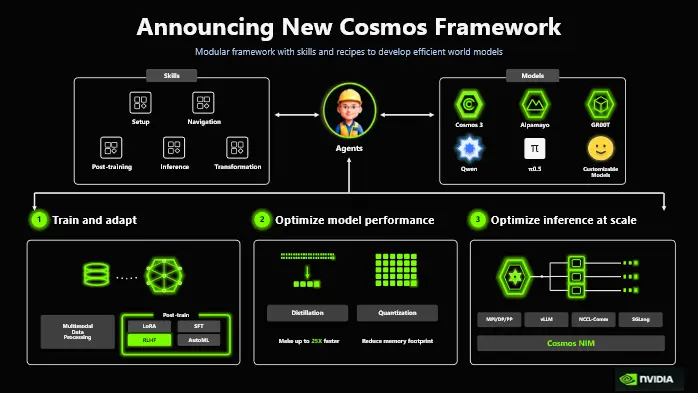
Source: NVIDIA Official
NVIDIA Cosmos is designed with built-in adaptability for Agentic architectures.
From Models to Infrastructure: Cosmos Sustains Physical AI Progress
As Physical AI increasingly relies on the coordination of action policies, environmental prediction, control execution, simulation validation and feedback learning, industry bottlenecks reside not only in models themselves but also in training data production, training environment construction, model training and evaluation, and the deployment on physical hardware. Advancing Physical AI requires end-to-end infrastructure to lower the barrier for developers to move from model competence to real-world task performance.
NVIDIA delivers reusable upper-layer development and model capabilities for diverse embodiments through foundation models, data tools, simulation environments, training frameworks and compute platforms. Within this stack, Cosmos assumes a central role in physical world modeling and data generation, and works alongside Isaac, GR00T and other offerings as part of NVIDIA’s Physical AI infrastructure ecosystem. Its vision can be summarized under three pillars: Better Data, Better Environment, Better Starting Point, referring to higher-quality data, improved training and validation environments, and stronger foundational model starting points respectively.
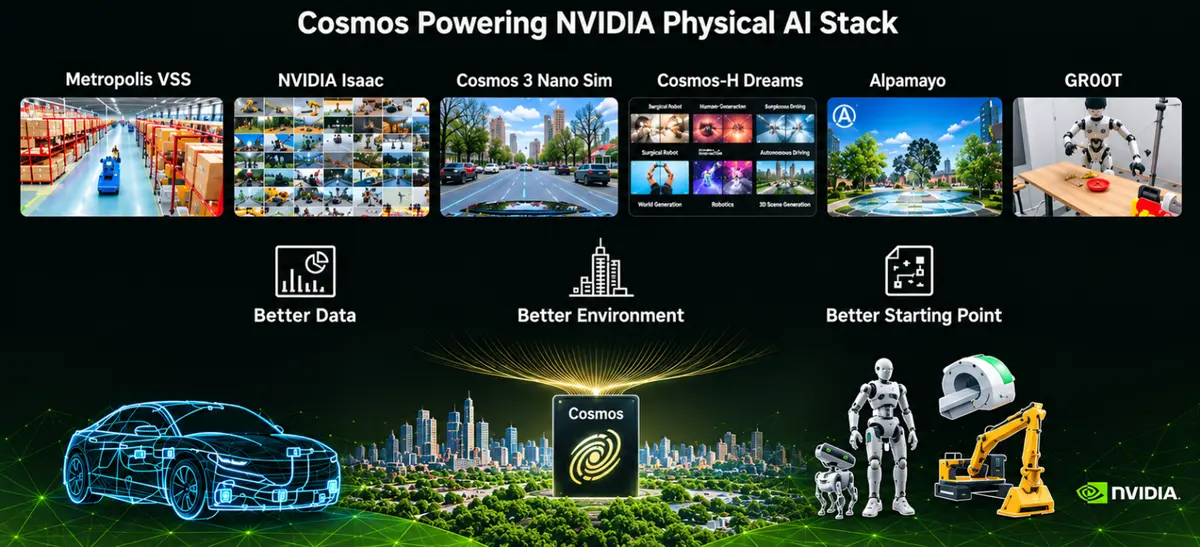
Source: NVIDIA Official
1. Better Data: Cutting the Cost of Producing and Processing High-Quality Physical Data
Training data for Physical AI is characterised by high acquisition costs, difficulty replicating diverse scenarios, and poor coverage of long-tail events. Leveraging world foundation models, data processing utilities and synthetic data capabilities, Cosmos helps developers expand training repertoires, process multi-modal data, and explore the generation of alternative environmental states and future trajectories. Its potential value lies not in replacing real-robot data entirely with synthetic data, but in amplifying the utility of limited real-world datasets.
2. Better Environment: Lowering the Cost of Training, Validation and Trial.
For Physical AI, model performance cannot be judged solely by offline benchmark results. Robots act within dynamic environments; actions reshape environmental states, which in turn condition subsequent decisions. Simulation environments therefore serve not only as training tools but also as key infrastructure for evaluating models, comparing policies and reproducing failures. NVIDIA supports robotic simulation, policy training and validation via Isaac Sim and Isaac Lab, tightly integrated with Cosmos and the data toolchain. Before deployment, developers can test a wider range of environments and task conditions, replicate certain failure modes in controlled settings, and iteratively close the loop from training to evaluation.
3. Better Starting Point: Providing Reusable Foundation Models and Development Frameworks
Building robotic foundation models from the ground up demands massive datasets, compute and engineering resources. Open models allow developers to build upon pre-existing capabilities and conduct post-training and deployment tailored to their specific robot embodiments, sensors, tasks and use cases. Cosmos 3 unifies visual reasoning, world generation and action modelling within a single model family, with open access to models, data pipelines, training and evaluation assets. NVIDIA also covers robotic models, development and simulation tools, and edge compute hardware through GR00T, Isaac and Jetson, respectively. This does not mandate that all robots adopt NVIDIA’s models or technical stack; rather, NVIDIA aims to lower the industry barrier to building Physical AI systems via open models and tooling.
NVIDIA addresses common developer needs by supplying broadly demanded compute, software, models and simulation infrastructure. As system complexity rises, synthetic data generation, parallel simulation, policy evaluation and inference create incremental compute demand, positioning NVIDIA to capture upside as Physical AI scales.
Conclusion: Physical AI Is Evolving from Isolated Breakthroughs to System Competence
The next phase of Physical AI brings convergence across model capabilities, decision-making mechanisms and system architectures: policy models learn to interpret the physical world and generate actions; world models forecast environmental dynamics and action outcomes; Agentic architectures furnish a systemic framework for planning complex tasks, invoking skills, monitoring execution and recovering from failures; while data, simulation, training and deployment infrastructure underpin iterative capability growth.
For NVIDIA, the compelling long-term opportunity is to integrate data production, world models, robotic policies, simulation training and compute deployment into a reusable Physical AI stack. Cosmos is a critical component, yet its strategic value must be assessed within the full development loop, rather than by parameter count or standalone benchmark scores.
The industry should track three key questions going forward: first, whether Agentic systems deliver durable performance gains on long-horizon tasks and anomaly recovery; second, whether synthetic data and simulation reduce the real-world data and training overhead required to add each new reliable task capability; third, whether NVIDIA’s open models and toolchain achieve broad developer adoption and translate into sustained demand for training, simulation and deployment.
If the early goal of Physical AI was to teach robots to execute motions, the next era is about enabling robots to scale their task capabilities. NVIDIA’s vision is to supply the foundational models, development environments and compute infrastructure to power this expansion.
