

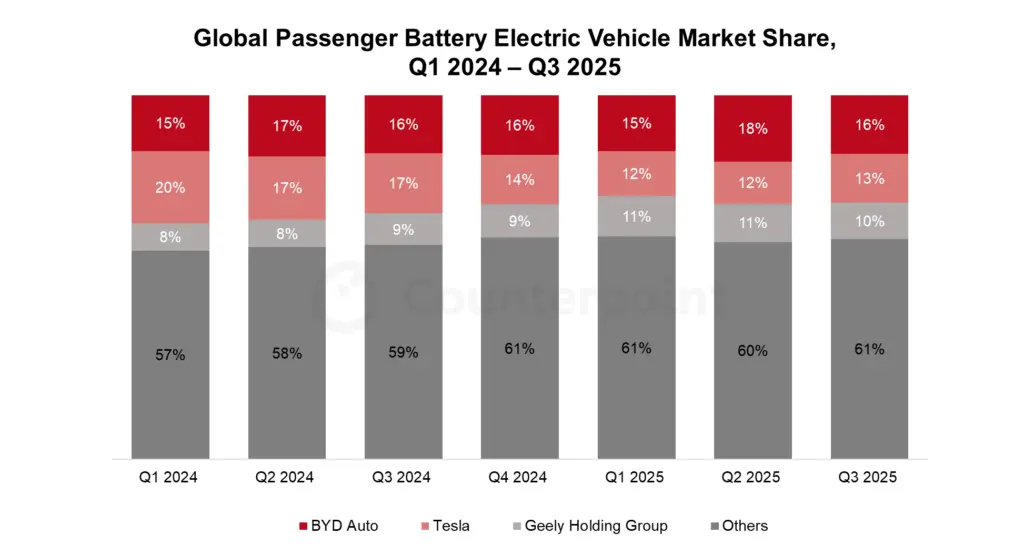
| Marken | Q1 2024 | Q2 2024 | Q3 2024 | Q4 2024 | Q1 2025 | Q2 2025 | Q3 2025 |
| BYD Auto | 15% | 17% | 16% | 16% | 15% | 18% | 16% |
| Tesla | 20% | 17% | 17% | 14% | 12% | 12% | 13% |
| Geely Holdings | 8% | 8% | 9% | 9% | 11% | 11% | 10% |
| Sonstige | 57% | 58% | 59% | 61% | 61% | 60% | 61% |
Markthighlights
Zentrale Erkenntnisse:
- Die weltweiten EV-Verkäufe verzeichneten im dritten Quartal 2025 ein starkes Wachstum und stiegen um 32 % im Jahresvergleich (YoY).
- Batterieelektrische Fahrzeuge (BEVs) behaupteten weiterhin ihre dominierende Rolle und machten rund zwei Drittel der gesamten EV-Verkäufe aus. Das BEV-Absatzvolumen stieg um 32 % gegenüber dem Vorjahreszeitraum. Plug-in-Hybridfahrzeuge (PHEVs) trugen ebenfalls moderat zum Wachstum bei und legten um 6 % YoY zu.
- Die BEV-Durchdringung erreichte im Quartal einen neuen Meilenstein und machte 18 % der weltweiten Pkw-Verkäufe aus, gegenüber 14 % im gleichen Zeitraum des Vorjahres.
- China blieb der wichtigste Wachstumsmotor und trug 60 % der weltweiten BEV-Verkäufe bei, gefolgt von Europa und den USA.
- Auf Modellebene gingen Tesla Model Y, Galaxy Xingyuan und Tesla Model 3 als die weltweit meistverkauften Elektrofahrzeuge des Quartals hervor.
Top 3 BEV-Akteure
- BYD Auto
Die BYD Auto Group behauptete ihre unangefochtene Führungsposition im globalen BEV-Markt mit knapp 0,6 Millionen verkauften BEVs, was einem Wachstum von 33 % im Jahresvergleich (YoY) im dritten Quartal 2025 entspricht. Das Unternehmen verzeichnete eine starke Nachfrage in Überseemärkten wie Europa, Südostasien und Lateinamerika und exportierte mehr als 0,15 Millionen Fahrzeuge, wobei 27 % der gesamten BEV-Verkäufe außerhalb Chinas erzielt wurden. BYDs Stärke liegt in einem breit diversifizierten Portfolio, das sowohl BEVs als auch PHEVs umfasst, insbesondere in den Segmenten kompakte SUVs und Limousinen, unterstützt durch wettbewerbsfähige Preise und Skaleneffekte. Die BYD Seagull, Dolphin und Yuan UP waren die meistverkauften Modelle des Unternehmens im dritten Quartal 2025. - Geely Holding
Die Geely Holding Group belegte den dritten Platz im globalen BEV-Ranking mit einem weltweiten BEV-Marktanteil von 10 % und erzielte ein Wachstum von 51 % YoY im dritten Quartal 2025. Der Konzern profitierte von einer starken Dynamik der Marken Galaxy und Zeekr in Chinas preisgünstigem und mittlerem EV-Segment. Die Strategie, erschwingliche Preise mit fortschrittlichen Softwarefunktionen zu kombinieren, findet weiterhin großen Anklang bei inländischen Käufern und ermöglicht es Geely, in einem zunehmend wettbewerbsintensiven Markt kontinuierlich Marktanteile auszubauen. Innerhalb des Konzerns entfiel mehr als die Hälfte der gesamten BEV-Verkäufe auf die Marke Galaxy. Zu den meistverkauften Modellen zählten der Galaxy Xingyuan, Galaxy E5 und Geometry Panda Mini EV.
- Tesla
Tesla belegte weltweit den zweiten Platz mit einem Marktanteil von über 13 %, wobei die Verkäufe im dritten Quartal 2025 um 7 % YoY stiegen. Das Wachstum wurde vor allem durch die überarbeitete Version des Model Y, die auf starke Nachfrage stieß, sowie durch die Einführung der Langversion des Model Y in China getragen. Darüber hinaus erhielten die Verkäufe in den USA zusätzlichen Auftrieb, da Verbraucher noch vor dem Auslaufen der staatlichen EV-Steuergutschriften im Oktober 2025 von der letzten Förderphase profitieren wollten.
Die Daten auf dieser Seite werden vierteljährlich aktualisiert.
Der hier verwendete Begriff „Verkäufe“ bezieht sich auf Großhandelszahlen, d. h. auf Auslieferungen ab Werk durch die jeweiligen Marken.
Im Bereich der Elektrofahrzeuge (EVs) werden in dieser Analyse ausschließlich batterieelektrische Fahrzeuge (BEVs) berücksichtigt. Plug-in-Hybride (PHEVs), Hybridfahrzeuge (HEVs) sowie Brennstoffzellenfahrzeuge (FCVs) sind nicht Bestandteil dieser Studie.
Für detaillierte Einblicke in die Daten kontaktieren Sie uns bitte unter [email protected].
Medienvertreter wenden sich bei Presseanfragen bitte an [email protected].
| Für einen detaillierteren Absatz-Tracker für Elektrofahrzeugmodelle klicken Sie bitte unten:
Globaler Absatz-Tracker für elektrische Pkw-Modelle, Q3 2025 Dieser Bericht erfasst die globalen Verkaufszahlen von elektrischen Pkw nach Marke und Modell in 23 Regionen auf quartalsweiser Basis (China, USA, Deutschland, Großbritannien, Frankreich, Spanien, Japan, Indien, Italien, Südkorea, Thailand, Indonesien, Vietnam, Brasilien, Argentinien, Russland, Malaysia, Philippinen, Singapur, ROE, Lateinamerika, Naher Osten und Afrika sowie Ozeanien). Der Bericht hilft dabei, regionale Markttrends, Markendynamiken und den Durchdringungsgrad verschiedener EV-Typen besser zu verstehen. Mehr erfahren | Kontaktieren Sie uns |


