

- As broadband speeds rise, in-home Wi-Fi is becoming a bigger part of the overall broadband experience.
- Operators should use a tiered approach: Wi-Fi 6 mesh for packages under 500Mbps, Wi-Fi 7 mesh for packages between 500Mbps and 1Gbps and Wi-Fi 7 FTTR for premium multi-gigabit subscribers at 1Gbps and above.
- Wi-Fi 7 strengthens the premium mesh proposition with higher capacity, 6 GHz and MLO improving backhaul and end-device connectivity.
- Monetizing whole-home connectivity as a managed service is the larger opportunity. Operators should use monthly add-ons and bundled packages to generate recurring revenue. Global operators are already seeing success with this strategy.
- Operators can use network visibility, diagnostics and proactive management to identify and target the right customers for mesh Wi-Fi and FTTR.
Broadband operators globally have invested considerable capital into their fiber networks in an effort to deliver faster speeds to their customers. While operators are now able to deliver gigabit or multi-gigabit speeds to the home, consumers are evaluating their broadband experience based on connectivity at the end device. This makes the quality of the in-home Wi-Fi experience a critical metric for operators to monitor and improve.
Consumers already responded to poor in-home Wi-Fi experience during the COVID-19 pandemic and associated lockdowns. Many turned to retail channels, purchasing mesh Wi-Fi units, in an effort to improve coverage and experience. This highlighted the potential of the home network, with companion apps enabling advanced features such as parental controls, security features and network health monitoring. Operators have since improved their own solutions, delivering their own companion apps with equivalent features; however, bundling of mesh Wi-Fi has lagged in many markets, with mesh access points often included in only premium broadband packages.
This represents both a challenge and an opportunity for broadband operators. If customers deploy third-party mesh Wi-Fi systems, operators will lose control and visibility over the home network experience, while remaining responsible for the broadband experience in the eyes of the customer. Operators can offer mesh Wi-Fi and fiber-to-the-room (FTTR) more widely across their broadband propositions, improving customer experience, reducing churn and enabling new revenue opportunities.
While operators must own the home network, there is no single solution suitable for every subscriber. A basic 100Mbps package has very different requirements and economics than a multi-gigabit FTTH service. Operators will therefore need a tiered strategy with Wi-Fi 6 mesh providing affordable whole-home coverage in entry-level packages under 500Mbps, Wi-Fi 7 mesh delivering higher performance in higher speed packages from 500Mbps to 1Gbps and Wi-Fi 7 FTTR enabling premium gigabit and multi-gigabit experiences in broadband packages at 1Gbps and above to the end device throughout the home.
Wi-Fi 7 Strengthens the Case for Premium Mesh
Wi-Fi 6 mesh systems will remain an important technology in the home networking portfolios of operators. This will be the standard approach where the primary objective is to improve home Wi-Fi coverage at modest broadband speeds. However, as operators migrate customers to gigabit and multi-gigabit packages, the performance requirements of the home network will increase. At this point, improving coverage alone is no longer sufficient and operators will need to ensure that higher broadband speeds are delivered consistently across multiple rooms and devices.
Wi-Fi 7 enables operators to address the growing performance requirements in the home. Higher-capacity tri-band architectures and the use of the 6 GHz band can improve performance between mesh nodes. A tri-band Wi-Fi 7 implementation uses 2.4 GHz, 5 GHz and 6 GHz bands, with 6 GHz particularly useful for mesh backhaul. 6 GHz mesh backhaul is capable of supporting broadband speeds of 1Gbps. In an FTTR scenario, Wi-Fi 7 can go further and support multi-gigabit connectivity to the end device. Utilizing Multi-Link Operation (MLO) can improve wireless backhaul and end device performance, enabling premium home network experiences. Overall, Wi-Fi 7 can deliver higher, more consistent speeds, reduce latency and improve coverage compared to Wi-Fi 6 mesh solutions, making it an ideal solution for premium home Wi-Fi.
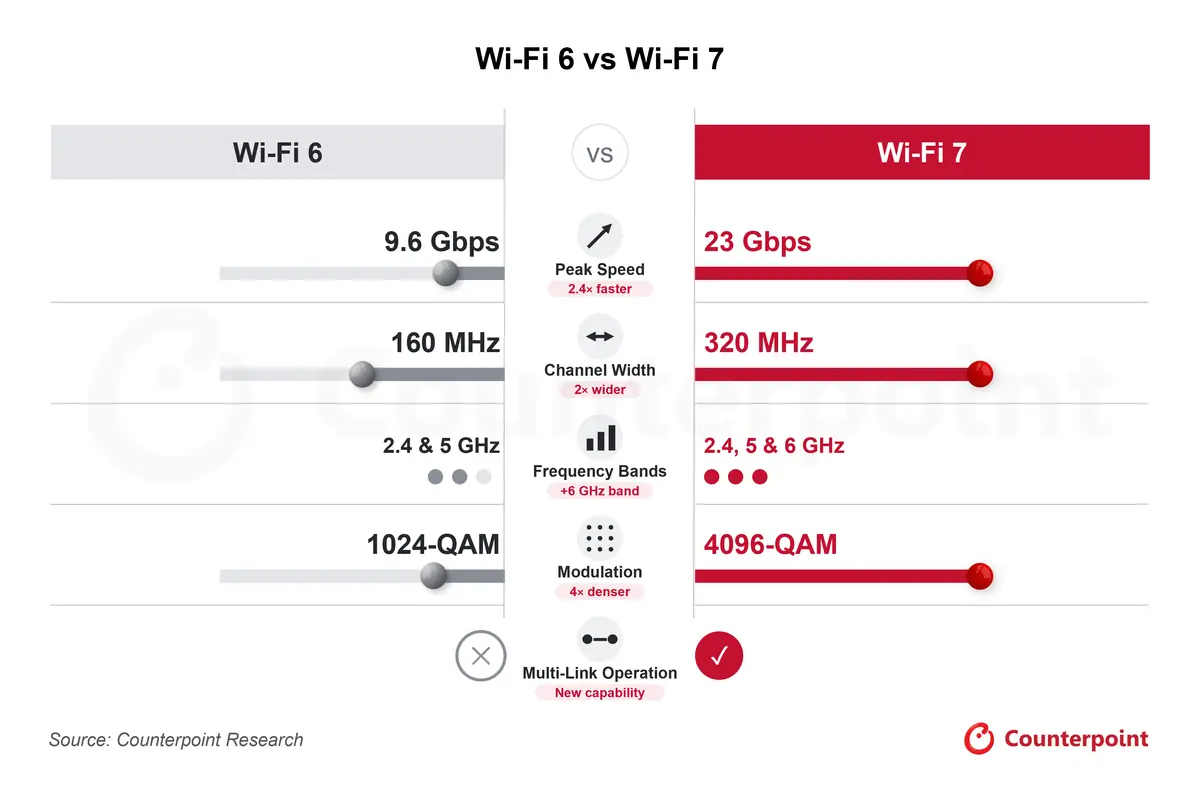
Operators have increasingly deployed Wi-Fi 7 solutions across their portfolios, with a clear trend demonstrating the ongoing transition from Wi-Fi 6 to Wi-Fi 7. End device support for Wi-Fi 7 continues to grow, with Wi-Fi 7 share of new shipments of smartphones, laptops and tablets increasing. 35% of smartphones, 30% of laptops and 13% of tablets shipped in the first half of 2026 supported Wi-Fi 7. Wi-Fi 7 is no longer only relevant in a small number of flagship devices and is becoming mainstream. As Wi-Fi 7 in end devices continues to grow, the limiting point becomes legacy access points, increasing the importance of access points that support the latest standard.
