The year 2020 saw growing adoption of 5G devices throughout the United States, driven in part by the launch of the first 5G enabled iPhone in the fourth quarter. While this flagship helped push 5G further into the mainstream for consumers, there was also considerable movement towards 5G in the low-to-mid price segment in the second half of 2021. With expanding 5G coverage and OEMs looking to meet demand at different price points, 2021 may well see a $200 5G device.
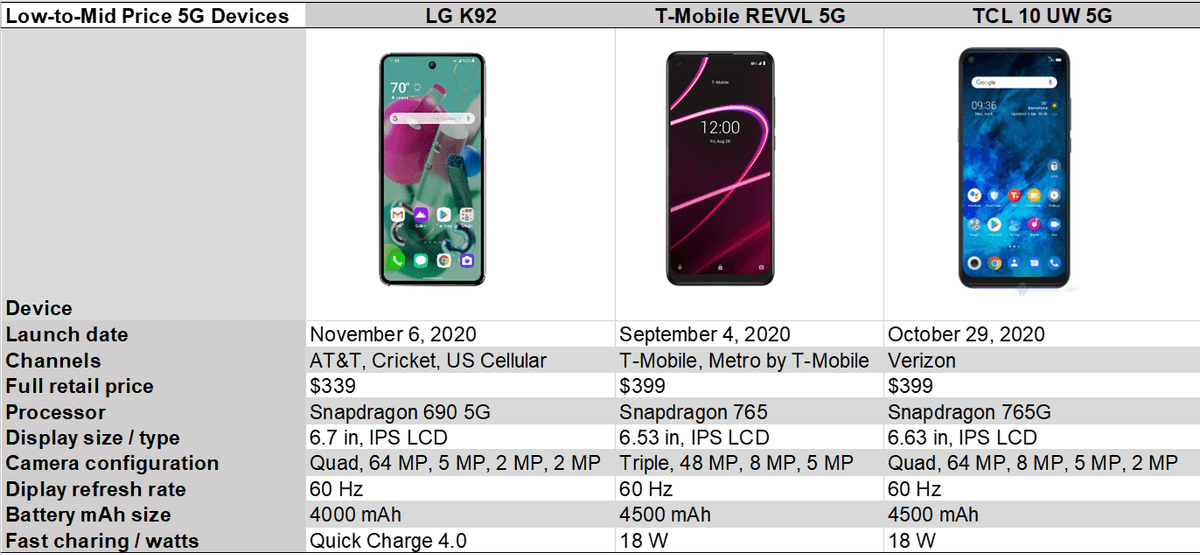
In the first half of 2020, there were no carrier compatible 5G smartphones with retail prices below $400, but the release of T-Mobile’s REVVL 5G, the LG K92 and TCL 10 5G changed that. Additionally, releases like Google’s Pixel 4a 5G, Motorola’s One 5G and Samsung’s Galaxy A51 5G were all on promotion at points during Q4, bringing their prices below $400 and adding competition to a 5G price segment that did not exist just months before. By all indications, competition among 5G devices in this price band will become even more fierce in 2021.
What to Expect in 2021
So far this year, OnePlus has introduced the Nord N10 5G to the US market at $300, Motorola has released the One 5G Ace at $399 and ZTE has unveiled the Blade X1 5G at $384. With a growing array of devices for consumers to choose from, OEMs are packing their 5G devices in this range with improved specs and differentiating features. For example, the Motorola One 5G Ace comes with a 5,000mAh battery that is marketed as lasting up to two days on a single charge. The OnePlus Nord N10 5G features 30W fast charging and 90Hz refresh rate. With battery life being one of the most common pain points for consumers, features like a 5000 mAh battery and 30 W fast charging should help OEMs attract customers. As the price band becomes more crowded in 2021, consumers can expect competition to push OEMs to include even more impressive specs. Improved cameras, higher refresh rates, more RAM and more powerful processors will be on the radar.
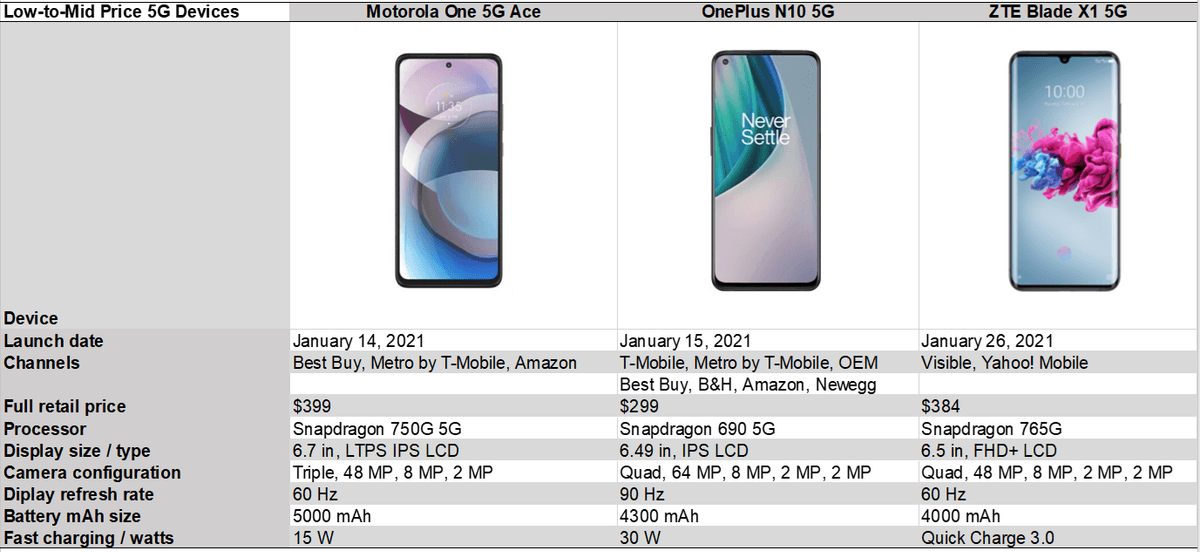
Consumers can also expect even more competitive pricing. As 5G coverage expands, more people will want access at all price points, driving OEMs to produce even lower cost 5G phones. These devices will likely have to cut corners on specs to hit this price point but will bring 5G to an even larger segment of the population. Given that most of the devices mentioned above feature 6GB of RAM, a 4000mAh or higher capacity battery and a 6” or larger display, there is certainly some room to cut costs. When we consider that the OnePlus Nord N10 5G has all these features, plus a 90Hz refresh rate, and costs $300, we should expect to see a $200 5G device, and potentially a sub-$200 device, in 2021.
Consumers will have broader access to 5G networks from carriers and a more diverse array of 5G price points to choose from in 2021. According to our monthly channel share tracker, 65% of devices sold in December were 5G capable. This number should surpass 80% in 2021 with the further introduction of 5G devices in new price bands. But sales of popular non-5G devices like older iPhones and the lower market share of individual low-cost devices will create a ceiling, as could the current chip shortage. While most users will only have access to sub-6GHz bands on low-to-mid price devices in 2021, this may change at the upper bounds of this range as mmWave is deployed in more cities and users expect more from their device. With competition driving more impressive specs and the expansion of 5G coverage driving 5G devices into new price points, consumers will be the winners in 2021.


