- Global sub-$200 smartphone shipments are forecast to fall by approximately 40% between 2025 and 2030.
- The overall smartphone market is expected to return close to its 2025 volume by 2030, but the affordable segment will remain structurally smaller.
- Entry-tier smartphones will experience the sharpest contraction as higher component costs and minimum specifications reduce the viability of the lowest-priced devices.
- Higher price tiers will absorb part of the displaced volume, but affordability pressure could also extend replacement cycles, increase used and refurbished substitution, and slow smartphone and mobile internet adoption in lower-income markets.
- OEM fortunes to be determined by portfolio breadth, with entry-tier specialists facing greater pressure and vendors with convincing premium portfolios better positioned to capture market value.
Beijing, Berlin, Buenos Aires, Hong Kong, London, Los Angeles, New Delhi, Seoul, Taipei, Tokyo – September 23, 2026
More than 230 million annual sub-$200 smartphone shipments are forecast to disappear from the global market between 2025 and 2030, according to Counterpoint Research’s latest Smartphone Shipment Forecast by Price Band tracker. The segment is expected to decline by approximately 40% over the period, even as the overall smartphone market recovers toward its 2025 volume by the end of the decade.
The divergence reflects the structural shock from the 2026–2027 downturn. Higher memory and chipset costs, increasing minimum specifications and reduced OEM willingness to support non-strategic market presence will sharply reduce entry-tier availability. Some consumers will move upward, while others may keep their current devices for longer. Used phones will also absorb some demand, while first-time smartphone adoption risks slowing in markets where handset affordability is already a major barrier to mobile internet use.
Principal Analyst Yang Wang commented, “The smartphone market will recover in unit terms, but the affordable segment will not return to its previous standing. The opportunity now shifts toward better-specced mainstream devices and premium products, although higher tiers cannot absorb all the lost volume. The result will be a market that is similar in overall size but materially different in value and competitive profile. There is also a wider connectivity risk, as the loss of affordable new smartphones could make it harder for first-time users in lower-income markets to come online.”
Global Smartphone Market Recovers, But Sub-$200 Volume Does Not
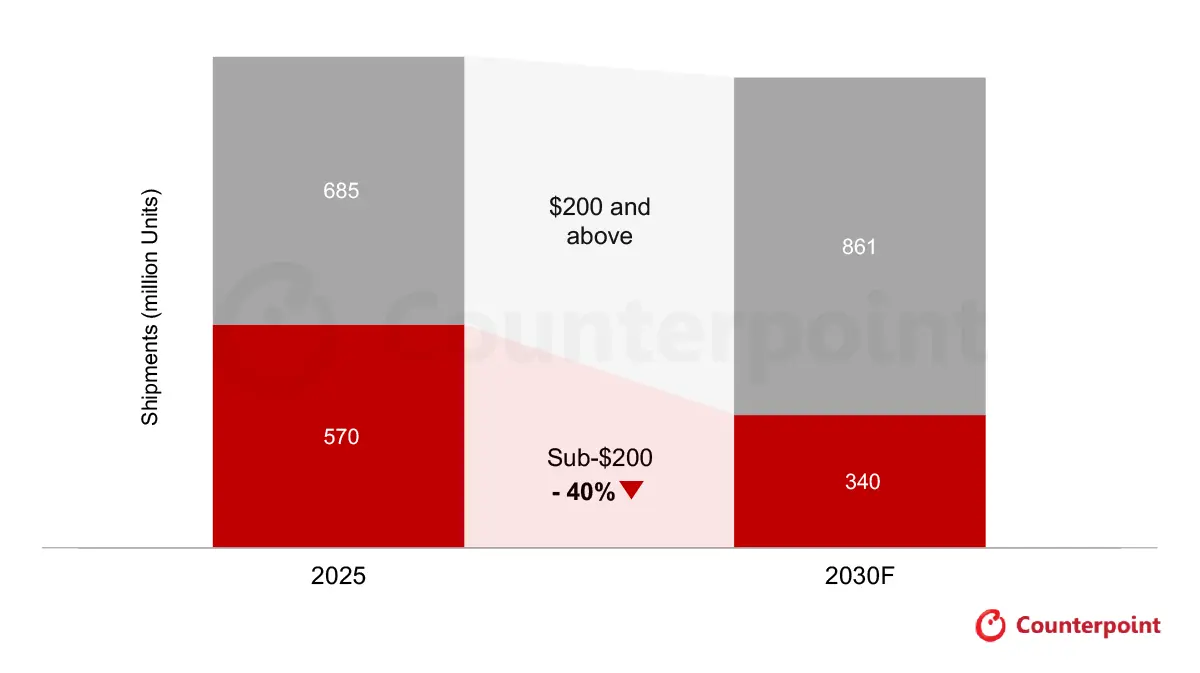
Source: Counterpoint Research Smartphone Shipment Forecast by Priceband, September 2026
Affordable market contraction outlasts the downturn
Global smartphone shipments are forecast to recover to approximately 1.20 billion units in 2030, only modestly below the level recorded in 2025. However, sub-$200 shipments are expected to remain approximately 40% lower, while shipments priced at $200 and above grow by approximately 26%. The entry tier will account for the largest part of the contraction because component costs represent a greater proportion of the bill of materials and manufacturers have less room to absorb increases.
Growth trajectories will diverge sharply through 2030. Premium smartphone shipments are forecast to grow at approximately 7% CAGR, while the high and mid tiers remain broadly flat. The flat mid-range is particularly significant. If the reduction in affordable smartphones reflected straightforward consumer trading up, the nearest tiers would be expected to expand strongly. Instead, the forecast points to a combination of upward migration, delayed replacement and lost new-device demand. As a result, higher tiers will not absorb all the volume disappearing below $200.
The implications extend beyond smartphone shipments. In low- and middle-income countries, handset affordability remains a leading barrier to mobile internet adoption, and the impact is greatest among lower-income consumers. The contraction of the sub-$200 market could therefore slow the transition from feature phones and shared devices to personally owned smartphones, widening the challenge for operators, governments and the wider mobile ecosystem seeking to expand meaningful connectivity, content and value-added services.
Addressing this risk will require a broader affordability response, including device financing, trade-in and circular-device programmes, targeted subsidies, tax reform and continued industry efforts to protect the availability of commercially sustainable entry-level devices.
Smartphone Shipment CAGR by Price Band (2021-2030)
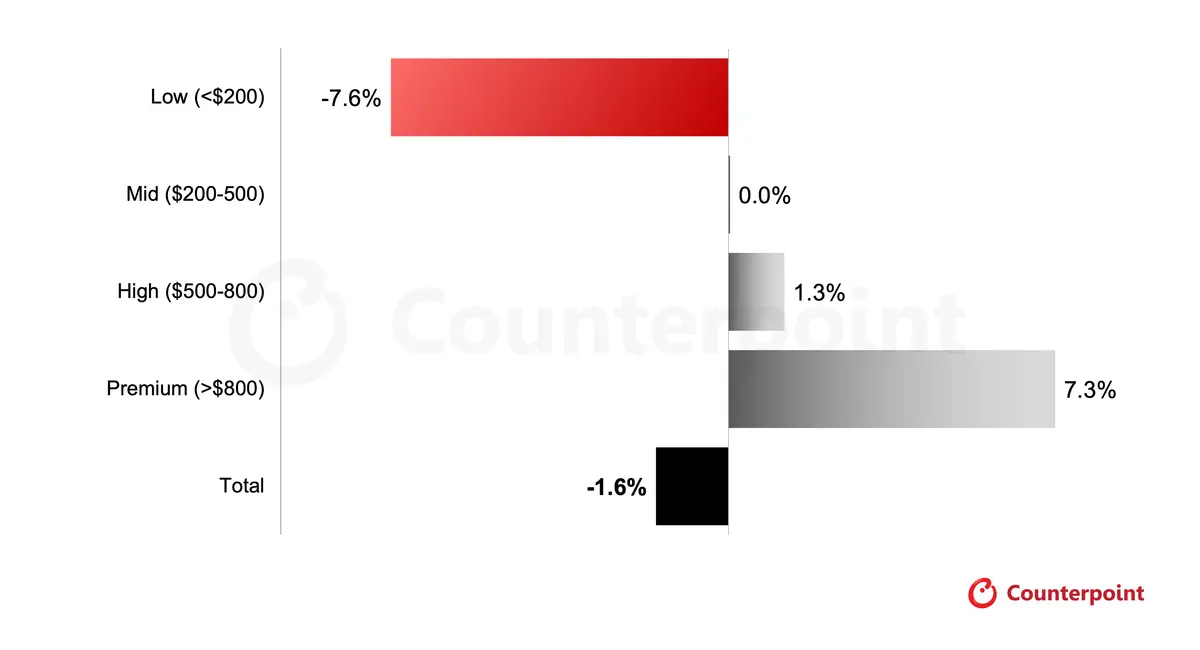
Source: Counterpoint Research Smartphone Shipment Forecast by Price Band, September 2026
Mid-range becomes the industry’s new battleground
Despite remaining broadly flat in volume, the mid-range should become more important strategically as OEMs concentrate product launches, marketing investment and channel resources on better specced mass market products. Devices in this segment will increasingly combine higher memory and storage, 5G connectivity, better cameras, longer software support and selected on-device AI features at prices accessible to a broad consumer base.
This will make the mid-range more important to both volume and profitability. Differentiation will increasingly come from areas such as design, imaging, battery life and durability, rather than specifications alone. As premium technologies move into lower price bands, OEMs should have more scope to deliver visible upgrades without requiring consumers to move directly into flagship price points. Competition should also intensify as more brands concentrate launches, marketing investment and channel resources in the same mainstream tiers. With a broadly stable pool of demand, gaining share will be difficult and could put pressure on margins.
Premium drives revenue growth
Premium smartphones are expected to take a growing share of shipments and an even larger share of market value through the end of the decade, providing the industry’s strongest opportunity for revenue growth and continued product innovation. Demand will remain supported by affluent user bases, financing, trade-ins and ecosystem loyalty, while foldables, advanced imaging, higher storage configurations, innovative design and more capable on-device AI provide new ways to raise ASP.
The benefits should remain concentrated among vendors with established brands, strong ecosystems and sustained channel investment. Apple should remain the largest contributor to premium smartphone market value. Samsung is positioned to benefit across both mainstream and premium segments, given its portfolio, scale and willingness to maintain lower margin products in order to secure market coverage. Huawei is expected to make the largest Chinese OEM contribution to higher-tier expansion, supported by flagships, foldables and its recovery in China. Other major Chinese OEMs also have selective opportunities to improve mix, although their ability to build premium volume will vary by region and channel.
Recovery will produce a higher value market
A stronger shipment recovery is forecast from 2028 as component availability improves, retail pricing stabilizes and purchases postponed during 2026 and 2027 are realized. However, the market that emerges from the downturn should be structurally different. The mid-range should represent a larger share of mainstream demand, while premium devices take a larger share of industry value.
Foldables and on-device AI should strengthen product differentiation and provide OEMs with new ways to increase revenue, although neither is expected to create a broad shipment supercycle independently. Toward the end of the decade, the wider commercialization of 6G-capable devices should support an incremental upgrade cycle and accelerate the movement of advanced capabilities across premium and mid-range products. However, maintaining an accessible path into smartphone ownership will remain equally important if advances in networks, devices and AI are to reach a broader share of the global population.
About Counterpoint Research
Counterpoint Research is a global market research firm specializing in products across the technology ecosystem. We advise a diverse range of clients – from smartphone OEMs to chipmakers and channel players to Big Tech – through our offices located in the world's major innovation hubs, manufacturing clusters and commercial centers. Our analyst team, led by seasoned experts, engages with stakeholders across the enterprise – from the C-suite to professionals in strategy, analyst relations (AR), market intelligence (MI), business intelligence (BI), product and marketing – to deliver services spanning market data, industry thought leadership and consulting. Our core areas of coverage include AI, Automotive, Consumer Electronics, Displays, eSIM, IoT, Location Platforms, Macroeconomics, Manufacturing, Networks and Infrastructure, Semiconductors, Smartphones and Wearables. Visit our Insights page to explore our publicly available market data, insights and thought leadership, and to understand our focus, meet our analysts and start a conversation.
Follow Counterpoint Research


