• China’s smartphone shipments declined 10% YoY in Q3 2026, hitting a 14-year low amid continued memory price hikes.
• Huawei and Apple captured 40% of shipments, widening their lead over rivals and suggesting that a strong premium presence is a market share advantage during the memory crisis.
• Huawei maintained its market leadership in Q3, supported by a relatively stable pricing strategy. However, price hikes since September are expected to weigh on Q4 sales.
• The iPhone 18 Pro series saw a strong early launch in China, supported by the delayed base model launch and a narrowing price gap with premium Android devices, which enhanced its competitive appeal.
• With both Apple and Huawei joining the price hike, rising memory costs are becoming increasingly difficult for OEMs to absorb internally, putting further pressure on consumer demand.
Beijing, Berlin, Buenos Aires, Fort Collins, Hong Kong, London, New Delhi, Seoul, Taipei, Tokyo – Oct 19, 2026
China’s smartphone shipments fell 10% YoY in Q3 2026, marking the lowest Q3 level since 2012, according to preliminary data from Counterpoint Research’s Market Monitor Tracker. The market decline was broadly in line with Counterpoint's expectations, as continued memory price hikes significantly increased BoM costs and exacerbated supply shortages, leading to a much steeper decline in the second half of the year.
China Smartphone Q3 Sell-in Shipment Share Top 6 Brands (Preliminary Data)
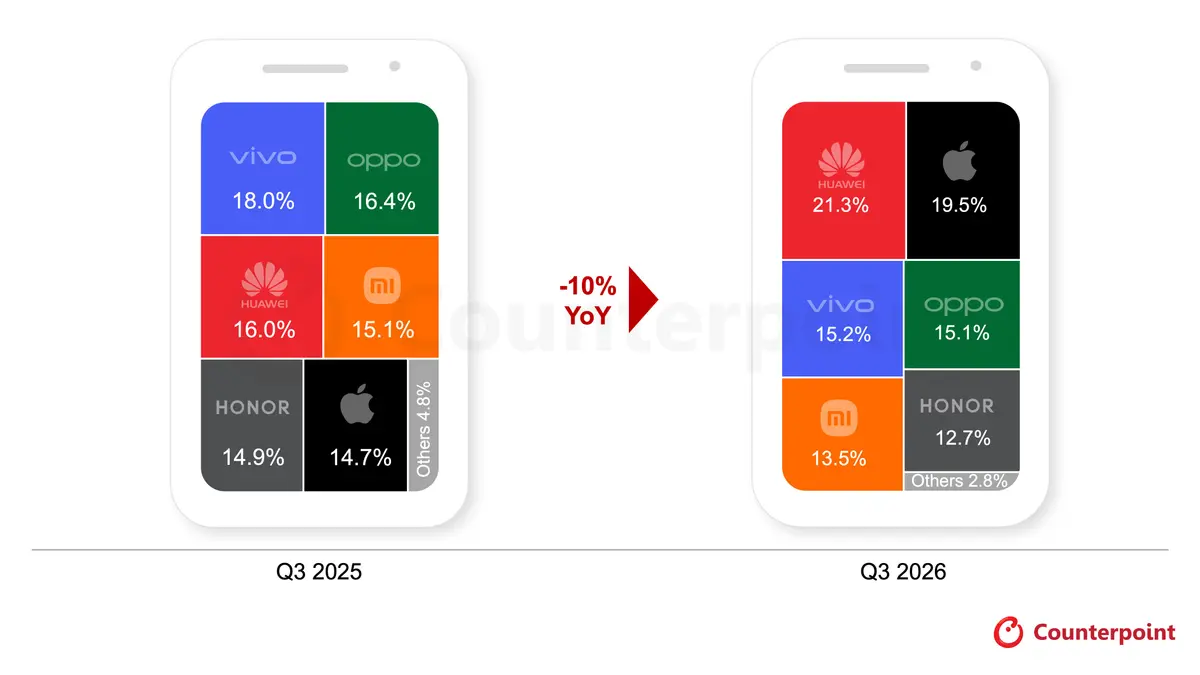
Source: Counterpoint Research’s preliminary Market Monitor report (based on sell-in)
Notes: OPPO includes OnePlus and realme. Percentage totals may not add up to 100% due to rounding.
Huawei led the China smartphone market in Q3 2026 with a 21.3% market share. Supported by pricing stability in the earlier part of the quarter, Huawei delivered solid performance across its portfolio. Strong sales of the entry-level Enjoy 90 Pro Max, mid-range Nova 16 and flagship Mate 80 helped the brand achieve 19% YoY shipment growth in Q3. However, Huawei officially raised prices from September 1, potentially putting further pressure on sales going forward.
Apple ranked second with a 19.5% market share in Q3. The iPhone 18 Pro series saw a strong launch in China, with sales in the first three weeks up 23.5% YoY compared with the iPhone 17 Pro series. The delayed launch of the base iPhone 18 may have encouraged some consumers to trade up to the Pro models, supporting their early sales momentum.
September saw a wave of flagship launches, with most models going on sale before National Day to capture peak holiday demand. Chinese Android OEMs have adopted different product strategies: Xiaomi delayed the base Mi 18, while vivo, OPPO and HONOR added Pro Max models to their flagship lineups. At the same time, OPPO and HONOR introduced more affordable variants positioned slightly below their base models, such as the Find X10E and Magic9 Super. By offering a wider range of price points, OEMs can better manage consumers’ price perceptions and absorb higher component costs while limiting starting price increases. This allows them to sustain ASP growth while minimizing the potential impact of price hikes on sales.
With both Huawei and Apple now raising prices, the extent of cost inflation suggests that OEMs are increasingly unable to fully absorb the higher component costs. As price increases become more widespread, consumers are responding by delaying upgrades, waiting for major promotional periods to purchase, or turning to the refurbished market for more affordable options. These behaviors could further weaken smartphone demand and put additional pressure on Q4 sales.
About Counterpoint Research
Counterpoint Research is a global market research firm specializing in products across the technology ecosystem. We advise a diverse range of clients – from smartphone OEMs to chipmakers and channel players to Big Tech – through our offices located in the world's major innovation hubs, manufacturing clusters and commercial centers. Our analyst team, led by seasoned experts, engages with stakeholders across the enterprise – from the C-suite to professionals in strategy, analyst relations (AR), market intelligence (MI), business intelligence (BI), product and marketing – to deliver services spanning market data, industry thought leadership and consulting. Our core areas of coverage include AI, Automotive, Consumer Electronics, Displays, eSIM, IoT, Location Platforms, Macroeconomics, Manufacturing, Networks and Infrastructure, Semiconductors, Smartphones and Wearables. Visit our Insights page to explore our publicly available market data, insights and thought leadership, and to understand our focus, meet our analysts and start a conversation.

