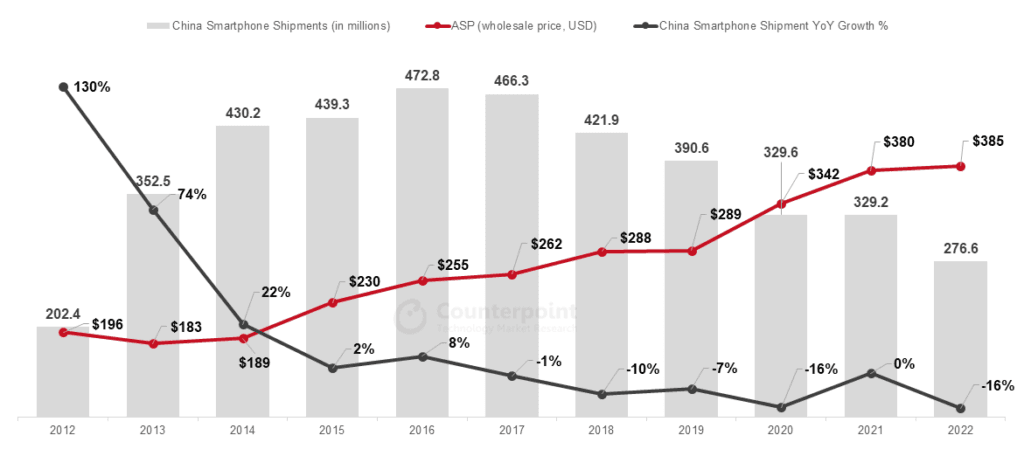
- China’s smartphone average selling price (wholesale) has continuously increased since 2014, reaching $385 in 2022.
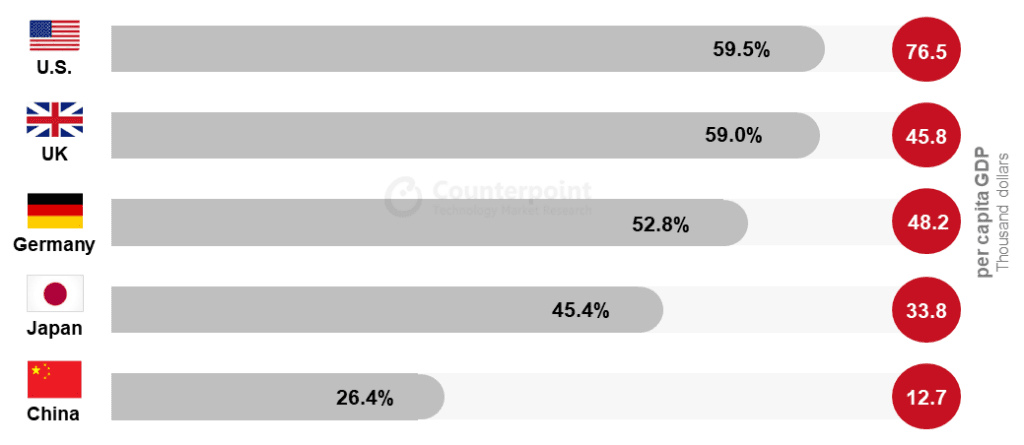
- The share of high-end smartphones (≥$500 wholesale price) in China’s smartphone market increased to more than 26% in 2022. Though the figure still lagged behind that in developed countries, Chinese consumers’ appetite for premium smartphones will continue to grow.
- Chinese smartphone OEMs are committed to bringing consumers a better experience. Smartphones have also been improving and changing in terms of features like form factor, computing performance, display and imaging.
- Counterpoint expects that the share of the ≥$500 segment will reach 40% by 2035.
China’s smartphone shipments fell 16% YoY in 2022 to less than 280 million units, the lowest in nearly a decade, according to Counterpoint Research’s data. But still, the Chinese market made up 22.6% of global shipments, much higher than second-placed India's 12.4%.
Benefitting from the popularity of mobile broadband networks, the booming mobile internet content and application ecosystem, and fast economic growth, China’s smartphone market entered the 2010s with fast growth in shipments and revenues and reached its peak in 2016 with more than 470 million units in shipments. This was also the period when vivo, OPPO, Huawei and Xiaomi developed into major homegrown smartphone OEMs.
However, after the boom ended, smartphone shipments started to decline every year. The market also embraced more intense competition and OEMs increased their focus on product differentiation. Over the past three years, both supply and demand in the market have been further hit by the COVID-19 pandemic.
More and more people have now started questioning the potential of China’s smartphone market. However, we think the market downturn has been exaggerated due to COVID-19, which impacted consumer sentiment and behavior. With China dropping pandemic-related curbs and announcing a 5% GDP growth target for 2023, the economy and consumer confidence should gradually recover. China's smartphone market is expected to see its first positive growth in 2023 after 2016.
China Smartphone Shipments and Average Selling Price (Wholesale), 2012-2022
 Source: Counterpoint Market Monitor Service
China’s smartphone sales revenue in 2022 only fell 11.7% from 2016, though the shipments were down 41.5% in the same period. China’s smartphone ASP has been increasing every year since 2014.
4G and 5G technologies and continuously improving core elements such as processors, imaging and displays have increased the manufacturing cost of smartphones. Major OEMs have also started seeking quality and sustainable development in the face of increasing competition. They are focusing more and more on product innovation and differentiation and investing in long-term technological competitiveness, such as operating systems, AI algorithms, computational photography and self-designed chips. These initiatives are strengthening their R&D capabilities.
Chinese OEMs are also actively practicing social responsibility, such as developing customized features for the visually impaired, hearing impaired and other disadvantaged groups. More environment-friendly materials are being used in smartphone products to promote sustainable development and consumer awareness of environmental protection. These efforts will also help domestic brands grow in the mid-end and high-end markets while offering higher-quality products and services to customers.
The ≥$500 (nearly RMB 4,000 retail price) segment accounted for more than 26% of total sales in China in 2022, up from 11% in 2016 when the market recorded its highest shipments.
With over 1 billion smartphone users, China has become the second-largest high-end smartphone market in the world (nearly 70 million smartphones sold at above RMB 4,000 in 2022). However, compared with other leading high-end markets, China is still well behind in terms of both high-end segment share and individual incomes.
China’s government has announced that the disposable income of its citizens will increase to a new level in 2035, while the proportion of middle-income groups will also increase significantly. Regardless of whether China's GDP per capita will cross $20,000 (the conventional threshold for a developed country) in 2035, the ASP of smartphones, as well as the premium smartphone share, should continue to grow amid long-term economic growth and steady consumption upgrade..
Share of ≥$500 Segment in Major Regional Premium Markets and GDP Per Capita, 2022
 Source: Counterpoint Research
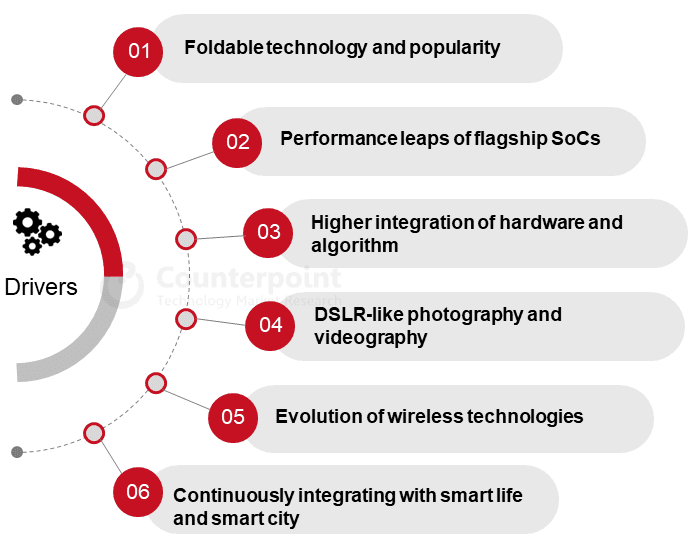
For a long time to come, the smartphone will remain the most important carrier for people’s entertainment, consumption and social interaction, with its lite productivity functions becoming ever stronger. The smartphone itself continues to improve. For example, the popularity of foldable-screen technology adds a new form factor and offers differentiated applications, content and user experience. A larger screen not only steps up the immersive experience for gaming and video but also becomes the optimal production tool for the mobile office with accessories such as stylus and mouse, and fast-developing productivity applications.
Premium Smartphones Will Continue to Improve
 Source: Counterpoint Research
Other key elements of the premium smartphone will also improve over time, including processor performance, AI computing power, imaging capability and mobile bandwidth.
First, the latest 3nm-based chipset will go into mass production in 2023. The next-generation 2nm technology is also under progress and TSMC plans to realize mass production in 2025. At the same time, chip design houses will develop higher-performance, higher-efficiency micro-architectures or even new instruction sets for processors. This should significantly improve the comprehensive performance of the flagship SoC platform. The computing power of premium smartphones is expected to approach that of PC.
Second, major Android smartphone brands can offer more differentiated features in their premium products with self-developed hardware and algorithm. Taking photography as an example, multi-lens fusion and computational photography have become mainstream. Also, the resolution of the main camera has reached 200 million, which undoubtedly puts forward higher requirements for related AI capabilities and algorithms. Counterpoint believes that OEMs with self-developed chips can better deal with the challenge.
Finally, wireless technology will continue to improve. With large bandwidth and lower latency, smartphones have become the center of content consumption and production. With the advent of computing networks, smartphones will become the super-entrance to cloud applications, cloud games, cloud enterprises and other cloud-based services. In addition, smartphones are becoming more closely integrated into the smart home, smart transportation and smart city. This also means that in the future, smartphones will become more indispensable for us.
In a word, Counterpoint is always long on the potential of China's premium smartphone market. In 2023, China’s smartphone shipments will recover to more than 280 million units. The high-end segment is expected to outperform the overall market, realizing a YoY growth of nearly 5%. By 2035, both smartphone ASP and premium smartphone share (≥$500) will be up another notch. Premium smartphones will make up nearly 40% of the total market.


