COVID-19, work from home and study from home have accelerated the demand for Wi-Fi products at an unprecedented rate. According to Counterpoint Research’s latest estimates, Broadcom shipped more than 1.2 billion Wi-Fi chipsets in 2021 for the smart device and gateway segments.
Broadcom has been one of the key players leveraging their strong position in providing Wi-Fi chipset solutions to capitalize on this surge in demand. The company has been at the forefront with its vision and roadmap to deliver advanced Wi-Fi experiences. Wi-Fi 6/6E has been the major growth driver for Broadcom across both consumer and enterprise segments. Since the launch of its Wi-Fi 6 portfolio, Broadcom has shipped more than a billion Wi-Fi 6/6E chipsets globally. Riding on this success, Broadcom recently announced its complete portfolio of the next-generation Wi-Fi 7 chipsets.
The new Wi-Fi 7 standard unlocks newer capabilities that provide users a richer experience when they connect, learn, game, and consume content. This standard boosts capacities and throughputs to multi-gigabit levels even in congested scenarios. Wi-Fi 7 more than doubles the bandwidth compared to the current generation of Wi-Fi 6 solutions by leveraging two or more available spectrum bands and advanced modulation and transmission techniques. This drives next-generation applications such as UHD video streaming, low-latency AR/VR, cloud gaming and higher capacity hotspots even in constrained environments not possible earlier.
Broadcom’s Latest Wi-Fi 7 Solutions Driven by Key Foundational Capabilities
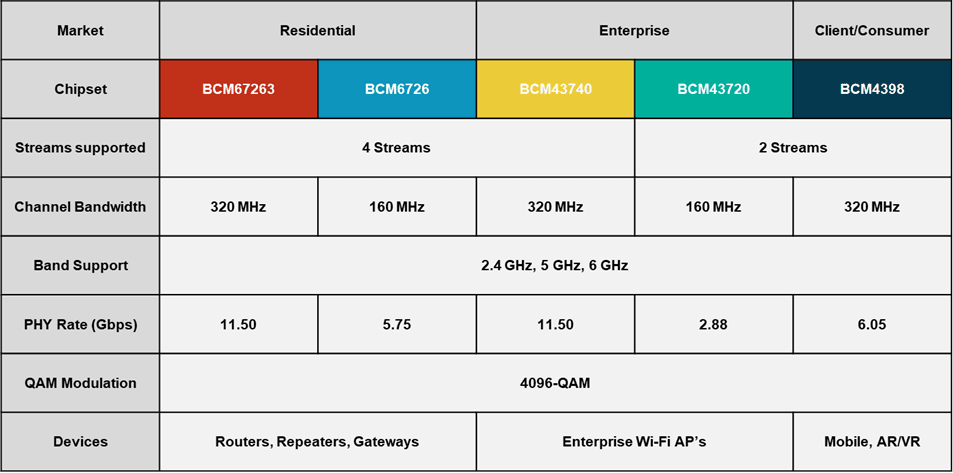
- 320 MHz channel: Wi-Fi 7 brings double the channel width compared to Wi-Fi 6/6E. Channel bandwidth determines the signal’s data rate. The higher the channel bandwidth, the faster the connection. On the 6 GHz Wi-Fi band, it can provide 3x320 MHz channels. 320 MHz effective channel can be created by combining two 160 MHz channels in the high bands. This, in turn, allows for improved user data speeds and capacity.
- 4K-QAM (Quadrature Amplitude Modulation): QAM transmits data through symbols containing a specific number of bits. It is an advanced modulation technique for digital telecommunication. The higher the number, the more data is carried in each cycle. The new 4096-QAM can transmit 12 bits per symbol as compared to 10 bits of 1024-QAM, which results in the peak PHY data rate increasing by 20%.
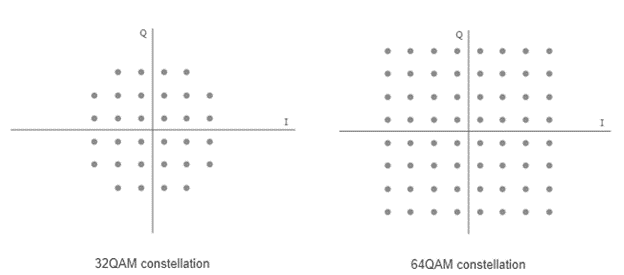
- Multi-Link Operation (MLO) allows two bands (5 GHz and 6 GHz) to be combined to form a single connection. This allows APs and base stations to have multiple radio interfaces to transmit and receive data. In situations where the wireless traffic is non-uniformly distributed across the channels, MLO aids in improving the network reliability and capacity under tough conditions, while ensuring continued availability of bandwidth and speed to mission-critical and consumer applications.
- Zero-Wait Dynamic Frequency Selection is a system that is designed to eliminate the wait time while connecting to another channel. Access points need to change their channel immediately when a radar signal is detected in the current DFS channel. When transferring to a fresh channel, the access point must hear to the medium for a minute before it is allowed to transmit a beacon to be certain that no radar is presently being operated on the same channel. This allows the transition to a newer channel with negligible interruption.
- Native Automated Frequency Coordination (AFC) is an open-source framework system for broadcasters that pertains to (6 GHz) indoor/outdoor applications. AFC improves the range and lowers the latency while transmitting at higher power. AFC in the background allows the device to validate with a registered database in real time, calculate the channel and spectrum availability, and allot the available frequency while the existing services are shielded and safe from interference. This helps improve Wi-Fi range and link speed. It automatically boosts coverage even in the 6-GHz transmit range for both indoor and outdoor environments and makes use of the best available spectrum.
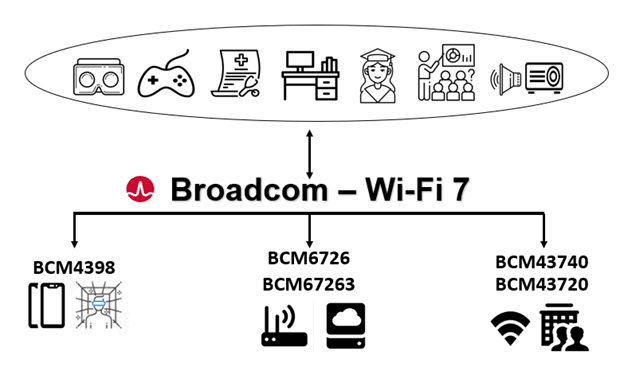
Applications and Use Cases
AR/VR and Gaming: Broadcom aims to drive immersive Metaverse (AR/VR) applications across home and enterprise with its Wi-Fi 7 portfolio. Higher throughputs and reliable connectivity are critical to power the immersive experiences in AR/VR, whereas lower latency is key for cloud gaming experiences where it is incredibly important for gamers to have a lag-free, responsive, and accuracy-driven gameplay.
Telemedicine: Doctors can monitor and collect data on patients with the help of sensors from the patient monitoring machines in real time to get instant insight and make quick decisions in these types of mission-critical situations. The high-throughput and low-latency promise can also power remote or robotic surgeries with higher precision and high-definition remote diagnosis or surgery assists.
Multi-room Video/Audio Distribution is another use case that enables users to connect to multiple devices and provides a seamless way to efficiently stream/share the latest 4K movies and stream high-resolution music to multiple devices throughout the home without the hassle of wires/cables hanging everywhere.
Similarly, there are multiple applications possible where high throughputs, low latency and high capacities are required.
Key Takeaways
- With the Wi-Fi 7 standard coming to the market, Wi-Fi connectivity will be the powerhouse for digital growth across various industries and applications.
- Main focuses on reliability and performance in congested networks are vital value propositions that Broadcom is trying to address with its new Wi-Fi portfolio.
- Latest services such as the Metaverse, cloud gaming, 4K/8K video streaming and enhanced mesh networking can use Wi-Fi 7 to its fullest potential. Smartphones and AR/VR will be the primary driving force for Wi-Fi 7 adoption.
- Low latency, high speeds and high reliability from Wi-Fi 7 can power the growing demands of the industrial, retail and enterprise segments.
- Broadcom’s chipsets which are being sampled right now will make their way into the products in the second half of 2022.
- Key Broadcom customers which should adopt Wi-Fi 7 solutions starting this year include Apple, Hewlett-Packard, Motorola, IBM, Linksys, Tenda, Cisco, and others.
However, the competition remains strong as Qualcomm continues to expand its Wi-Fi 7 portfolio across multiple devices and infrastructure which will drive Wi-Fi 7 adoption faster than we have seen for previous generations.


