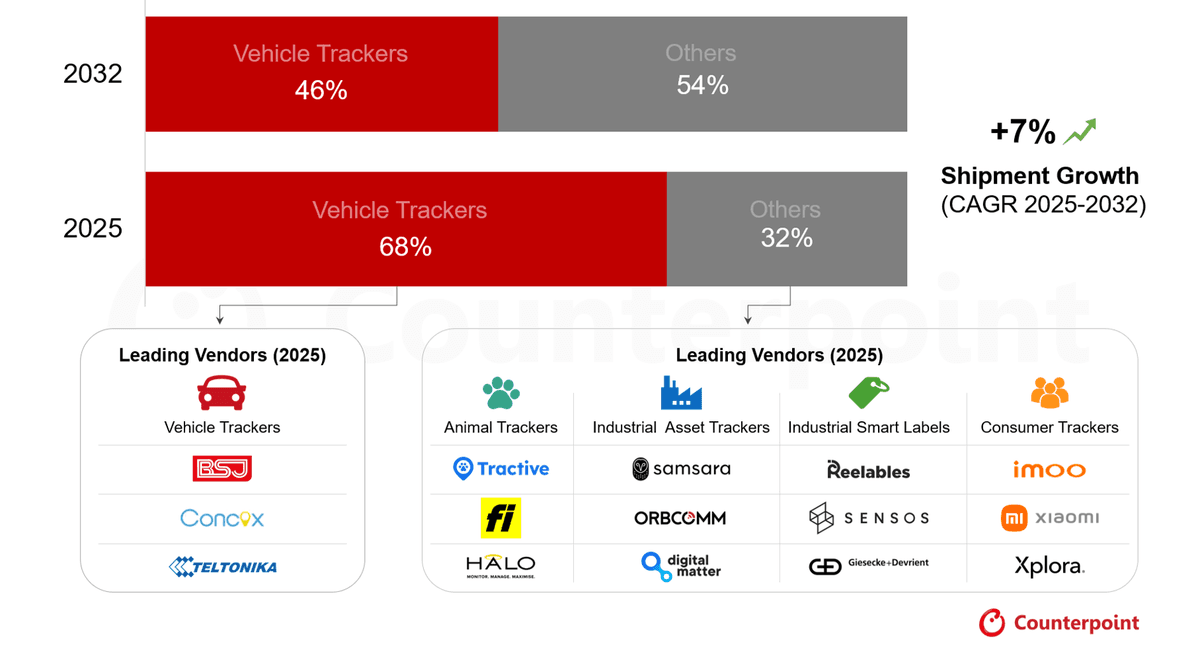
- Global asset tracking device shipments are projected to grow at a 7% CAGR from 2025 to 2032, with most of the growth during the period being contributed by applications outside traditional vehicle tracking.
- Vehicle tracker remains the largest application but is witnessing flat growth due to increasing embedded connectivity in vehicles.
- Industrial smart labels are the fastest-growing application, driven by growing demand for item-level supply chain visibility in logistics.
- The industry will gradually consolidate as enterprises increasingly adopt integrated hardware, connectivity, cloud software, and AI-powered asset management platform, favouring vendors with end-to-end solution.
Seoul, Beijing, Berlin, Buenos Aires, Fort Collins, Hong Kong, London, New Delhi, Taipei, Tokyo – July 16, 2026
For years, the asset tracking market has been largely driven by vehicle telematics, with fleet management and logistics accounting for the majority of deployments. However, the market is entering a new phase as enterprises shift their focus from tracking vehicles to tracking individual assets, industrial equipment, and inventory, along with newer categories such as reusable packaging and livestock. This transition is being driven by the need for real-time visibility that now extends beyond the vehicle to the assets it carries.
According to Counterpoint Research's latest Global Asset Tracking Device Tracker & Forecast, Global Asset Tracking Device shipments are projected to grow at a 7% CAGR from 2025 to 2032, with most of the growth during the period being contributed by applications outside traditional vehicle tracking. Industrial asset tracking, consumer tracking, animal tracking and, most notably, industrial smart labels will drive the next wave of market expansion.
Global Asset Tracking Market Shipment Share by Application, 2025 vs 2032
Commenting on the market scenario, Principal Analyst Tina Lu said, “The asset tracking market is entering its next growth phase. For years, vehicle telematics has been the industry's primary growth engine, but future expansion will increasingly come from tracking individual assets rather than vehicles. As enterprises seek real-time visibility across reusable packaging, industrial equipment, retail inventory and high-value assets, the market is evolving from fleet visibility to complete asset visibility.”
Lu added, “While vehicle tracking will remain the largest application contributing 68% of the total market in 2025, its share is expected to decline to 42% by 2032 as embedded connectivity increases across passenger and two-wheeler vehicles. The fastest growth will instead come from industrial smart labels, consumer tracking and industrial asset tracking where enterprises require item-level visibility, longer battery life and lower deployment costs across increasingly digital supply chains.”
Commenting on the technology dynamics, Research Director of IoT Practice, Mohit Agrawal said, “The future of asset tracking will not be defined by a single connectivity technology. Different applications require different connectivity technology. While 4G Cat 1 bis will remain the dominant technology, accounting for around 40% of global shipments, LTE-M, NB-IoT, LoRa, satellite connectivity and, over the longer term, 5G eRedCap will each play an important role in addressing the diverse needs of asset tracking applications.”
Agrawal added, “The market is entering a period of gradual consolidation, particularly in vehicle tracking, as fleets and enterprises increasingly move beyond standalone hardware and adopt integrated platforms combining devices, connectivity, cloud platforms, and intelligent software. AI is enabling the next phase of fleet digitalization by transforming connected asset data into predictive maintenance, route optimization, driver behavior analysis, fuel efficiency, and automated decision-making. Vendors that can offer integrated platform including hardware, connectivity, software, and AI capabilities will be better positioned to capture the next wave of market growth.”
This research encompasses asset tracking devices utilizing various technologies such as LoRa, Sigfox, satellite, and cellular (2G, 3G, 4G, NB-IoT, LTE-M, 5G). RFID, Bluetooth, Wi-Fi, and other non-GNSS-based devices are excluded from this research.
For detailed research, refer to the following reports available for subscribers:
· Global Asset Tracking Device Market Tracker & Forecast, 2023-2032F
About Counterpoint Research
Counterpoint Research is a global market research firm specializing in products across the technology ecosystem. We advise a diverse range of clients – from smartphone OEMs to chipmakers and channel players to Big Tech – through our offices located in the world’s major innovation hubs, manufacturing clusters and commercial centers. Our analyst team, led by seasoned experts, engages with stakeholders across the enterprise – from the C-suite to professionals in strategy, analyst relations (AR), market intelligence (MI), business intelligence (BI), product and marketing – to deliver services spanning market data, industry thought leadership and consulting. Our core areas of coverage include AI, Automotive, Consumer Electronics, Displays, eSIM, IoT, Location Platforms, Macroeconomics, Manufacturing, Networks and Infrastructure, Semiconductors, Smartphones and Wearables. Visit our Insights page to explore our publicly available market data, insights and thought leadership, and to understand our focus, meet our analysts and start a conversation.


