

- 6G is being designed as an AI-native system from the beginning. Qualcomm expects the AI agent, rather than the device, to become the primary interface, and it expects many agents rather than one.
- Once an AI agent becomes the primary interface for a device, the shape of network demand inverts. Consumer networks were built on the assumption that people consume more than they produce.
- If the uplink cannot be widened indefinitely and a pair of glasses cannot be pushed past its thermal ceiling, the only remaining variable is where the work actually happens. So, hybrid processing stops being an optimization and starts being the architecture.
- The biggest bottleneck for 6G rollout will be the global allocation of frequencies. The licensing involves the crucial upper 6 GHz spectrum band. Besides, many telecom operators are still trying to recoup the massive financial investments they made in 5G networks.
Qualcomm held its 6G Leadership Day event in San Diego on August 26, 2026, bringing together the teams responsible for its wireless research, standards work, infrastructure products and patent licensing, along with Ajit Pai, president and CEO of the US wireless communication industry association CTIA. The purpose of the event was to set out where the company believes the next cellular generation is heading as 3GPP locked in the execution roadmap for Release 21 at its June 2026 meeting in Singapore. Release 21 will carry the first normative, commercially deployable 6G specifications, due by March 2029.
6G is being designed for agents, not screens
The theme that ran through every session was that 6G is being designed as an AI-native system from the beginning.

Qualcomm expects the AI agent, rather than the device, to become the primary interface, and it expects many agents rather than one. For the past five generations, the device itself has held that central position. Applications were designed for a screen, the user operated the screen, and the network served the device in front of them. In agent-centric experiences, the user addresses the agent and the agent decides which device, which model and which network resource to draw on.
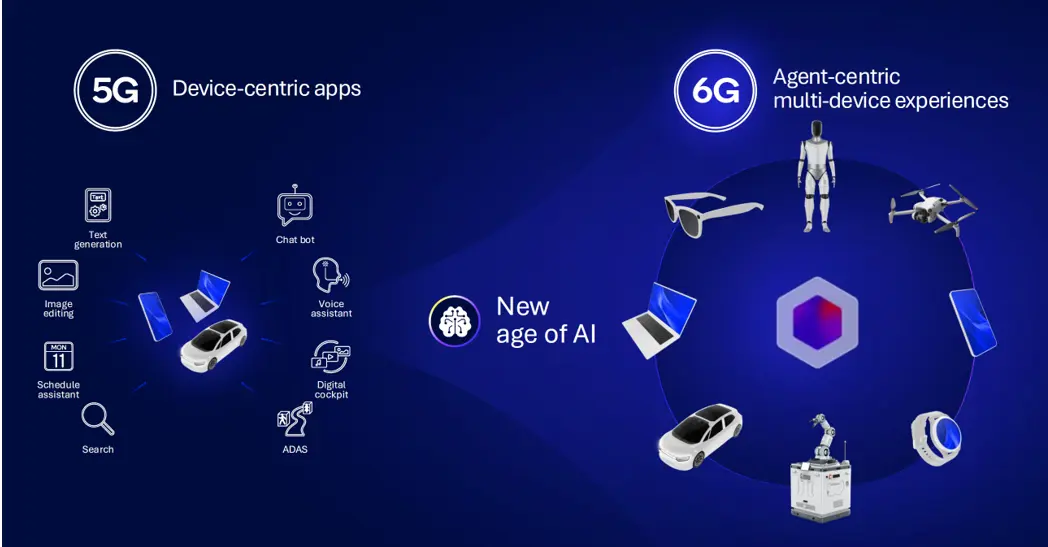
Qualcomm’s own definition of AI-native is broader than adding a model to the core network. The company describes it as a five-layer architecture, only one of which is about the radio. The air interface and radio technologies are boosted by data-driven design rather than hand-tuned rules. The infrastructure is dimensioned and architected to carry telco and AI workloads on the same footprint. Devices and networks become agentic, self-optimizing dynamically instead of following static rule-based configurations. The network is expected to serve agentic AI devices with enhanced UX along with physical AI at the industrial edge, while personal AI and physical AI are supported across connectivity and compute alike. That last layer is the one that concedes the argument, because it puts compute on the same footing as the network.

The uplink is where the strain shows
Once an AI agent becomes the primary interface for a device, the shape of network demand inverts. Consumer networks were built on the assumption that people consume more than they produce. “Video down, taps and text up” is the current mantra and Time Division Duplex (TDD) slot configurations, spectrum allocation, and massive MIMO investment all reflect that. Agentic workloads run the other way when inference sits off-device, because the device becomes a context collector as well as a consumer of content. In the agentic era, it sends camera frames, audio, screen state, location and app state up to the model in the cloud and what comes back is tokens or a short clip. Smart glasses are the clearest example, sending continuous visual context up and a single sentence down. Multiple Mbps upload against a few hundred bytes of download.
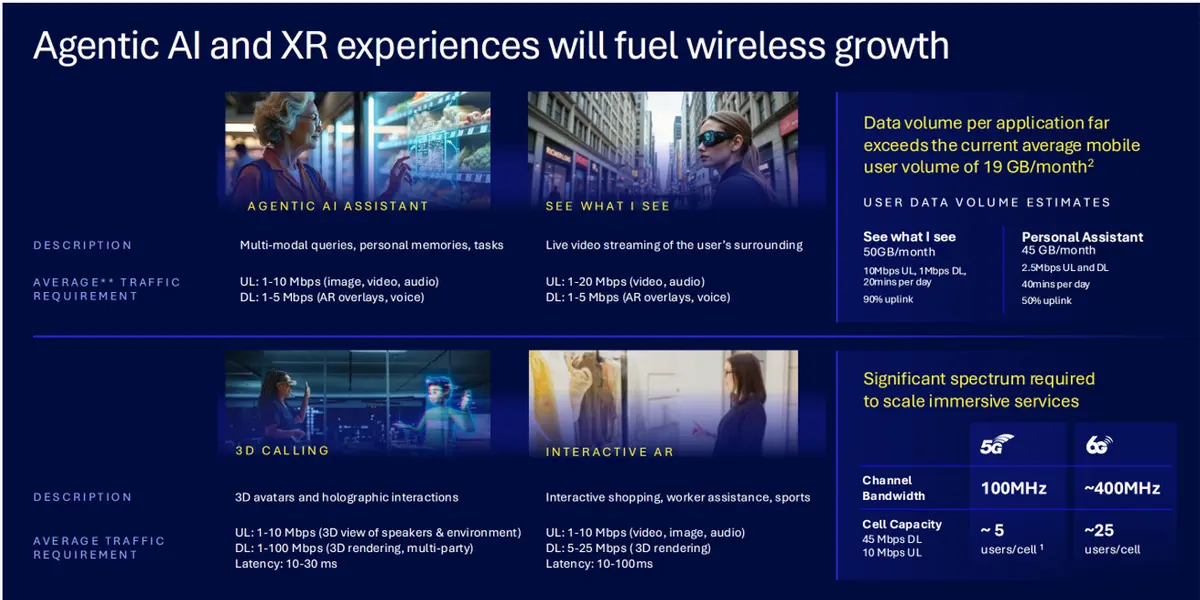
One of the use cases that Qualcomm spoke about at the event was life casting – “See what I see.” Twenty minutes of daily live video streaming can lead to 50 GB of data being generated every month with 90% uplink traffic, while using the personal assistant for 40 minutes daily can result in 45 GB of data every month, with 50% of it giving uplink traffic. For comparison, the current average mobile user consumes 19 GB a month, so one pair of glasses running life-casting generates more than twice the traffic of a whole user today. Massive uplink bandwidth would be required for these use cases involving smart glasses. Qualcomm's answer on the radio side is width, roughly 400 MHz of channel bandwidth against 100 MHz in 5G, which it translates into about 25 users per cell rather than about five at 45 Mbps down and 10 Mbps up.
The uplink is not the only ceiling. The transmit power of a device on someone's face or wrist is limited by SAR regulation, battery and skin temperature rather than by radio design. 23 dBm, equivalent to 200 milliwatts, is the regulatory and thermal limit, and anything with a battery and a human next to it will need to stay in the same power envelope as today. Sustained uplink at high power drains a phone fast and heats it, so devices back off. Energy makes it worse. Transmitting a bit over a cellular network costs orders of magnitude more than processing it locally on an efficient NPU.
Compute placement becomes a live decision
Neither of those ceilings moves. If the uplink cannot be widened indefinitely and a pair of glasses cannot be pushed past its thermal ceiling, the only remaining variable is where the work actually happens. So, hybrid processing stops being an optimization and starts being the architecture.
The practical consequence is that a question that used to be settled at design time now has to be answered continuously. When a user asks an agent to do something, part of the work can run on the device, part at the network edge, part at a switching office and part in a data center. This is now a decision that is taken use case by use case, and the industry has no framework yet for moving work between those layers.
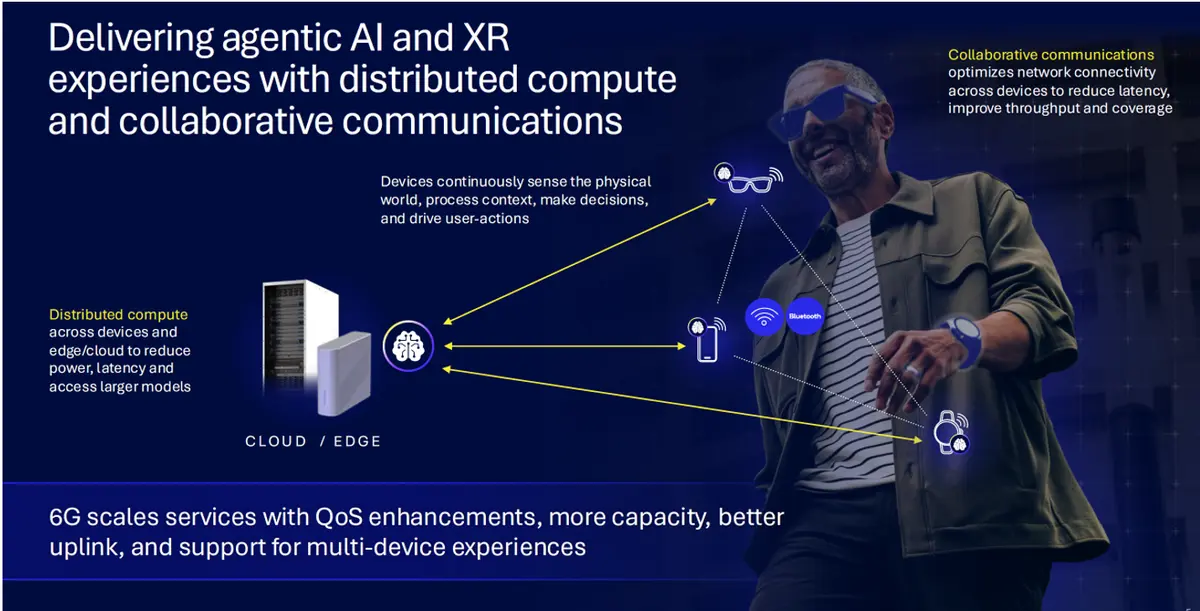
One of the demonstrations at the event showed how a smart glass, smartphone and smartwatch can collaborate on delivering agentic and XR experiences. Collaborative communications and distributed compute will ensure that the “low latency, low power” target is met, with access to larger models if needed. To deliver on this promise, the devices need to work seamlessly, offloading the workloads as needed.
Let’s say glasses are rendering continuous environment context and in good RF/network scenarios, the compute is offloaded to the edge to save battery and access larger models. However, if the network is poor, then on-device compute kicks in on the smartphone or the glass itself. A smartwatch can complement this with data on biomarkers and motion.
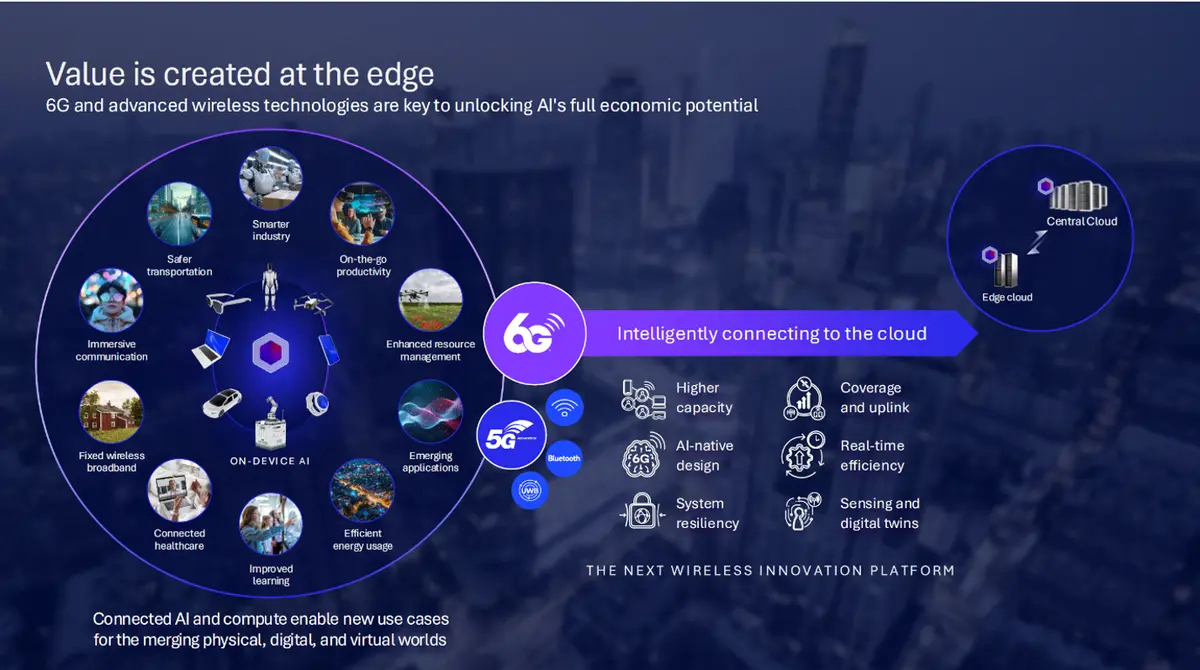
Distributed compute is the key platform for Qualcomm as it now provides compute from the edge to the cloud, and 6G plays a key role by providing connectivity from devices to the cloud. The job of the 6G network is to extend what the device can reach rather than to replace what it can already do locally.
What did Qualcomm demonstrate?
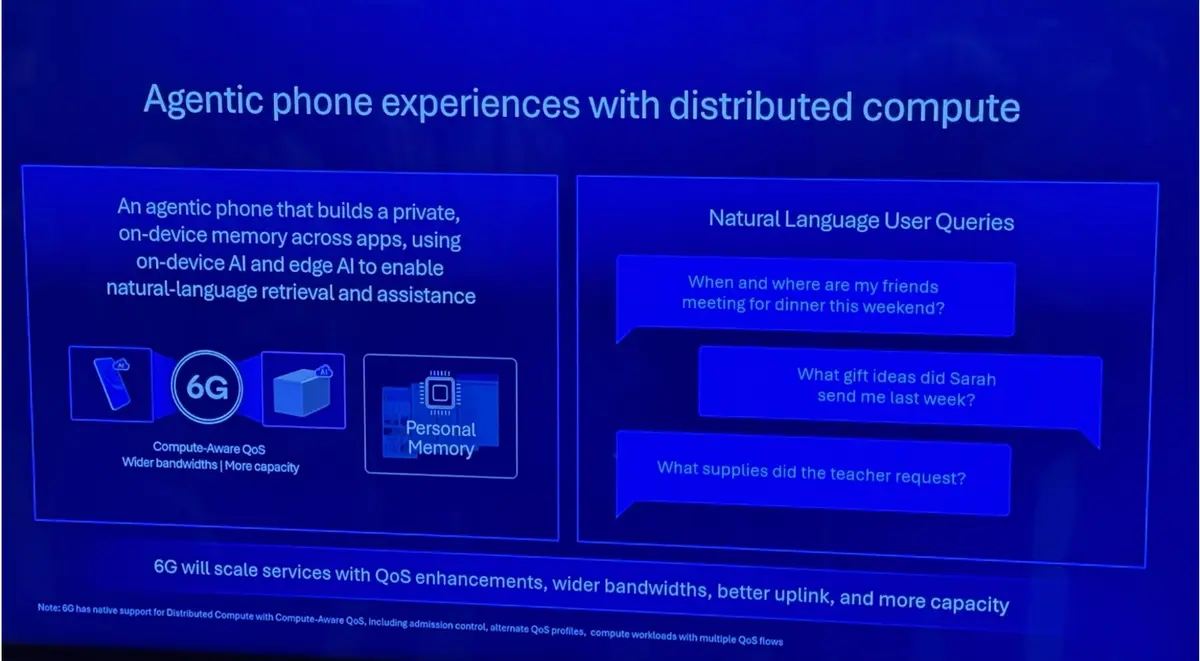
Agentic search on the phone
Qualcomm demonstrated a smart search assistant that searched across multiple messaging applications and groups using natural language. The phone used on-device memory across applications and edge AI to enable this search. Distributed compute and on-device computations play an important role in delivering the output.
AI Recall on smart glasses
Qualcomm demonstrated the use case for “AI Recall” using smart glasses. The glasses continuously captured images of the surroundings, which were later used to recall key moments of a football game or to answer mundane questions such as “Where did I leave my glasses?”, with a proactive assistant telling the user it was last seen on the couch table.
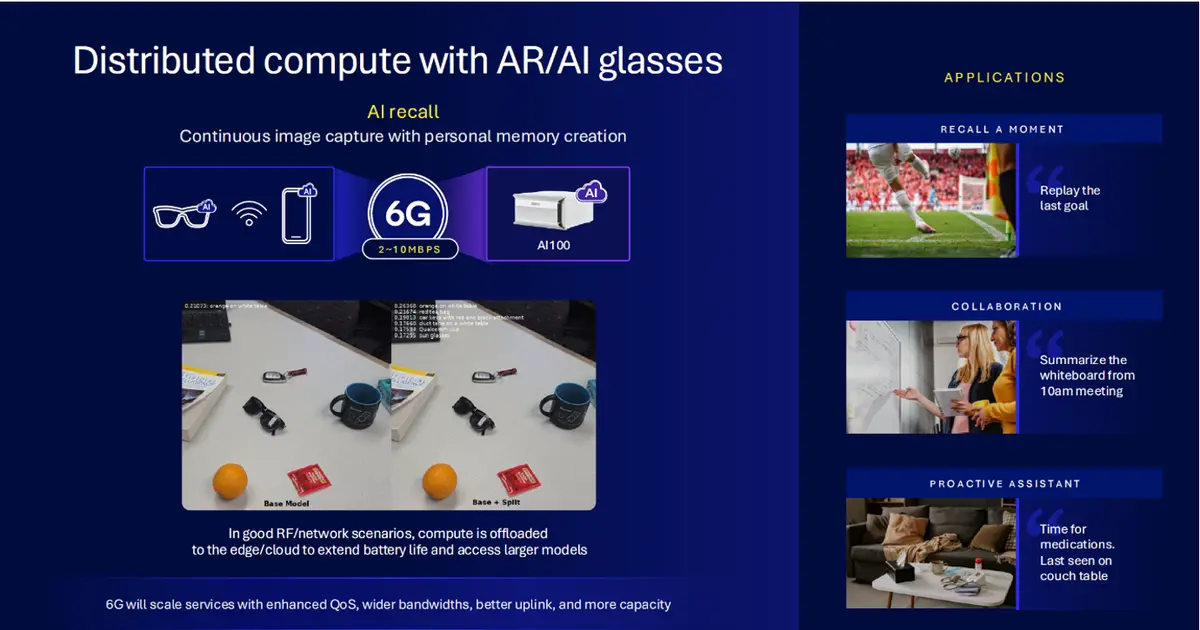
In this demonstration, compute was offloaded to the cloud or the edge to extend the battery life of the device. On-device compute took over when the network was poor.
Wide-area sensing
Wide-area sensing in 6G uses existing cellular infrastructure as a giant radar system to detect, track and image objects that do not even carry a connected device. Qualcomm successfully demonstrated wide-area sensing using a full-duplex base station on its campus. It was able to detect and classify drones and vehicles at distances of around 100 meters to over 800 meters, using Sub-6 GHz spectrum and machine learning to tell one drone from another.
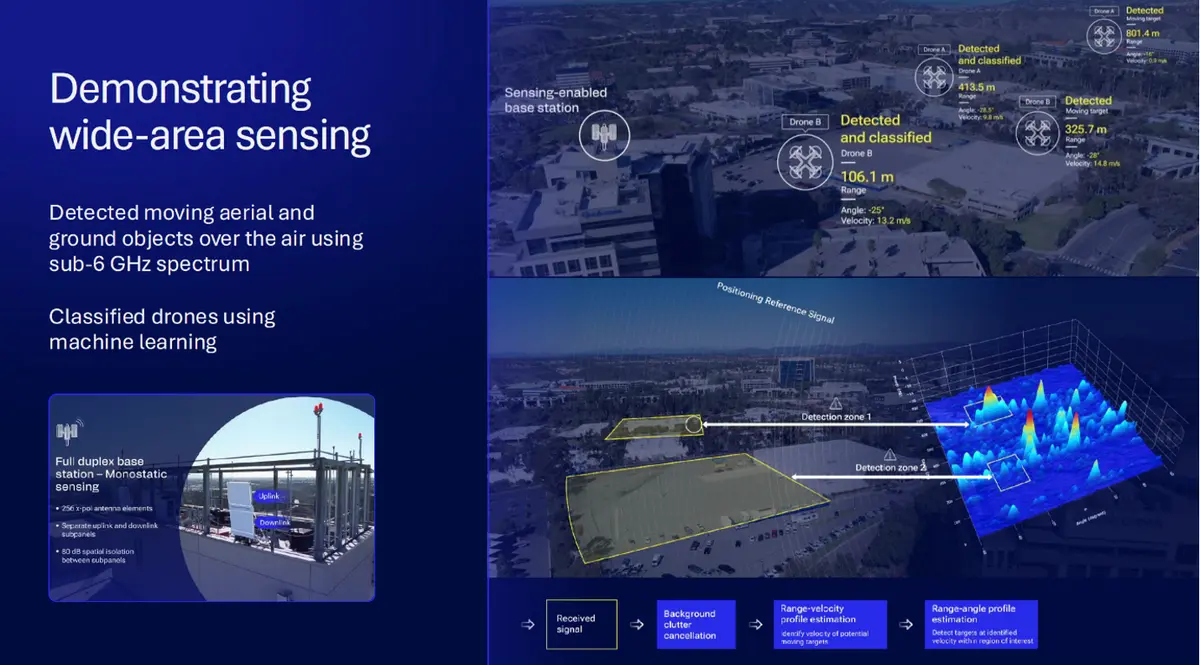
Wide-area sensing can enable multiple use cases such as object detection, drone tracking for delivery, obstacle monitoring on railroads, and intruder monitoring.
Timeline
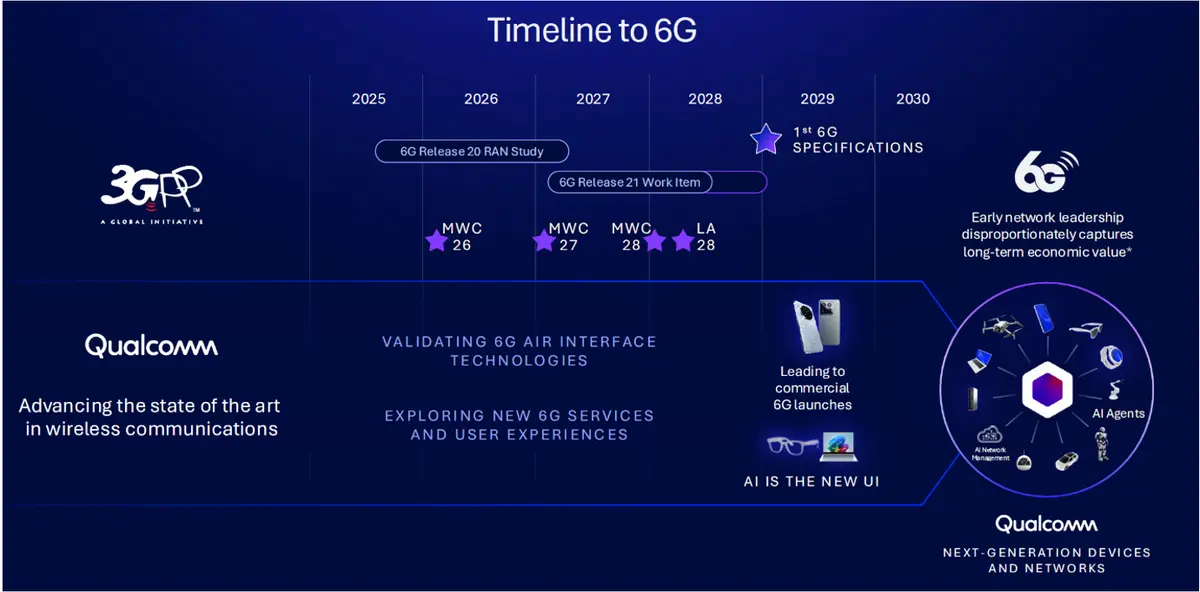
The schedule is specific enough to be held to. 3GPP is moving from the Release 20 study item into the Release 21 work item, with the first normative specifications due by March 2029 and commercial launches following from there.
Analyst takes
Qualcomm has taken an early initiative in evangelizing 6G technology, though it is still three years away from commercialization. The company is right in presenting converging timelines and paths of 6G’s and AI’s development. It positions 6G as AI-native, which is as much a design philosophy as a technical specification. At the same time, the compute continuum across edge to cloud will be a growing trend and Qualcomm has the building blocks to take advantage of this emerging continuum.
Qualcomm presents 6G as one of the tools required to make the agentic interface work. But agents are displacing the application interface now on 5G and 5G-Advanced, even as Release 21 specifications are not due until March 2029, with products arriving later. The agentic interface will therefore already be established by the time 6G arrives, which makes 6G the generation that scales it rather than the one that starts it. In our opinion, an agent-centric world will be the context in which 6G operates, and 6G's contribution will be to make those experiences work at scale.
AI is changing the nature of traffic, with uplink becoming as important, if not more, as downlink. Therefore, Qualcomm's decision to treat uplink as a first-class design target is well placed; the open question is whether carriers will follow. 5G's uplink deficit was a commercial choice and should not be looked at as an engineering failure or gap. Carriers had the option to run uplink-favourable TDD configurations but did not as the structure of the market required them to focus on download speeds. In our opinion, 6G will improve the uplink capacity through denser deployment and treating uplink as a design target rather than leftover capacity. But capacity alone will not rebalance the traffic, because 6G can permit all the uplink capability it likes and still arrive with the same imbalance unless the industry changes how it monetizes and what it sells.
The device ceiling is the part that no amount of network investment fixes. Carriers can add spectrum and densify all they like, but none of it raises the power budget of something worn on a user’s face. That asymmetry is what makes distributed compute and hybrid AI processing the decisive capability of the coming decade, and it is why on-device processing will matter more than raw network capability for wearables and glasses.
Wide-area sensing was the most striking thing in terms of demonstrations at the event. It arrives largely as a byproduct of full-duplex radios and dense infrastructure, so the marginal cost of offering it is low, though the buyer is still taking shape. Enterprises, municipalities and infrastructure owners are the likely candidates, and none of them buy the way consumer subscribers do. Qualcomm is positioning it as the sensing layer for digital twins, which puts the buyer in industrial and infrastructure budgets rather than consumer ones.
What could slow 6G rollout down
The biggest bottleneck for 6G rollout will be the global allocation of frequencies. The licensing involves the crucial upper 6 GHz spectrum band. Besides, many telecom operators are still trying to recoup the massive financial investments they made in 5G networks. If operators do not see an immediate business case or new revenue streams for 6G, they may choose to delay buying new cell tower hardware and instead stick with "5G-Advanced" software upgrades for longer.
The 6G standards are also dependent on cooperation between Huawei, Qualcomm, Nokia and Ericsson. This is one of the biggest risks facing 6G because a disagreement on technical standards would not only delay the March 2029 milestone, it could split the industry into regional technology blocs. A hard split is unlikely, because global roaming depends on common specifications. Even so, regional alliances are forming, and the US and its partners have signed a 25-nation 6G grouping that pointedly excludes China. 3GPP follows a consensus model for making decisions and it is this consensus-building process that could delay the specifications release.
Disclaimer: The blog is based on Qualcomm’s 6G event in San Diego. The author’s travel for the event was sponsored by Qualcomm. However, the views in this blog are independent.

