

- AGIBOT introduces the Worken productivity framework, quantifying robots' effective work output to support ROI evaluation and output-based pricing for Robots-as-a-Service (RaaS).
- AGIBOT advances its "Three Intelligences in One" initiative , unveiling new models including GO-3 Preview and WITA-OMNI to strengthen robots' mobility, interaction and autonomous task-execution capabilities.
- AGIBOT unveils new hardware including the third-generation AHA3 platform and the OmniHand 3 Ultra, continuing to build out its full-stack technology system spanning models, data collection and robot hardware.
AGIBOT Innovation Day 2026 was held on October 29 at the Shanghai World Expo Center, where more than a thousand attendees witnessed a series of major announcements that underscored the company's growing industry influence. Centered on its "Three Intelligences in One" framework, AGIBOT continued to iterate on its embodied foundation model capabilities, advancing the commercial rollout of humanoid robots across core use cases. The company also reported progress on several of the key bottlenecks constraining humanoid robot commercialization, including embodied operating system development, end-to-end data collection infrastructure, in-house core hardware, and the co-building of industry ecosystem standards.
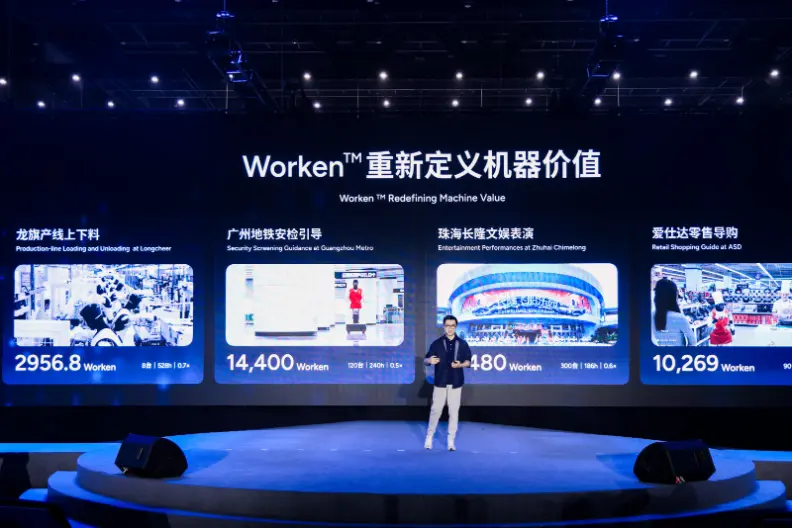
Addressing the industry's lack of a standardized framework for quantifying the productivity value of humanoid robots, AGIBOT introduced the concept of "Worken". The metric combines three key indicators — the number of active robots, autonomous working hours, and output efficiency — to calculate effective working hours adapted to different deployment scenarios. With the humanoid robot industry on the cusp of its growth phase, the Worken framework carries significant implications for accelerating commercialization. On one hand, it gives enterprise decision-makers an objective yardstick for quantifying the returns of putting humanoid robots to work, allowing them to plan fleet scale, validate projects and calculate ROI based on Worken. On the other hand, humanoid robot makers can use Worken to evaluate and continuously optimize their robots' productivity across different scenarios. Worken can also serve as a pricing unit for RaaS services, with lessees billed by Worken output rather than by time.
[2026 AGIBOT Innovation Day] Worken, Redefining Machine Value
Source: AGIBOT
AGIBOT's embodied model technology roadmap has evolved from "One Body, Three Intelligences" to "Three Intelligences in One," in which mobility, interaction and task-execution intelligence are deeply coupled and co-evolve around the robot body as the carrier.
In Mobility Intelligence, having addressed the fundamentals of stable standing and fast movement, AGIBOT continues to push the ceiling of robots' motion capability. Technologically, it has moved beyond fixed, pre-choreographed trajectories, building on its AGILE generative motion-intelligence framework to pursue motion generalization, environment generalization and self-evolution.
In Interaction Intelligence, the company's embodied, omni-modal end-to-end interaction model, WITA-OMNI, enables proactive omni-modal interaction, full-duplex streaming local interaction, and closed-loop intent-driven interaction. In a live demonstration, facing a complex environment, the Yuanzheng (Expedition) A3 robot accurately recognized interaction intent with a response time under one second, with its movement+s, facial UI and voice output working in close coordination. Powered by the WITA-OMNI embodied interaction model, human-robot interaction has moved beyond mechanical question-and-answer exchanges to become more natural and lifelike.
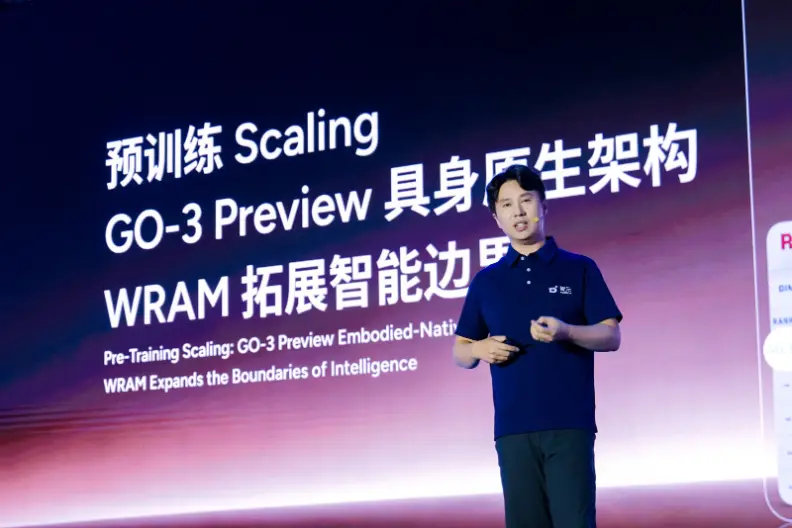
In Task-execution Intelligence, AGIBOT unveiled its GO-3 Preview embodied foundation model, which topped three major industry benchmarks: RoboDojo, RoboTwin and RoboColiseum. GO-3 Preview's WRAM (World Reasoning Action Model) architecture unifies task understanding, future prediction and action generation within a single framework. This allows the model to scale along both data and model size dimensions, meaning performance can continue to improve simply by expanding training data and model size. Shaochen Wang, Research Analyst at Counterpoint Research, said: “GO-3 Preview marks an important milestone in AGIBOT's technology roadmap. Built on the new model, the Genie series of robots will gain stronger environment and task generalization capabilities and substantially shorten factory deployment timelines. GO-3 Preview will provide key technical support for the continued optimization of the Worken metric.”
[2026 AGIBOT Innovation Day] GO-3 Preview Embodied-Native Architecture, Pre-Training Scaling
Source: AGIBOT, Counterpoint Research
AGIBOT also unveiled a series of hardware innovations, including its third-generation hardware architecture, AHA3, which serves as the computing backbone of "Three Intelligences in One"; an all-new, self-developed dexterous hand product lineup, with the OmniHand 3 Ultra offering full-area tactile sensing and 21 active degrees of freedom; and the industry's first under-skin liquid-cooling system for robot joints, embedded beneath the outer shell, alongside dust-proof, water-proof and explosion-proof joints developed for specialized application scenarios requiring ultra-high reliability. The Genie family also welcomed a new member: the safety-rated, heavy-duty wheeled embodied robot G2 Max. With dual-arm payload capacity of up to 50kg, supported by a 7-degree-of-freedom force-controlled dual-arm system and a waist pitch structure, the G2 Max is built for a wide range of complex industrial tasks and can cover a broad working range of 0.1 to 2.5 meters.
The recent release of GPT-6 Astra reignited debate over large language models versus embodied foundation models as the right path forward. Speaking at the event, AGIBOT co-founder Dr. Yao Maoqing said that for humanoid robots to perform stable, efficient work in real-world physical environments, both high-quality data and high-performance hardware are indispensable — and that regardless of how the underlying technology evolves, AGIBOT's data systems and full-stack software-and-hardware capabilities will remain essential to commercial success. Ethan Qi, Associate Director at Counterpoint Research, said: “At this stage, rather than debating which technical path is right, humanoid robot makers should focus on commercial deployment, identify more use cases, and work with ecosystem partners to scale from single-point validation to 1-to-N expansion. On that foundation, they can build a data flywheel and achieve collective robot intelligence. Large language models and embodied models are not a zero-sum game; they can coexist and complement each other, providing differentiated intelligence support across different vertical domains.”
