

The second edition of the World Humanoid Robot Games was held in Beijing from August 22 to 26, 2026. Over the five‑day event, 2,056 humanoid robots participated in 51 events in 1,301 matches. Notable improvements were achieved in terms of event scale, robot completion capability and competition performance.
As joint innovation partners of 5G Capital, Huawei and China Unicom Beijing delivered a comprehensive assurance system built on 5G‑A network technologies for the Games, catering to differentiated service requirements from general spectators, media outlets, and various types of humanoid robots.
Many track‑and‑field and competitive events in this competition require robots to operate in full autonomy, raising higher demands for stable network connectivity, status feedback and multi‑terminal collaborative support. Leveraging 5G‑A technologies including high‑uplink transmission, network slicing, AI‑powered intelligent scheduling, together with 300 MHz large‑bandwidth resources, the venue delivers consistent latency of 20‑30 ms and 20 Mbps uplink speed for competing robots across all areas. This enables participants either to tele‑operate robots or deploy models remotely for robot autonomous reasoning, making full‑autonomous robot operation achievable in track‑and‑field and competitive contests.
The competition has fully demonstrated how 5G‑A networking empowers humanoid robots and offered new practical insights for the humanoid‑robot industry to explore cloud‑edge‑end collaboration and remote‑model deployment.
China Unicom Beijing 5G‑A Network Undergoes Real‑world Tests with 2,056 Competing Robots
The 2026 World Humanoid Robot Games is a representative epitome of a future human‑machine‑inclusive society. During the event, thousands of spectators, hundreds of humanoid robots and multiple high‑definition media camera feeds operated concurrently inside the National Speed Skating Oval. The venue network needed to meet multi‑faceted service requirements: it had to satisfy spectators’ social‑media connectivity, support high‑concurrency streaming live‑broadcast services, and guarantee smooth and stable backhaul of 8K ultra‑high‑definition videos. At the same time, it enabled low‑latency real‑time remote control and multi‑robot collaboration for competing robots to accommodate high‑bandwidth concurrent uplink traffic from hundreds of humanoid robots, which brought unprecedented challenges to China Unicom Beijing’s network deployment.
This event was not an isolated venue‑level network optimization, but a real‑world validation of 5G Capital’s long‑term network evolution capabilities in embodied‑intelligence scenarios. In recent years, China Unicom Beijing has continuously advanced network evolution from large‑scale 5G coverage, 5G SA and high‑bandwidth connectivity to 5G‑A high‑uplink transmission, multi‑frequency coordination and AI‑powered intelligent operations. The competition further verified the replicable value of these capabilities for Mobile‑AI scenarios. In partnership with Huawei, China Unicom Beijing deployed Huawei LampSite 5G‑A pico base stations within the large‑scale venue to build an indoor distributed network supporting 300 MHz ultra‑large bandwidth. A dedicated 100 MHz carrier was reserved exclusively for humanoid‑robot services to isolate robot traffic, media live‑streaming and public internet access. Impressive performance metrics were achieved: the venue peak uplink speed hit 1 Gbps, average end‑to‑end service latency was below 30 ms, and end‑to‑end latency for robot‑related services reached as low as 18 ms during the opening ceremony. By securing reliable network support for the humanoid robot games, China Unicom Beijing once again put the concept of network egalitarianism into practice. Beyond the National Speed Skating Oval, China Unicom Beijing has achieved large‑scale coverage of 5G‑A hundred‑megabit high‑uplink networks across key urban areas.
Instead of prioritizing specialized services at the expense of user experience, the event‑oriented network assurance adopted dynamic resource scheduling across time slots, zones and service types. While differentiated guarantees were delivered for critical services such as robot operations and media transmission, basic end‑user services including instant messaging, ticketing, QR‑code scanning and payment remained stable and accessible. This resource‑scheduling mechanism, which balances critical‑service performance and public‑user experience, provides new practical references for network services in future environments with coexisting diverse intelligent agents.
Validated through real‑world testing by thousands of humanoid robots at the games, core 5G‑A capabilities – high‑uplink transmission, carrier isolation, network slicing and AI‑driven intelligent scheduling – will serve as the fundamental communication underpinning for humanoid robots moving from laboratory prototypes to large‑scale commercial deployment, unlocking value across full‑industry scenarios.
2026 Marks the Humanoid Robot Industry’s First Year of the Deployment Phase
2026 is regarded as an inflection point for humanoid robots to achieve regular operations in industrial manufacturing, logistics and service‑industry scenarios. According to Counterpoint Research forecasts, global humanoid robot shipments will exceed 50,000 units in 2026. In the same period, shipments of quadruped robots and commercial intelligent robots will surpass 90,000 units and 200,000 units, respectively. The AI robot industry is entering a phase of large‑scale development, with robot products of diverse form factors rapidly penetrating factories, commercial districts and public spaces.
As a critical growth pole for the global embodied intelligence industry, China’s Ministry of Industry and Information Technology (MIIT) and the State‑owned Assets Supervision and Administration Commission (SASAC) jointly issued a circular in June 2026 to launch the 2026 Special Initiative for Real‑Scenario Training of Humanoid Robots and Embodied Intelligence. Centring on key scenarios in industrial, service and special‑purpose sectors, the initiative accelerates the formation of a closed‑loop of “real‑scenario training – data accumulation – product iteration – large‑scale deployment”. By the end of 2026, over 100 high‑value application scenarios will be cultivated, driving large‑scale rollout at the 10,000‑unit level.
Furthermore, to standardize the development of the humanoid robot industry, the MIIT has led the drafting of the Guidelines for the Development of the National Humanoid Robot Industry Standards System (2026 Edition) and initiated the establishment of a “digital identity” system for humanoid robots. By 2028, the “one‑device‑one‑code” mechanism for humanoid robots will be fully implemented, forming a mature whole‑chain management system. This provides institutional support for full‑lifecycle management of humanoid robots via public mobile networks.
5G‑A Technology Enables Cloud‑Edge‑End Collaboration
Currently, the humanoid‑robot industry is confronted with multi‑dimensional challenges including model capability, supply of real‑scene training data, and on‑device computing‑power constraints. During the 2026 World Robot Conference (WRC), scenario‑oriented demonstrations covering industrial, household and logistics use cases showcased advances in humanoid robots’ autonomous reasoning and collaborative operation capabilities. Meanwhile, they also revealed notable shortcomings in current‑generation robot standalone intelligence: robots are heavily reliant on structured environments and adapt to fixed‑point tasks via imitation learning; long‑horizon tasks must be split into multiple short‑task segments with considerable latency for task reasoning.
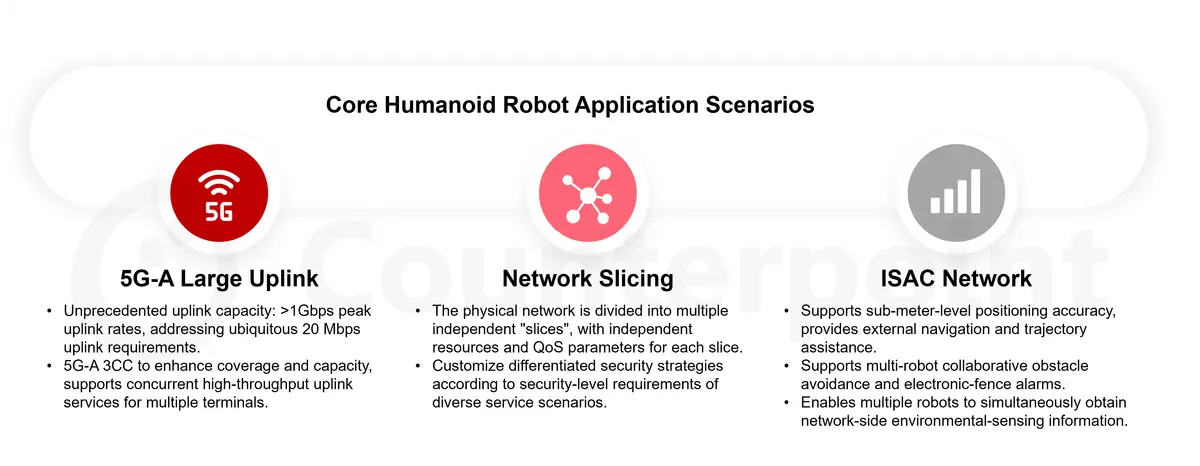
The successful 5G‑A network deployment at the World Humanoid Robot Games has demonstrated to the industry both the feasibility and necessity of a cloud‑edge‑end collaborative architecture for humanoid‑robot model development, data acquisition and application deployment. On one hand, leveraging the high‑bandwidth strengths of 5G‑A networks, humanoid‑robot developers can remotely monitor robots deployed across diverse scenarios, achieve real‑time backhaul of operational data, and roll out new operational skills remotely via OTA updates. This drastically boosts the efficiency of post‑training for humanoid robots, enables fast adaptation to new operating environments, and accelerates commercial adoption across key vertical sectors. On the other hand, as the Data‑as‑a‑Service (DaaS) business model targeting high‑quality data supply gains rapid momentum, demand for collecting both physical‑robot data and human‑demonstration data will surge. Supported by 5G‑A’s high‑uplink transmission capacity, centralized remote management for multiple data‑collection devices becomes feasible to meet distributed‑operation requirements for large‑scale data acquisition.
Furthermore, 5G‑A networks can compensate for inference limitations of on‑device VLA models and help handle long‑tail anomalies in real‑world scenarios. At present, on‑device VLA models cannot effectively address anomalies occurring in practical operations and still require extensive human intervention. Benefiting from 5G‑A’s high uplink bandwidth and robust anti‑interference performance, large Vision‑Language (VL) models can be deployed at the edge of facilities such as factories and warehouses. This delivers end‑to‑end processing including real‑time environmental perception, anomaly identification and recovery‑strategy generation, substantially reducing on‑site manual involvement. Additionally, powered by network‑slicing technology, 5G‑A delivers average latency at the 10‑millisecond level for humanoid‑robot remote control, far lower than conventional 5G networks. For high‑risk scenarios such as firefighting and rescue missions, humanoid robots can seamlessly switch to remote teleoperation models, allowing specialists to precisely control every motion from afar and mitigate unknown risks.
5G‑A Technology Underpins the Real‑world Deployment of Humanoid Robot Applications
5G‑A technology is safeguarding the application rollout of humanoid robots across various vertical sectors. According to Counterpoint Research’s forecasts on humanoid robot applications, intelligent manufacturing, commercial and household services, and warehousing services will soon replace entertainment‑oriented commercial use, as well as education‑and‑research data collection, as the major deployment directions for humanoid robots. By 2030, humanoid robot shipment shares in these sectors are projected to stand at 45%, 25% and 20%, respectively.
Global Humanoid Robot Shipment Breakdown by Application, 2030F

In the field of intelligent manufacturing, it is necessary to build swarm intelligence for humanoid robots. Complex long‑range tasks can be decomposed into multiple subtasks and assigned to different robots for parallel execution to boost operational efficiency. Meanwhile, the cloud‑based brain serves as the computing hub for swarm intelligence. It can integrate local experience from humanoid robots, enable skill sharing and mutual learning among robots deployed in diverse scenarios, resolve complex common problems that a single robot cannot handle independently, and break the computing‑power bottleneck of individual humanoid robots.
The development of swarm intelligence for humanoid robots imposes brand‑new upgrade requirements on the Industrial Internet of Things (IIoT). First, full‑coverage ultra‑large bandwidth and sub‑millisecond deterministic latency are required to support real‑time dynamic perception and cluster collaborative scheduling for hundreds of humanoid robots. Second, full‑coverage stable 100‑Mbps uplink capability is needed to connect the native computing power of humanoid robots, factory‑edge computing power and cloud computing pools, so as to achieve seamless collaboration between the on‑board brain of humanoid robots and the cloud‑based brain. 5G‑A acts both as the network foundation for factory digital‑intelligent transformation and a key enabler for the large‑scale deployment of industrial humanoid robots.
In commercial and household service scenarios, humanoid robots are deployed in a distributed manner and interact physically with humans. It is essential to set up electronic fences to restrict robot movement ranges, safeguard human privacy and security, and prevent unauthorized remote manipulation. Adopting lightweight network slicing and encryption algorithms for air‑interface transmission, 5G‑A technology delivers financial‑grade secure connections for dispersedly deployed robots, building a security barrier for harmonious human‑robot coexistence. Furthermore, in terms of human‑robot interaction, the high‑uplink capability of 5G‑A supports real‑time backhaul of high‑definition audio‑video interaction data. Leveraging large cloud‑based language models, human‑like natural conversations can be realized, enabling various professional services for end users such as child‑companion learning, fitness and health guidance, and e‑commerce shopping.
Modern intelligent logistics and warehousing scenarios demand networks with high‑precision indoor positioning capability. Such networks dynamically compute optimal paths for handling robots in real time, accurately assign operational tasks to loading‑unloading and sorting robots, reduce congestion and waiting time via intelligent scheduling, and comprehensively improve warehousing operational efficiency. Featuring integrated sensing‑and‑communication capabilities, 5G‑A networks deliver sub‑meter‑level high‑precision positioning for AI robots. For high‑concurrency data‑transmission demands, 5G‑A technologies including carrier isolation and cell merging can provide reliable, smooth network connections even under high‑density and high‑load conditions.
Conclusion
By 2030, global deployment of humanoid robots will reach the million‑unit scale. A suite of brand‑new business opportunities including DaaS, RaaS and SaaS will emerge around intelligent robots and dexterous hands. A single humanoid robot can consume hundreds times more token‑based computing resources than an ordinary consumer device. New business platforms will be deeply integrated with 5G‑A networks. Taking DaaS and SaaS as examples: DaaS will drive demand for tens of millions of hours of heterogeneous robot data collection and massive‑scale data governance; SaaS enables users to access scenario‑specific application services for various vertical industries over 5G‑A networks.
In the agent‑era, to cope with the growing volume of intelligent‑agent and large‑model inference workloads and underpin the development of the robotics industry, Chinese operators are accelerating the transformation of networks from pure connectivity pipes to computing‑power networks. They are building native intelligent networks integrating secure connectivity, environmental perception, distributed computing power and large models. Counterpoint Research believes that the embodied‑intelligence industry and AI‑native networks will boost each other and evolve in tandem.

