Autonomous Network Level 4: From Operational Automation to Commercial Intelligence
- Autonomous Network Level 4 (AN L4) is emerging as a strategic growth platform, shifting the focus from operational efficiency to network monetization.
- Rising network complexity is accelerating the transition from task automation to AI-driven autonomous decision-making.
- Industry momentum is building, with operators increasing AN L4 investments and commercialization expected to accelerate toward 2030.
- Legacy infrastructure, fragmented operations, and data challenges remain the biggest barriers to large-scale AN L4 deployment.
- MTN South Africa has successfully partnered with Huawei to achieve TM Forum AN L4 IP Certification of their IP/Transport network as the first in the world.
Introduction
Communications Service Providers are no longer pursuing an autonomous network merely for operational efficiency but are now seeking to manage their increasing levels of network complexity while unlocking new major ways of delivering value. The commercialization of 5G Standalone, network slicing, private networks, edge computing, API's, and AI-enabled services dramatically increases the number of parameters in the network and the number of permutations of services and operational decisions that require real-time management. Traditional operational models that rely heavily on manual processes, static policy, and automation that is specific to a given domain are becoming increasingly difficult to scale in these new conditions.
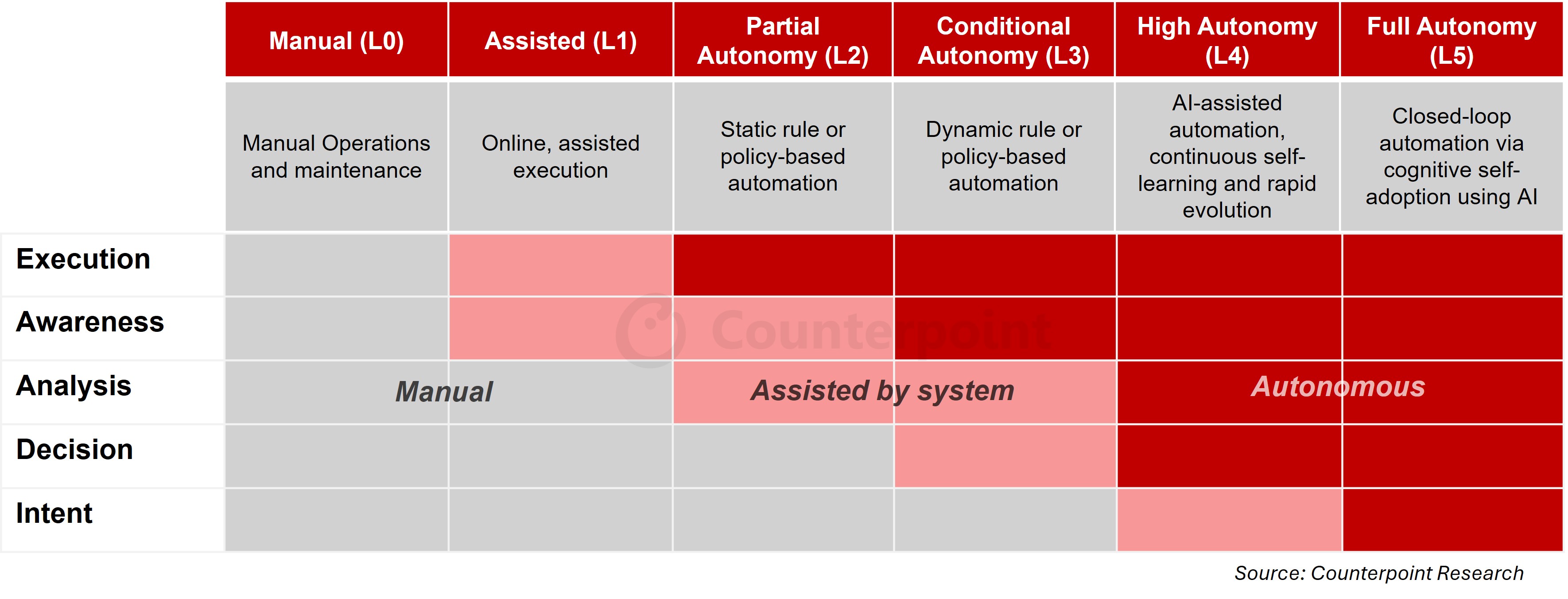
The industry is shifting its focus from task automation to decision automation. The level of commercial impact is higher between AN L2 and AN L4. Automating workflow in Levels 0-Level 2 focuses on improving operational efficiencies and minimizing total cost of ownership. Operating networks using Levels 3-Level 4 represents a fundamental change in operation from human management to AI-driven management of operations; thereby enabling service providers to monetize value-added differentiated connectivity, enterprise SLAs, and intent-based services, at volume.
It was a key point of discussion at DTW2026, highlighting the current state of AN L4. TM Forum also highlighted that most operators plan to increase their investments to make networks more advanced and monetizable. The traction is expected to speed up toward the end of the decade and in the early stages of the 2030s. It is a clear indication of operators’ intent to deploy AN L4, and it forms a formidable part of their commercial growth strategy, especially as 6G looms large. Additionally, TM Forum highlighted 40 ANLAV validations awarded to 17 companies, recognizing operators making measurable progress toward Level 4 autonomy in production.
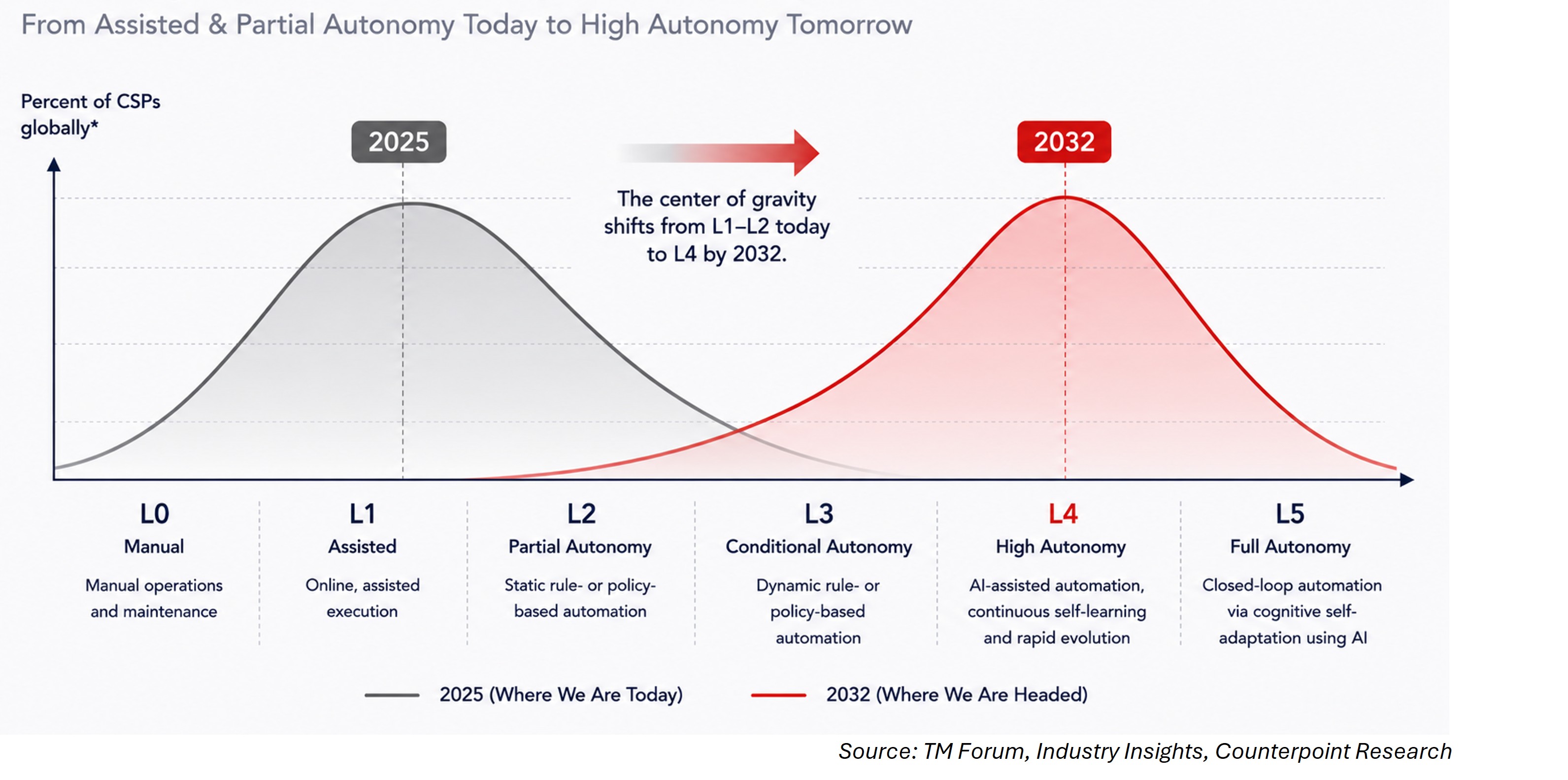
From Assisted Autonomy Today to High Autonomy by 2032
Today, most operators are operating at Assisted (L1) or Partial Autonomy (L2), where automation mainly involves static, rules-based, and domain-specific automation. Given the pace of recent developments, Counterpoint Research expects that by 2032 the industry center of gravity will shift significantly toward High Autonomy (L4) due to six converging trends:
- The network becomes increasingly complex (e.g. 5G SA, slicing, edge, multi-cloud) to the point where manual management is no longer feasible.
- Enterprises expect an outcome-based service model, with guaranteed SLAs rather than just attempting best-effort connectivity.
- The ability to scale operations becomes essential as legacy manual processes can no longer accommodate network growth.
- Pressure to improve the customer experience through real-time issue resolution and consistent quality.
- Creating a revenue opportunity through advanced forms of connectivity, including dynamic provisioning and SLA-based service management.
- AI and automation technology maturing to the point that closed-loop, AI-native operations become economically viable.
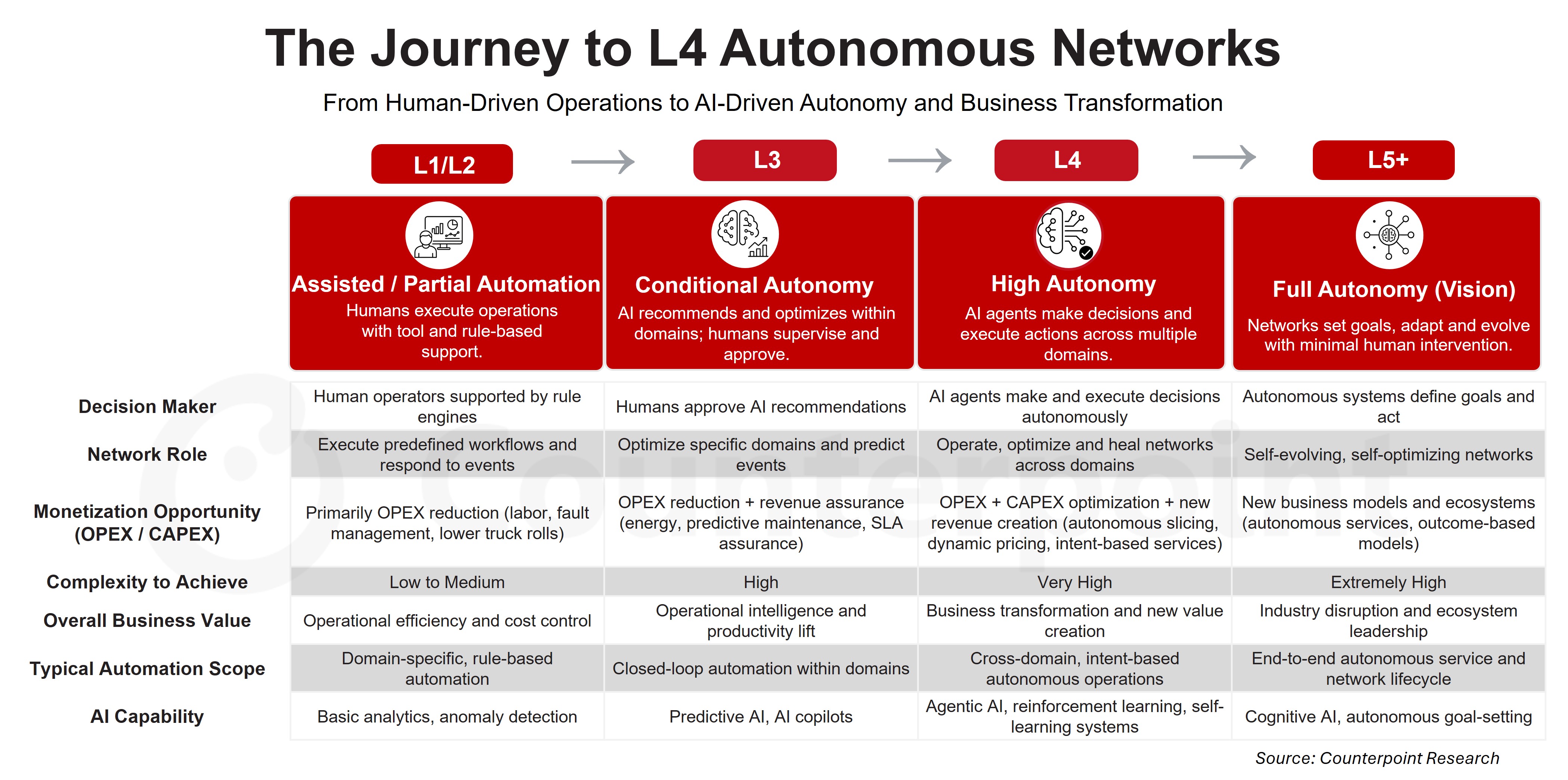
Current AN L4 Deployment: Market Reality, Challenges and Outlook
Currently, the deployment of autonomous networks (ANETs) worldwide is very much real but at uneven scales. Some operators have demonstrated that the use of L4 automation can be successful within certain types of networks and business cases. However, the bigger challenge now is to extend and replicate this success across the entire network. Counterpoint Research identifies four major market forces that are shaping the present market.
Where Markets Stand Today
The autonomous networks industry is now in full production mode as many operators validate domain-specific Level 4 deployments of Autonomous Networks across service assurance, network operations and optimization.
- Ericsson has the largest portfolio of AN L4-related operator engagements among all vendors, partnering with KDDI, Telstra, DNB Malaysia, Mobily, and others to bring intent-driven operations and AI-enabled closed-loop automation to commercial use.
- Huawei, has emerged with the most complete strategy for large-scale commercialization of AN L4 as well, supporting AI-based agents, digital twins, and multi-domain autonomous operations platforms through partnerships with STC group, China Mobile, Enter Peru, and MTN South Africa.
- Nokia’s focus on foundational technology for autonomous networks includes, AI-native operations, digital twins and trusted orchestration. The company is beginning to demonstrate this focus through early results of its collaboration with Telenor Norway.
- ZTE has established itself as an industry leader in implementing agentic, AI-driven autonomous networks through collaborations with major Chinese operators.
- Amdocs is also helping accelerate the transition towards AN L4 by collaborating with 1Finity, Supermicro and NVIDIA on a live AI-RAN blueprint featuring cloud-native, AI-driven RAN orchestration and closed-loop workflows.
Although the transition to create large-scale AN L4 deployments is progressing quickly, there are still many structural issues impeding progress:
- Legacy technology debt remains the largest barrier to AN L4 adoption because of fragmented OSS/BSS environments, siloed operational domains and heterogeneous network infrastructures. Each of these issues can still cause barriers for interoperability and for creating an end-to-end autonomous workflow.
- Most operators are still only partly automating their operational loops. For example, the major operational responsibilities of fault remediation, service assurance, and policy enforcement require human involvement before the transition to true closed-loop autonomy can be made.
- Autonomous capabilities remain highly dependent on use cases, and as such, simpler examples of autonomous capabilities, such as anomaly detection and predictive maintenance, are being deployed much faster than higher order capabilities such as autonomously determining which available network resources should be allocated between domains for specific applications.
- The lack of consistent data and fragmented data across each of the individual network domains is creating a lack of trust in terms of independent and autonomous systems, so that operators are not prepared to assign operational control to an AI service without having some means of explainability, auditability, or governance over how the AI makes its decisions.
- The complexity of telecom networks being multi-vendor and multi-domain is creating significant challenges for successfully deploying autonomous network workflows across RAN, transport, core, cloud, and IT environments that were all designed to operate independently.
- Current AN L4 deployments remain largely domain-specific and geographically constrained, with few operators having established the organizational, operational and governance frameworks required to scale autonomous capabilities across their entire network estate.
Future Dynamics: The Technology Enablers Closing the Gap
According to five distinct technological changes projected over the next several years, the market is likely to move from pilot (trial) phase into operating as a platform (completely automated solution). The main areas affected by these changes include:
- Network Operations based on AI – the evolution of AI from recommending solutions to implementing them through several vendors working together seamlessly across multiple domains
- Digital Twins - by creating up-to-date, live simulations of the network, operators will be able to "test" changes or adjustments before actually implementing them
- Intent-based Orchestration - the development of a translation mechanism to allow for quick and accurate translation of desired business goal(s) (e.g. "Ensure that this SLA is met") into its corresponding configuration within the network.
- Closed Loop Automation with "Guardrails" – systems designed to autonomously detect, determine, and enact based on specified parameters while remaining within strict limits (safety zones), to ensure the reliability of the action taken by the autonomously acting system.
- Unified Real-time Data Layer – a single location for an accurate, comprehensive view of the network's various elements at one time (including all the physical, logical, and virtual components) across all domains will allow the autonomous systems to utilize this information to create accurate and timely actions based on that data.
Resilient, AI-native cloud core infrastructure: The AN L4 is built upon a solid, durable cloud-native core infrastructure. This architecture offers a foundation that integrates container-based Micro-Service Containerized approaches supported by Kubernetes orchestration. It has redundant/decentralized availability, combines AI & predictive analysis using AI Ops and intelligent automated closed-loop systems, and delivers high-quality data to support AI-created or autonomous decision-making without risk of new failures.
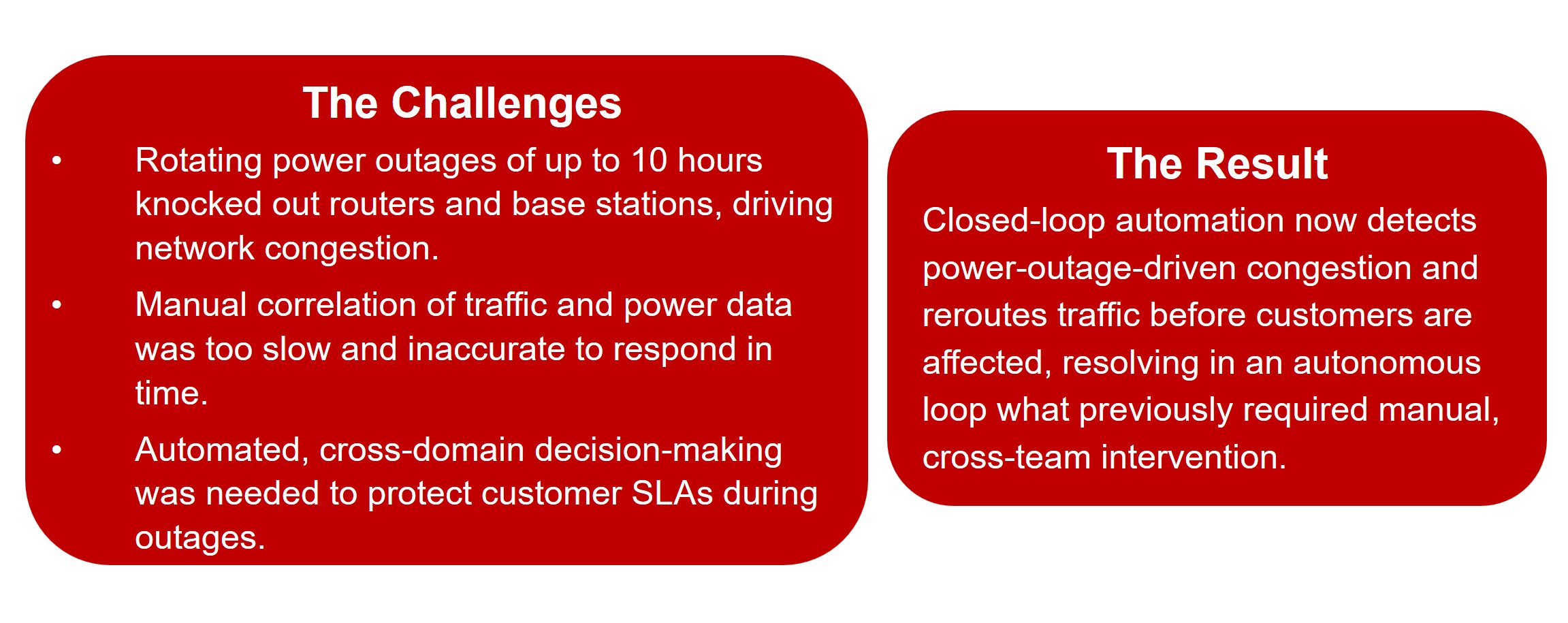
Case Study: MTN South Africa
MTN South Africa’s IP/Transport network is the clearest evidence to date that AN L4 outcomes are achievable at scale. The operator becomes the world’s first to achieve TM Forum AN L4 IP certification, scoring Grade A across all IAADE dimensions (Intent, Awareness, Analysis, Decision, Execution) with more than 15 SLA-based path calculation factors built into its closed-loop automation.
Next Phase Targets
- Agentic AI expansion, combining copilot assistance with intelligent, autonomous agents.
- Multi-domain autonomy, extending closed loops across both core and transport.
- Large-scale deployment via the Huawei-MTN innovation lab.
- OPEX and reliability gains through predictive fault management and reduced manual O&M.
- Digital transformation delivers a measurably superior customer experience.
Best Practices for Operators Pursuing AN L4
- Start with high-value use cases: service assurance, fault management, and customer experience optimization before attempting broad deployment.
- Adopt closed-loop operations to automate monitoring, decision-making, and remediation end-to-end, not just at the task level.
- Embed AI into operations for predictive assurance, self-healing, and intelligent automation, not as a separate analytics layer.
- Enable end-to-end orchestration spanning RAN, transport, core, cloud, and edge domains to avoid autonomy gaps at domain boundaries.
- Build on resilient, cloud-native infrastructure from the outset; retrofitting resilience onto fragile infrastructure after the fact is far harder.
Conclusion
The route to AN L4 is more than automating additional processes; it is about allowing networks to comprehend intentions, make independent judgments, and optimize results for increasingly complex digital infrastructures continuously. The companies that invest in high-value use cases, AI-based operations, and closed-loop assurance will be the ones best positioned to gain efficiency and create new revenue streams.
Category
Industry
AI
Service
Premium
Report Type
Report
Time Period
Other
Receive our insightful weekly newsletter and stay ahead of the competition.
Author
Vaibhaw Verma


Vaibhaw Verma is a Research Associate at Counterpoint Market Research, based out in Noida, India. He is a part of Automotive Research team, exploring the various segments of Smart Automotive and specializing in Advanced Driver Assistance System (ADAS).Vaibhaw holds a (PGDM) Post Graduation Diploma in Management degree in Business Analytics and Marketing from Ramaiah Institute of Management, Bangalore, India.