

Autonomous driving development has arrived at a pivotal inflection point. The industry is rapidly diversifying toward vision-first, foundation-model-driven "end-to-end" (E2E) autonomy. During NVIDIA GTC in Berlin, a live demonstration ride of NVIDIA’s latest Level 2++ (L2++) Hyperion driving stack showcased autonomous navigation through dense, bustling urban streets. The demonstration offers a concrete, under-the-hood look at how NVIDIA’s AV software architecture functions in complex real-world environments and highlights why anchor OEM partnerships, notably with Mercedes-Benz and its next-generation MMA-platform vehicles (anchored by the CLA), represent a defining commercial milestone for software-defined vehicles (SDVs). Great case study for NVIDIA’s AV stack being adopted by Mercedes.
The best thing I can say about the ride is that it felt normal. The car merged, waited its turn, went around double-parked vans and handled local German right-of-way rules like as driving these streets every day..
- One car, two brains. The Alpamayo AI model does almost all the driving, and a rule-based safety system Halo OS checks every move it makes.
- No lidar, no HD maps. Cameras and radar plus a normal navigation map are enough for city driving. That’s what makes it affordable on a CLA.
- It learned Germany fast. The same software that drives in San Francisco handled near-side traffic lights and “rechts vor links” in Berlin.
- It reads the street. Hazard lights, open cargo doors, double-parked vans: it planned around them early and smoothly.
- You can still steer. Nudge the wheel around a pothole and the system keeps going instead of switching off.
- The real test is the monetization. The tech is ready. Whether drivers pay $50 to $100 per month is the open question. At least it works for Tesla, GM to some extent.
Silicon, Sensors & Software.
| Event | NVIDIA GTC Berlin, 20–22 October 2026 |
| Car | Mercedes-Benz CLA (electric), the first car on the MMA platform and MB.OS |
| Feature | MB.DRIVE ASSIST PRO, point-to-point city driver assistance (SAE Level 2) |
| Computer | One NVIDIA DRIVE AGX Orin-class computer, up to 254 TOPS |
| Sensors | 10 cameras, 5 radars, 12 ultrasonic sensors. No lidar |
| Maps | Regular navigation maps. No HD maps |
| Software | NVIDIA Alpamayo AI driving model(runs a non-reasoning model of about 400–500M parameters) plus a rule-based safety stack on NVIDIA Halos, running on NVIDIA Hyperion, under Mercedes MB.OS |
WATCH: NVIDIA Hyperion L2++ Driving Demo: AI Takes the Wheel in Berlin
One Car, two brains
The CLA runs two driving systems at once on the same chip. NVIDIA calls it a dual-stack design, and for me it’s the most interesting part of the whole thing.
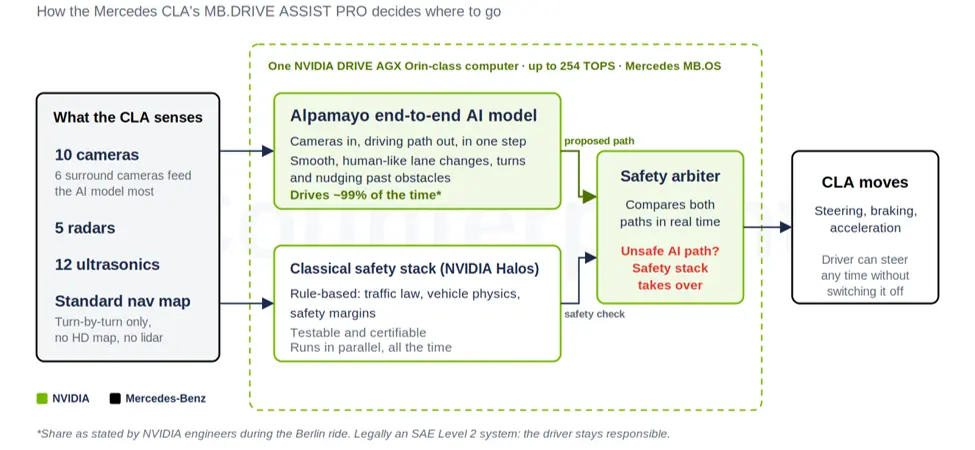
Figure 1: How MB.DRIVE ASSIST PRO decides where to go
The first is Alpamayo, an end-to-end AI model. It looks at the camera feeds and comes up with a path to drive in one step, a bit like how you glance down a street and just know where to go. The NVIDIA team told me it does around 99% of the driving, from lane changes and speed to turns and squeezing past obstacles. Most of what it sees comes from six surround cameras: two at the front and two on each side.
The second is a rule-based safety stack built on NVIDIA Halos. Running concurrently on the same DRIVE Orin chip is Halos, NVIDIA’s classical, deterministic stack. An onboard Safety Arbiter continuously compares the trajectories produced by both pipelines. If the Alpha model proposes a path that breaches safety margins, violates kinematics, or risks collision, Halos instantaneously takes command. This bridges organic driving behavior with ASIL-certifiable automotive safety.
No lidar, no HD maps
A decisive industry shift reflected in the Hyperion L2++ platform is the deliberate departure from high-definition (HD) mapping and costly LiDAR hardware in consumer production vehicles:
- Standard Definition (SD) Map: The system relies entirely on standard turn-by-turn navigation feeds (e.g., standard mapping directions) rather than centimeter-level prior maps. The map solely instructs the vehicle that an upcoming turn is needed and onboard neural vision dynamically discovers drivable space, road boundaries, and turn corridors on the fly.
- Resilience to Dynamic Infrastructure: HD maps are sometimes not reliable when there are sudden road closures, lane shifts, or construction. NVIDIA's mapless approach visually assesses changes in real time, steering smoothly around cones and barriers without experiencing localization faults.
- Hardware Tiering Strategy: For hands-on/eyes-on L2++ products, vision and radar running on DRIVE Orin provides complete urban functionality at accessible automotive cost. For Level 3/Level 4 'eyes-off' systems (Hyperion 10), NVIDIA transitions to dual DRIVE Thor compute modules combined with LiDAR to handle manufacturer liability redundancy.
This keeps the cost down. HD maps have to be built and updated street by street, and lidar is still pricey, which is a big reason Mercedes can put this in a CLA and not only in an S-Class. It also handles change better. A pre-built map is out of date the moment a road crew puts out cones. A car that reads the road live just drives around them.
Lidar and more computing power still matter for robotaxis and future eyes-off cars. NVIDIA’s Hyperion 10 design for Level 4 uses two DRIVE AGX Thor chips, 14 cameras, 9 radars, one lidar and 12 ultrasonics. In Berlin, Mercedes said it’s extending its work with NVIDIA on Hyperion and Alpamayo for its Level 3 and Level 4 plans.
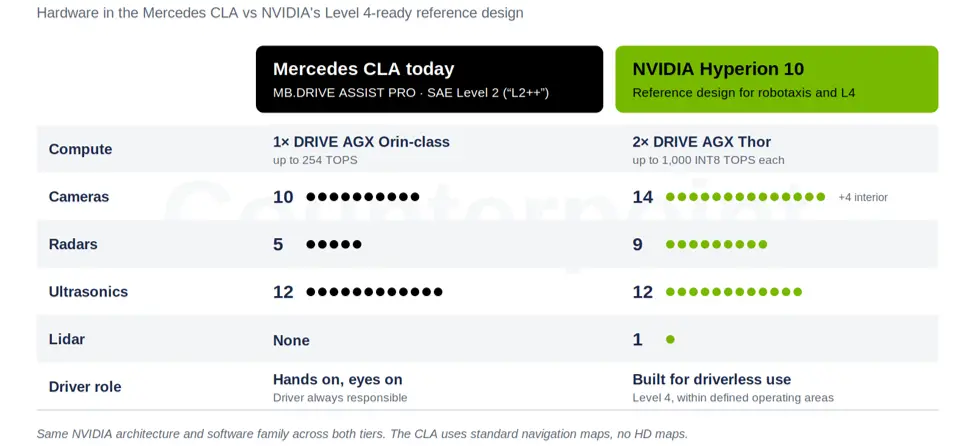
Figure 2: What’s in the CLA today vs NVIDIA’s Level 4-ready design
To clear one thing up: there’s no CLA with lidar or with Mercedes’ Level 3 DRIVE PILOT. That system was only on the S-Class and EQS, and Mercedes hasn’t brought it to the new S-Class for now.
Berlin is not San Francisco but Cross-Continental Transfer Learning & Adaptations Key
NVIDIA has been showing this software in San Francisco, so it had to learn German road habits without turning into a separate product. What we have seen is that a key obstacle in commercial AV scaling is localizing behavior across differing traffic regulations without fragmenting the underlying codebase. The Berlin drive demonstrated effective cross-continental adaptation between North American and European rules: Four differences came up on my ride.
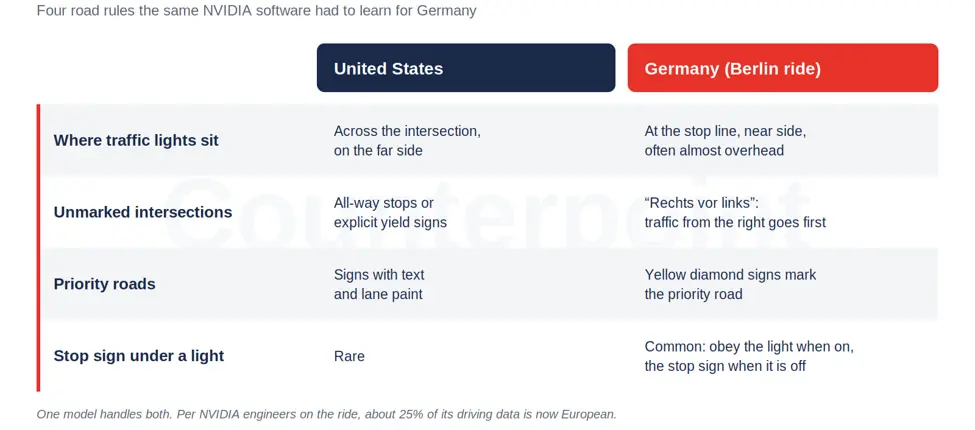
Figure 3: Four road rules that differ between the US and Germany
The NVIDIA engineers put this down to how much data the model has seen. They told me it was pre-trained on about 10 million hours of general web video and around 1 million hours of driving, then fine-tuned with reinforcement learning. Adding roughly 25% European driving data actually made it better in San Francisco’s crowded streets too. For rare long-tail anomalies, NVIDIA uses its Cosmos models to build synthetic test scenarios before new software goes out to cars.
Urban Nuance: Intent Detection, Lane 'Nudging', and Collaborative Steering
What was surprising to see how
- Context-Aware Object Recognition: The vision system could detect delivery truck hazard flashers or open cargo doors. The car also figured out pedestrian approach vectors, predicting stalls well before standard ADAS systems.
- Dynamic Lane Nudging: When confronting double-parked vehicles or road maintenance in narrow corridors, the car could verify oncoming clearances, use the opposing lane to nudge smoothly around, and return cleanly to its path.
- Collaborative Steering: The car could effortlessly adjust the steering wheel to avoid sudden potholes or road debris without triggering disengagements. Once the guidance is complete, the autonomous planner seamlessly re-engages. Mercedes calls this cooperative steering.
“Every vehicle programmable, updatable and perpetually improving”
— Ali Kani, VP of Automotive, NVIDIA, on the CLA launch
Mercedes-Benz Anchor CLA Becomes Anchor
The CLA is the first production car with NVIDIA’s full driving stack, and the first Mercedes on the new MMA platform with MB.OS. The Berlin test drive provides a clear window into how NVIDIA's AV stack translates directly into consumer vehicles, anchored by Mercedes-Benz and its next-generation MMA (Mercedes-Benz Modular Architecture) platform, premiering with the electric CLA-Class:
- Centralized Compute Architecture: Mercedes-Benz is replacing distributed multi-vendor microcontrollers with a consolidated central computing brain driven by NVIDIA DRIVE Orin and DRIVE Thor, unified under the Mercedes-Benz Operating System (MB.OS).
- Scalable Feature Tiering: Entry and mid-tier trims can offer high-performance, cost-effective urban L2++ navigation using standard camera and radar suites, while premium configurations integrate roofline LiDAR and redundant compute to deliver eyes-off Level 3 Drive Pilot.
- Data Engine & Monetization: Standardized compute across the entire MMA vehicle family establishes an expansive fleet capable of continuous over-the-air (OTA) capability improvements and monetization through software features. With thousands of cars carrying the same hardware, Mercedes and NVIDIA also get a steady stream of real driving data to improve the software, which then goes back out to the cars
Every CLA has the same sensors, but MB.DRIVE ASSIST PRO is a paid extra. In the US it’s $3,950 for three years. In Germany, Mercedes is starting with selected customers in Stuttgart and Munich from late 2026, with a free one-month trial, and says the UN R171 rules let it expand across the EU without country-by-country approvals. The CLA also scored Euro NCAP’s best overall safety result of 2025, which helps answer the obvious question of whether AI driver assistance is safe enough.
Key Takeaways
NVIDIA has garnered significant commercial partnerships and customers for NVIDIA AV solutions: the computer in the car, the AI model, the safety layer, and the data-centre and simulation tools used to train it all. For most automakers, building that themselves just doesn’t add up anymore.
Mercedes has made its choice. It keeps the customer experience and its own MB.OS, and lets NVIDIA handle the driving brain underneath. Others are heading the same way. At GTC Berlin, Volvo Cars said it’s adopting Hyperion and the Alpamayo Stack, and Bolt, Volkswagen Commercial Vehicles and Einride are building on Hyperion.
“Robotaxis are the first mass-market application of robotics and physical AI”
— Jensen Huang, NVIDIA CEO, GTC Berlin 2026
The big questions now are about money. Will drivers pay a subscription for help in city traffic? And if more brands run the same NVIDIA system, how do they make their cars feel different? After this ride, I’m convinced the tech works on European streets. How many CLA buyers sign up over the next year will tell us if the business works too. For Tesla & GM Cruise, we have seen healthy attach rates.

