- The value of global robotaxi services is projected to reach $168 billion by 2035.
- Global robotaxi fleets are projected to grow to 3.6 million by 2035 with the major push from the US and China. Key cities in Europe and rest of the world will provide significant incremental volumes.
- US-based Waymo and Tesla, and China’s Baidu Apollo Go, WeRide and Pony.ai are poised to be frontrunners, supported by strong tech, funding, and aggressive rollout strategies, building on their early mover advantage.
Seoul, Beijing, Buenos Aires, Hong Kong, London, New Delhi, San Diego, Taipei, Tokyo – April 13, 2026
The robotaxi market is expected to see transformative growth through 2035, with the market value for services projected to reach $168 billion, according to Counterpoint Research’s comprehensive new Global Robotaxi Vehicle Sales and Services Market Forecast covering all key players from the US, China, and global markets. This growth is underpinned by the rapid advancement in end-to-end AI models for autonomy, record investments, and expanding fleet sizes.
Global Robotaxi Fleet and Services Market Size
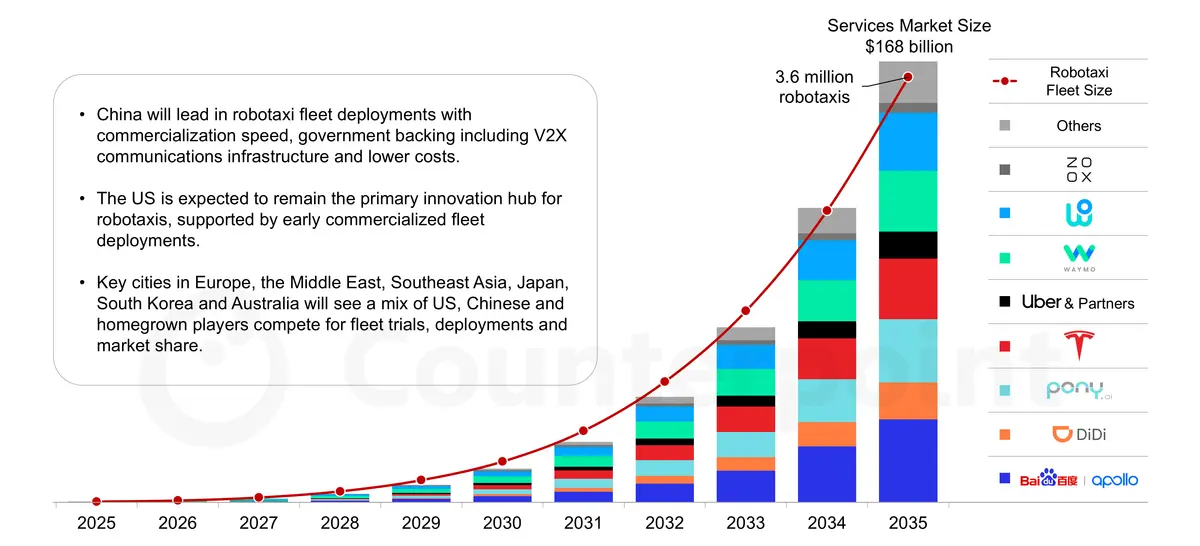
2026 is likely to be a critical inflection point for global expansion, as the robotaxi industry moves beyond localized pilot programs into large-scale commercialization. Leading players such as Waymo, Baidu Apollo, Tesla, WeRide and Pony.ai are scaling operations across North America, China, and key cities in Europe and Asia, signalling the end of the prolonged gestation period that characterized the past 10 years. By 2035, the global robotaxi fleet is expected to reach 3.6 million vehicles, fundamentally reshaping urban transit, and challenging the concept of vehicle ownership.
China will lead in robotaxi fleet deployments with commercialization speed, government backing including V2X communications infrastructure and lower costs. The US is expected to remain the primary innovation hub for robotaxis, supported by early commercialization in cities such as Phoenix, San Francisco, and Austin. The leading robotaxi players also benefit from strong investment capital and the gradual easing of safety exemptions by regulators for vehicles without traditional controls.
Senior Analyst Murtuza Ali said, “The robotaxi industry is entering a phase of rapid expansion along with the creation of high-margin, scalable services. By 2035, China and the US will together drive the majority of the global fleet deployment. However, key cities in Europe and Asia will enable further growth opportunities.”
Waymo has set a benchmark for commercial viability through its deployment in US cities, although Tesla’s entry into the dedicated robotaxi space in 2025 with its Austin pilot, has introduced new competitive pressure. While Waymo continues its ambitious expansion in the US and select cities outside the country, Tesla, which depends on vision-only autonomous technology, aims to accelerate its robotaxi deployments through its dedicated Cybercab vehicle. Other players like Zoox, Uber (the latter with its various partners), along with players like Lyft, Motional, May Mobility, Avride, are also expected to capture market share by offering more choice to consumers.
Associate Director Kevin Li said, “In China, Baidu is leading in deployments with its Apollo Go operating in major cities such as Wuhan, Beijing and Shenzhen. However, there too, major competitors WeRide and Pony.ai, funded through their IPOs in late 2024, have made significant progress over the past year, increasing their fleet sizes as well as operational domain. Together, these three leading companies are expected to corner the majority of the Chinese robotaxi market. Alibaba-backed Didi, China’s leading ride hailing company, is also trialling its L4 autonomous vehicles in Guangzhou, Shanghai and Beijing and may yet emerge as a late challenger in the robotaxi market.”
Key cities in Europe, the Middle East, Southeast Asia, Japan, South Korea and Australia will see a mix of US, Chinese and homegrown players like Wayve, MOIA, Grab, Bolt, Go Inc. and Kakao T compete for fleet trials, deployments and market share.
Research Director Peter Richardson said, “The regional lens in robotaxi market growth is critical. China’s early-mover advantage in regulatory approval and infrastructure will drive the largest absolute robotaxi fleet numbers, while the US leads in technological sophistication and per-vehicle utilization. Europe’s robotaxi growth will be more measured early on due to regulatory hurdles, but will have high-quality returns, while rest-of-world markets will accelerate post-2030 as cost-effective vehicle platforms mature.”
Counterpoint Research’s Global Robotaxi Sales and Market Forecast is based on proprietary bottom-up modelling of robotaxi vehicle fleet growth, utilization rates, unit economics, competitive positioning of key players, and potential regional regulation evolution and demand drivers. It provides actionable insights for OEMs, technology suppliers, fleet operators, investors, and policymakers. The report breaks down projections across four key regions – the US, China, Europe, and Rest of World – providing forecasts for annual new robotaxi vehicle sales, cumulative fleet sizes, vehicle sales revenue, and robotaxi services revenue.
The forecast report ‘Global Robotaxi Vehicles Sales and Services Market Forecast’ is now available for purchase at report.counterpointresearch.com
Feel free to reach us at [email protected] for questions regarding our latest research and insights.
About Counterpoint Research
Counterpoint Research is a global market research firm specializing in products across the technology ecosystem. We advise a diverse range of clients – from smartphone OEMs to chipmakers and channel players to Big Tech – through our offices located in the world's major innovation hubs, manufacturing clusters and commercial centres. Our analyst team, led by seasoned experts, engages with stakeholders across the enterprise – from the C-suite to professionals in strategy, analyst relations (AR), market intelligence (MI), business intelligence (BI), product and marketing – to deliver services spanning market data, industry thought leadership and consulting. Our core areas of coverage include AI, Automotive, Consumer Electronics, Displays, eSIM, IoT, Location Platforms, Macroeconomics, Manufacturing, Networks and Infrastructure, Semiconductors, Smartphones and Wearables. Visit our Insights page to explore our publicly available market data, insights and thought leadership, and to understand our focus, meet our analysts and start a conversation.


