

- India’s smartphone shipments declined 20% YoY in Q3 2026, as higher device prices weighed on consumer demand.
- Samsung reclaimed the top spot after nine quarters with a 17% share. Further, it was the only player among the top five to register YoY growth during the quarter.
- Ai+ Smartphone was the fastest-growing brand in Q3 2026, recording 306% YoY shipment growth, supported by an expanded product portfolio and increasing market presence.
- Sub-INR 20,000 shipments declined by 47% in Q3 2026, as rising model prices pushed devices into higher price bands.
- OEMs are expected to implement another round of price hikes after the festive season sale.
New Delhi, Beijing, Berlin, Buenos Aires, Fort Collins, Hong Kong, London, Seoul, Taipei, Tokyo – October 22, 2026
India’s smartphone shipments fell 20% YoY in Q3 2026 (July–September) to their lowest level in a decade, according to Counterpoint Research’s Monthly India Smartphone Tracker. Record-high memory prices drove up device costs, pulling down shipments for most brands. Amid persistently soft demand, OEMs held back on channel inventory, even ahead of the festive season.
Commenting on the market dynamics, Research Analyst Shubham Singh said, “Q3 marked a realignment for India’s smartphone market, as a memory-led cost squeeze compounded softer consumer demand. Rising component costs pushed device prices higher, putting increasing pressure on affordability and weakening the traditional mass-market volume engine, particularly below INR 15,000. Consumers became more selective, extended their replacement cycles and deferred upgrades, while OEMs prioritized margin protection, portfolio rationalization and leaner channel inventory over aggressive volume expansion ahead of Diwali. Sub-INR 20,000 shipments declined by 47% in Q3 2026 as rising model prices pushed devices into higher price bands.”
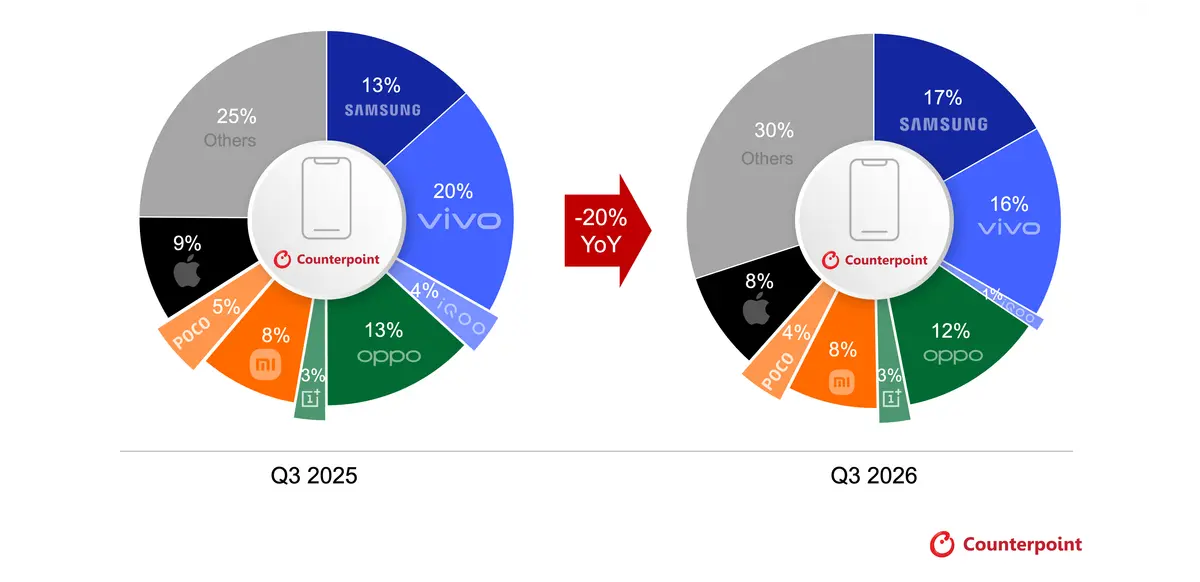
India smartphone Market Volume Share by Brand, Q3 2026 vs Q3 2025
Source: Counterpoint Research Monthly India Smartphone Tracker
Notes: Figures not exact due to rounding
Commenting on the market outlook, Research Director Tarun Pathak said, “Looking ahead, we expect India’s smartphone market to shrink by around 13% in 2026, with continued pricing pressure weighing on affordability and replacement demand. The post-festive seasonal slowdown will add to the pressure, while elevated component costs are likely to drive another round of price hikes after the festive season sale. The impact is already visible in the mass market, where OEMs are restructuring portfolios by introducing more 4G and lower-specification models and trading down specifications across some price segments to manage costs while maintaining price points.
Entering 2027, the market is likely to remain on a challenging footing, as higher device prices continue to extend replacement cycles and limit volume recovery. Growth opportunities will increasingly shift toward the premium and upper-mid segments, while the mass market remains under pressure from affordability constraints and tighter OEM margins. With upfront prices rising, no-cost EMIs, exchange offers and retailer-led promotions will become increasingly important conversion levers, helping consumers manage higher upgrade costs.”
Brand Dynamics
With a 17% share in Q3 2026, Samsung reclaimed the top spot in the market after nine quarters. The Galaxy A series drove volumes, supported by the brand’s balanced online and offline strategy. Samsung's relatively measured price hikes and proactive management of rising memory costs helped it outperform the overall market. Meanwhile, its eighth-generation Galaxy foldables, featuring a passport-style form factor for the first time, gained traction among consumers.
vivo (excluding iQOO) was in second place in Q3 2026, with a 16% share, narrowly trailing Samsung. The T series remained under pressure throughout the quarter. While the Y series continued to drive volumes, vivo introduced the new S series to bridge the portfolio gap between the Y and V series.
OPPO retained the third position with a 12% market share, driven by triple-digit growth in the above-INR 20,000 price segment as it realigns its portfolio following price hikes and places greater emphasis on the mid and premium segments.
Xiaomi (including POCO) ranked fourth with a 12% share. The brand continued to grow in the INR 10,001-INR 20,000 price band, emerging as the top brand. POCO’s C series, alongside Redmi’s A and number series, played a key role in driving the brand’s shipment volumes.
Apple has seen a strong start to the iPhone 18 Pro series in India, with initial sales nearly 20% higher YoY than those of the iPhone 17 Pro series. Continued demand for the iPhone 17 lineup points to healthy consumer interest, even as Apple adjusts pricing across its portfolio amid rising memory and component costs.
Other key trends
- Ai+ Smartphone was the fastest-growing brand in Q3 2026, with shipments increasing 306% YoY. The growth was driven by the brand’s expanded product portfolio, stronger marketing and increased consumer visibility during the quarter. Its focus on building awareness and expanding its reach across key channels helped accelerate its growth.
- Indian brands’ share increased from 2% in Q3 2025 to 7% in Q3 2026, driven by the growing number of domestic brands expanding their presence and boosting shipments in the lower price segments.
- MediaTek remained the leading chipset OEM with a 45% share in Q3 2026, but UNISOC witnessed a resurgence following OEMs’ focus on optimizing profits in the lower price segments.
- Among Transsion’s brands, itel recorded healthy YoY growth of 88%, driven by its 4G portfolio in the sub-INR 15,000 price segment.
- Google witnessed over 50% YoY growth in Q3 2026, driven by the increase in promotional activity and mainline retail expansion. The new Pixel 11 series introduced HiLight and advanced AI capabilities through Tensor G6 and Gemini Intelligence, reinforcing Google’s focus on AI-led differentiation.
Notes: Preliminary estimates; subject to revision
About Counterpoint Research
Counterpoint Research is a global market research firm specializing in products across the technology ecosystem. We advise a diverse range of clients – from smartphone OEMs to chipmakers and channel players to Big Tech – through our offices located in the world's major innovation hubs, manufacturing clusters and commercial centers. Our analyst team, led by seasoned experts, engages with stakeholders across the enterprise – from the C-suite to professionals in strategy, analyst relations (AR), market intelligence (MI), business intelligence (BI), product and marketing – to deliver services spanning market data, industry thought leadership and consulting. Our core areas of coverage include AI, Automotive, Consumer Electronics, Displays, eSIM, IoT, Location Platforms, Macroeconomics, Manufacturing, Networks and Infrastructure, Semiconductors, Smartphones and Wearables. Visit our Insights page to explore our publicly available market data, insights and thought leadership, and to understand our focus, meet our analysts and start a conversation.

