

Executive Takeaways
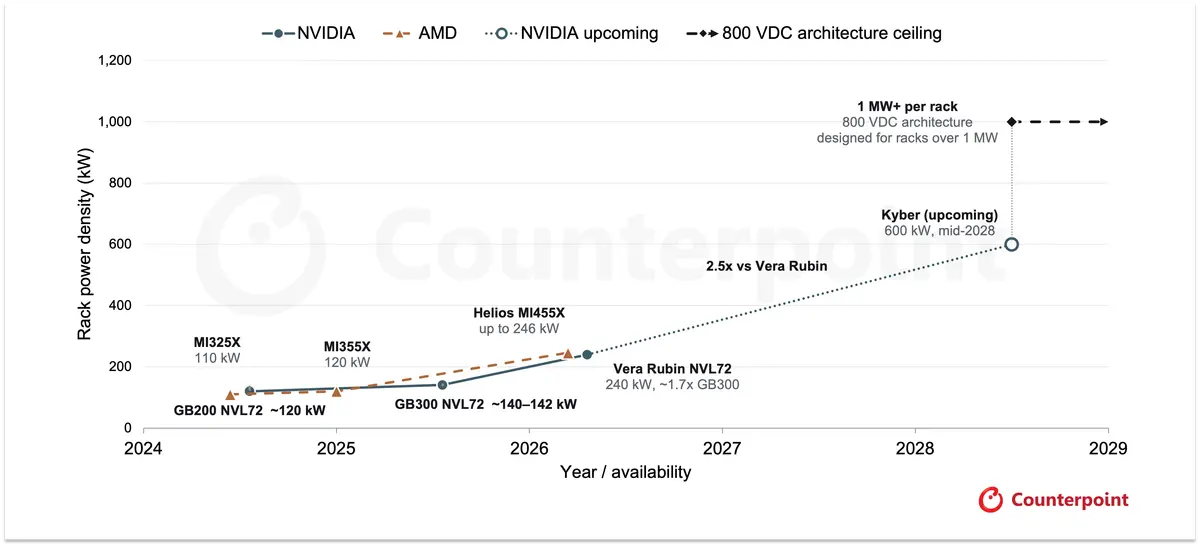
- As rack power rises from 140 kW towards 600 kW and eventually 1 MW, traditional low-voltage distribution requires increasingly large currents, heavier copper infrastructure and more space for power conversion. The move to 800 V direct current (800 VDC) is becoming inevitable as the industry looks to reduce current, simplify power delivery and improve the energy efficiency of AI infrastructure.
- NVIDIA has proposed a monopolar 800 VDC architecture while Microsoft, Meta and Google have jointly developed Mt Diablo power rack (originally the bipolar ±400 V). These indicate the broader shift to 800 VDC AI factories with eventual greenfield deployments with solid-state transformers (SST). NVIDIA and the hyperscalers are now also working towards eventually converging the approaches through OCP.
- Hyperscalers are trying to avoid vendor lock-in and make use of existing solutions from the mature EV-industry to balance efficiency, reliability and grid constraints. Neoclouds have different constraints; they are targeting deployment speed against infrastructure flexibility and capital costs by aligning themselves with NVIDIA to a large extent. We think the eventual supply chain will need to serve both.
Why does AI need a different way to deliver electricity?
Source: Counterpoint Research, Public
Rack power densities are already at ~140 kW and NVIDIA has announced Vera Rubin Ultra (Kyber) at 600 kW.
Largely, the industry agrees that compute is becoming power-hungry, and it needs to provide enough electricity to the chips to extract value. However, the physics behind copper and power conversion means that increasing current will increase the amount of copper (weight & space) and multitudes of conversions.
A traditional data-centre rack distributes power at low voltages, typically 54V direct current to the compute. At low rack power densities, this works out. However, AI racks are becoming hungrier for power as vendors try to fit in multiple GPUs / ASICs into a rack.
Consider a rack consuming 1 MW of power. At 54 V, delivering that power requires approximately 18,500 amperes of current. Higher current requires more copper (up to 200 kg for 18.5 kA), and creates higher resistive losses, making thermal management more difficult. The power distribution hardware also takes up space that would otherwise go to fit in more racks. At 800 V direct current, the requirement falls to 1,250 amperes.
Raising the distribution voltage allows data centres to move the same amount of power with less current, meaning lower copper mass, simplified distribution and more space for useful compute hardware. Hence, the industry is transitioning to 800 VDC in a phased manner starting with racks, conversion equipment, and eventually an entirely greenfield data centre architecture.
This has a meaningful impact on the cost and efficiency of delivering each token. Ideally, as much as possible, power should be spent on computing and not on conversion, cooling or losses.
800 VDC AI Factories
At the OCP Global Summit 2026 in San Jose, NVIDIA outlined a practical route for moving existing data centres from AC power distribution to 800 VDC, without having to change their entire electrical infrastructure. The industry has multiple ways to make this transition, depending on whether a facility is being built from scratch or upgraded.
Three routes to deployment
Source: NVIDIA, OCP Summit 2026
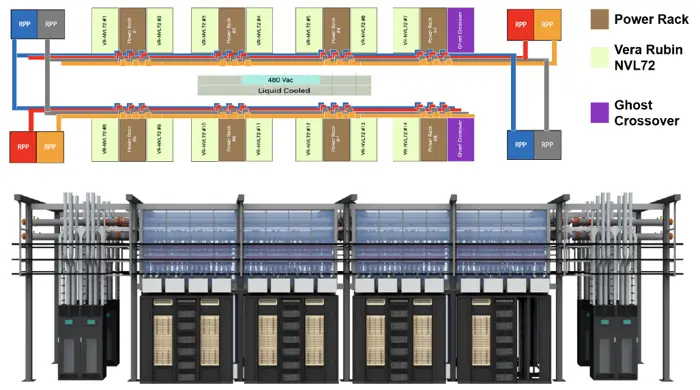
Option A: VR NVL72 Compute Scalable Unit Equipment Layout. 800 VDC is introduced via dedicated power racks put next to compute racks.
Option A – Rack-level deployment: A separate power rack is introduced that converts incoming AC power to 800 VDC, which is then distributed to equipment near the compute racks. Here, it is converted to the lower voltage required by the compute hardware. The operators keep most of their established electrical infrastructure instead of rebuilding the entire facility. Readiness targeted in Q3 2026.
Source: NVIDIA, OCP Summit 2026
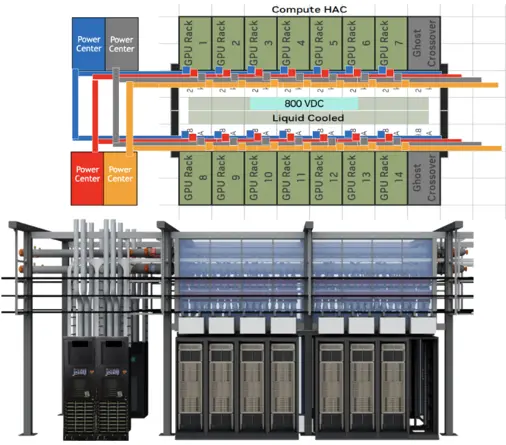
Option B: A centralized DC Power centre with AC input and 800 VDC output, distributes via DC busways/Tap cans or DC Remote Power Panels.
Option B – Cluster-level deployment: Power equipment is placed towards the head of row in a data centre, and DC distribution happens at row-level, to free up space and give more space for retrofits. This one is a more comfortable solution for colocation facilities and neocloud operators that need to support different customer configurations.
Option C. Source: NVIDIA, OCP Summit 2026
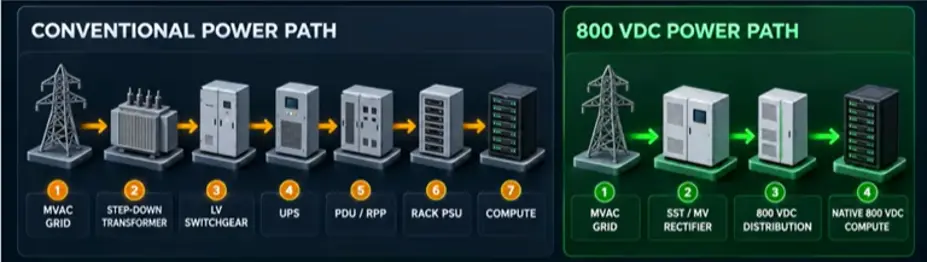
Option C - Solid-state transformer (SST) Approach: This is the greenfield longer-term approach for AI factories. An SST converts medium-voltage AC from the facility's electrical supply directly into 800 VDC, reducing the number of conversion stages between the grid and the compute system. NVIDIA targets Q1 2028 as the deployment horizon. The end-to-end power-path efficiency increases from 82.0% for a seven-stage AC architecture to 87.4% for an SST-based path, potentially saving 50 MW of continuous power per 1 GW of IT load.
NVIDIA’s power infrastructure is running ahead of the compute infrastructure. Its first MGX 800 VDC power racks are expected to enter production in the second half of 2026, followed by row-level power centres in 2027 and solid-state transformer (SST) blocks in 2028. Kyber, the Rubin Ultra rack designed to use 800 VDC natively, is expected in 2027. For next 18 months, options A and B are feasible where power will still be distributed within the rack over a 54 V busbar and the 800 VDC architecture will sit outside the rack.
Monopolar vs bipolar approaches, eventual convergence
NVIDIA's reference architecture above uses a monopolar 800 VDC bus. This approach has two main conductors: a +800 V carries the DC supply to the rack and 0 V reference provides a path through which current flows back to the power source. Microsoft, Google, and Meta propose a different architecture called Mt Diablo. It has two supply rails with opposite polarities around a common midpoint. A load connected between +400 V and – 400 V sees the full 800 V difference. Current flows from the positive rail through the load back to the negative rail. 400 V gives more flexibility in power conversion and component selection and has a mature supply chain because of the established EV power electronics. Based on the implementation chosen by data centres, the power electronics, connectors, grounding and circuit protection will be different.
Most recently, Mt Diablo specifications have evolved to support both bipolar ±400 VDC and monopolar 800 VDC distribution. Meanwhile, Google, Microsoft and NVIDIA are also collaborating through OCP to develop a common 800 VDC architecture. This suggests that the industry is moving towards greater compatibility, and the distinction between NVIDIA’s approach and Mt Diablo is becoming less pronounced.
Microsoft is supporting both 800 VDC and ±400 VDC distribution to power its Azure infrastructure. In our view, this is a balanced approach since Microsoft increasingly relies on NVIDIA GPUs in addition to its own Maia accelerators to meet the increasing AI workload demand. Hyperscalers with custom silicon are likely to support open standards at the level of power racks rather than becoming dependent on proprietary reference designs.

800 VDC Value Chain. Source: Counterpoint Research, OCP Summit 2026
We believe that the operators should be focused on whether power equipment from different suppliers can work together safely and reliably. While greater standardisation could reduce dependence on a single vendor's implementation, if interfaces differ, it could also potentially lead to lock-ins.
We see the actual deployment dates, the availability of suitable high-voltage power semiconductors, and a way where different vendors' equipment can interoperate as the critical milestones. The adoption will depend on demonstrated reliability and total system economics.
In its session, Delta presented 800 VDC-to-50/54 VDC conversion shelves with a reported peak efficiency of 98.5%. These are important in transitional architectures that distribute power at 800 VDC. Delta also demonstrated a fanless, liquid-cooled power supply design and a 2.5 MW coolant distribution unit (CDU).
Megmeet's session addressed the physical design of the power shelf towards a fully liquid-cooled, fanless shelf. It presented a phased change. The 330 kW rack power densities still get served at 54 V with greater reliance on liquid cooling. Generation 3 racks move towards 800 VDC input and fully liquid-cooled power conversion. Generation 4, with more than 600 kW and potentially 1 MW, uses native 800 VDC rack architectures and direct liquid cooling.
Using liquid cooling for both compute and power racks can reduce dependence on air-handling infrastructure and potentially support warmer liquid operating temperatures. It may make dry-cooling more practical in suitable climates and facility designs.
Hyperscalers vs Neoclouds
The key priority for hyperscalers is that 800 VDC and SSTs should deliver measurable gains at the data centre level, and should not increase operational risk. They will plan for the long-term and ensure that upgrades support newer generations of GPUs without needing a replacement with every generation. They would value Option C in the longer run. Furthermore, they will be reluctant to vendor lock-in in the near-term and hence support open OCP specifications like Mt Diablo, which enable them to source sidecar systems from multiple vendors and use the same power infrastructure to support both GPU and custom ASIC racks.
Neoclouds, on the other hand, need a faster time-to-market. Their only KPI is bringing as much compute online as quickly and as cost-effectively as possible. Options A & B are more practical than rebuilding the entire facility around SSTs. Many are likely to adopt NVIDIA’s MGX reference design, which has a ready-made customer base.
Conclusion
In our view, NVIDIA’s 800 VDC and the Mt Diablo will gain traction in different parts of the market even as the specifications converge in the longer run. We expect NVIDIA’s reference designs to lead through till 2027 as it gets a ready customer base in neoclouds, sovereign AI providers, colocation operators, and even hyperscalers currently reliant on GPUs. Potentially the balance can shift to Mt Diablo post-2028 when (and if) custom-silicon from hyperscalers take a significant share of the AI compute hardware deployment. Google’s TPU, Meta’s MTIA and Microsoft’s Maia are three major programmes developed by the companies behind Mt Diablo. In addition, there is AWS’s Trainium and emerging players like Cerebras’s WSE. This may shift the balance giving hyperscalers greater control to keep their power infrastructure independent of any single accelerator vendor.
The supply chain on the other hand has to prepare for both architectures. If the supplier chooses one architecture exclusively, they run the risk of missing opportunities in the other part of the market. We think that converging specifications should decrease the cost of supporting both.
To learn more, contact Counterpoint Research.
Counterpoint’s Global Cloud AI GPU, CPU and Compute ASIC Report, Q2 2026 tracks the global Cloud AI Server market, covering market outlook, ecosystem, and key compute technologies like CPU, GPU, and custom AI ASICs.
Read our coverage on related topics:, New Speeds, New Technologies, New Ways to Market: Five Trends to Watch from OCP, OCP 2026: The AI Battleground Shifts from Compute to Connectivity, NeoClouds: Emerging Specialized GPU Cloud Providers and the Evolving AI Infrastructure Landscape, Google and Qualcomm are Driving On-Device AI Mainstream
