US Inflation Numbers Show Impact of Memory Shortage on PC Prices
The shortage of memory chips resulting from the AI investment boom has impacted computer prices, as measured by the US Consumer Price Index (CPI). For only the second time in the last 15 years (with the first time being the height of the COVID-19 pandemic), computer prices are going up on a YoY basis.
The US Bureau of Labor Statistics (BLS) publishes CPI statistics for hundreds of categories, and it includes more than 300 sub-indices, each with a weighting that indicates the importance of the sub-index to the overall economy. For example, food items comprise 14% of the CPI and gasoline 4%. The category labeled “Computers, peripherals, and smart home assistants” has a weighting of 0.301%, a bit higher than that of televisions, which have a weighting of only 0.105%. The BLS doesn’t break out the three different products included in the label, but we believe that personal computers (desktop, notebook and tablet) constitute the majority of the category, which we will hereafter call simply “computers”.
When the BLS compiles prices for products like computers, its index is based on a “like-for-like” time series comparison. This means that if a new product is introduced with superior features but at the same price as an older product, this would translate to a price drop in the BLS inflation methodology. Thus, the tremendous increases in computers’ processing speed and utility act to drive the equivalent price down in the BLS category.
The CPI sub-index for computers is referenced to a baseline of 100 for December 2007. The most recent data point for the computer sub-index is 35.661. This means that a (hypothetical) computer purchased for $100 in December 2007 would be sold for $35.66 in May 2026. The lowest-ever reading for the computer sub-index was in December 2025 at 33.73; over 18 years, the price of computers dropped by two-thirds. This translates to an average annual price decrease of 5.9%.
The chart here shows the YoY change in the US CPI, which readers may recognize as the more familiar headline definition of inflation, and in the CPI sub-index for computers. In the period from 2012 to 2020, the CPI for computers was always negative on a YoY basis. The spike in inflation for computers preceded by about six months the general spike in inflation in 2021-2022, and undoubtedly, the huge increase in flat panel display prices during that time was a major factor in the PC inflation spike.
YoY % Change in US Consumer Price Index, 2011-2026
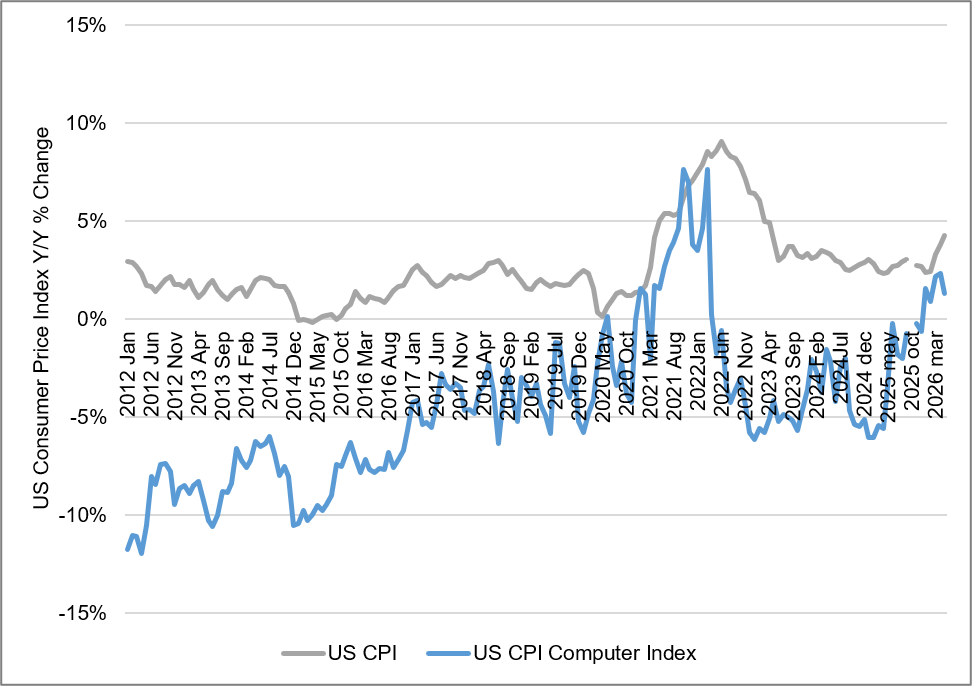
After the pandemic, the computer CPI sub-index hovered in the low single digits % until 2026, when it turned positive. The increasing price of memory is causing PC prices to increase. The increase was relatively small for the first five months of the year – the April YoY price increase of 2.3% is the highest here – but the upward trend appears set to continue. If we consider that the long-term average price decrease is 5.9%, then prices in 2026 are running about 8% higher than the long-term trend.
With the memory shortage showing no signs of letting up, and as higher memory prices cascade through the computer supply chain, we expect prices to increase further in the coming months. We will continue to track this indicator as a metric of the spillover effect of memory on the computer market.
Category
Industry
N/A
Service
Standard
Report Type
Report
Time Period
Other
Receive our insightful weekly newsletter and stay ahead of the competition.
Author
Bob Obrien
Robert J (Bob) O’Brien joined Counterpoint Research as part of its acquisition of DSCC, where he was Co-Founder, Principal and CFO of DSCC. Bob has decades of experience turning market and business analysis into strategic insights in the display and electronics industries. At DSCC, Bob takes the lead role in analysis of display materials, including glass and AMOLED materials, and covers developments in TV and other large-screen display applications. He is the principal author of DSCC’s AMOLED Material Report, the Advanced TV Shipment Report, and the Display Glass Report, and Bob contributes regularly to the DSCC Weekly Review.