The AI Era: How End Devices, Telecom Operators, and Infrastructure Vendors Are Evolving
- End devices are evolving from app‑based AI to system‑based AI. Users state intentions, AI agents handle the rest.
- Telecom operators are shifting from selling bytes to selling tokens. All three major Chinese operators now offer token‑based pricing plans.
- Network is shifting from downlink‑first to uplink‑downlink equivalence. AI devices demand fast uplink and downlink, low latency, and high reliability.
The AI boom has been ongoing for years, but it is now entering a new phase: the era of Agentic AI. In this emerging paradigm, large language models act as the brain, AI agents serve as the central nervous system, and end devices function as the body, working as a whole to enable a new kind of autonomous multi-step tasks.
This shift was on full display at this year's MWC Shanghai held in late June. Unlike previous years, where exhibitors focused on demonstrating isolated AI functions, this year they embed their technologies in real-world scenarios. For example, AI glasses delivering real‑time translation in a crowded exhibition hall, and AI smartphones automatically compiling meeting minutes and emailing them out.
The implications are profound, rippling across the entire industry chain, from end devices and telecom operators to infrastructure providers.
End Devices: Evolving From App‑level AI to System‑level AI
Before the Doubao smartphone debuted at the end of 2025, getting things done on a phone meant opening an app and operating it manually. AI, at that point, was merely an add-on feature, layered on top of the system without changing the device's fundamental nature.
The emergence of the Doubao smartphone signaled a shift. It brought a fundamental shift in the basic unit of interaction: instead of opening apps, users simply state their intention, and the phone, via one or more AI agents, carries out the task autonomously.
In this new paradigm, AI is no longer confined to individual applications. It becomes an integral part of the operating system itself. The system no longer waits for users to click a specific app to invoke AI; rather, it understands multimodal inputs – voice, gesture, text, and images – and even anticipates user needs, autonomously orchestrating apps to complete a user-defined goal.
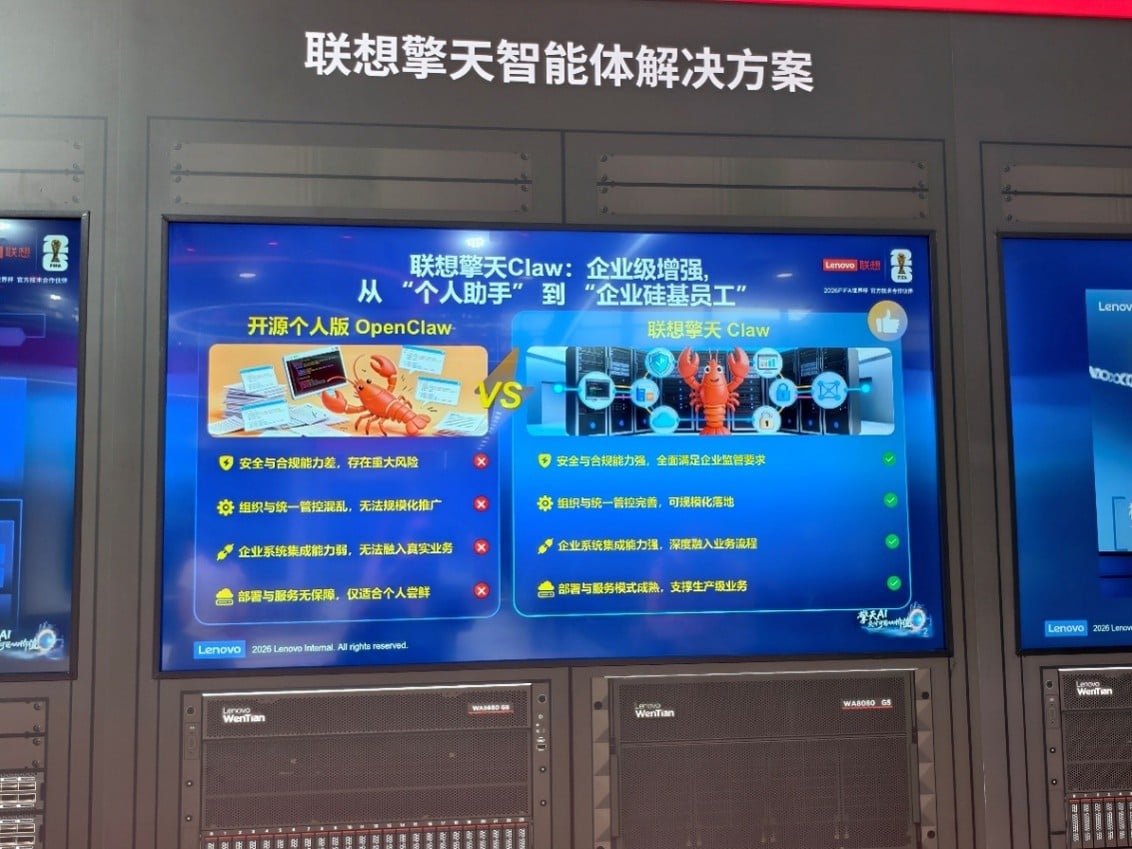
This transformation is not limited to smartphones; it is sweeping across other industries as well. In the PC industry, AI agents like Lenovo’s QingTian Claw now act as digital employees that reside on PCs, stay online 24/7, and perform hands-on tasks autonomously. Robot dogs follow voice commands to fetch what you need, while AI dolls are becoming interactive companions that can respond to human commands.
The deepening fusion of AI and end devices is creating new revenue streams, and telecom operators are racing to secure their share in the AI era. Their business logic is undergoing a historic shift, from "byte traffic" to "token‑based" operations. This year, all three major operators, i.e. China Mobile, China Unicom, and China Telecom, have already tested token-based pricing plans for both individual consumers and enterprise users.
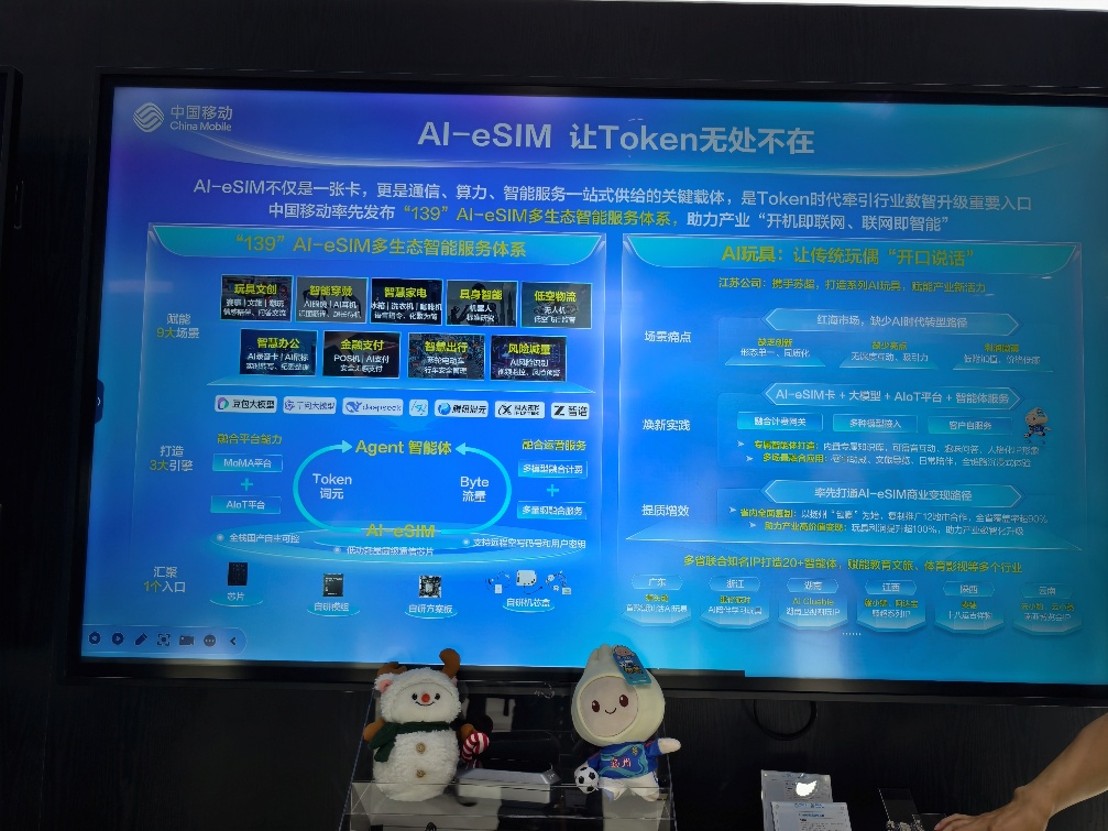
During Shanghai MWC, China Mobile also introduced the 1+3+9 AI‑eSIM intelligent service system.
- 1 = AI‑eSIM chip – the device‑side entry point that connects networks and AI.
- 3 = AIoT Platform (access), Agent Service (orchestration), and Byte+Token operations.
- 9 = nine application scenarios including toy products, financial payment, smart wearables, smart home appliances, smart mobility, risk reduction, robotics, drones and smart office.
Leveraging advanced packaging, the AI‑eSIM chip has been reduced to under 1mm², which is small enough to fit into devices such as AI glasses and smart earbuds that were previously too compact to accommodate a communication module. The chip integrates communication, computing, and AI capabilities, enabling connectivity the moment the device powers on and AI the moment it connects.
However, significant challenges remain. Telecom operators' core strength lies in network transmission, not in pricing power over computing resources. Since token consumption occurs on the model side, where operators have little leverage, they lag far behind cloud giants and top AI players in large model capabilities. Operators might end up just being the "pipes" that deliver computing power without adding much value.
Infrastructure Providers: From Downlink‑first to Uplink‑Downlink Equivalence
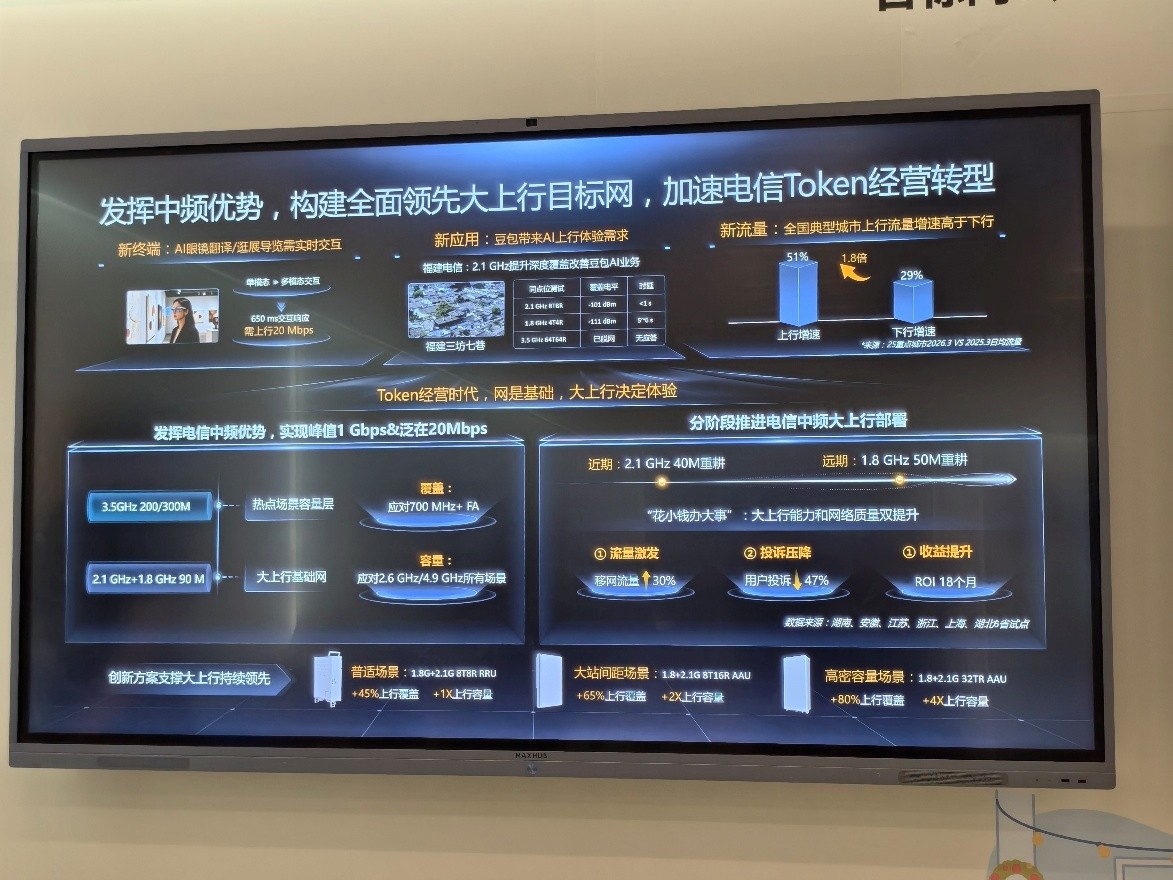
For AI devices and token‑based business models to truly take off, a faster, more capable network foundation is essential. AI devices demand real‑time interaction and must understand and respond instantly, whether users are speaking, taking photos, or recording videos. This requires two‑way, high‑speed, low‑latency connections, not just downlink‑heavy networks of the past. It also requires networks that deliver large uplink capacity with high reliability. That is exactly why leading global operators are accelerating the commercialization of large-uplink services in 2026.
During Shanghai MWC, Huawei showcased its 5G‑A large‑uplink solution in partnership with Shanghai Telecom, with field tests achieving peak uplink rates of 1Gbps and peak downlink rates of nearly 4Gbps.
According to Huawei, the U6GHz band, with its commercially ready end‑to‑end ecosystem, is poised to become the next "golden spectrum." The U6GHz band is capable not only of supporting current mobile AI service development, but also of providing 200MHz/400MHz single‑carrier bandwidth for next‑generation networks. Huawei also calls on the global industry to work together in accelerating the U6GHz spectrum and ecosystem development, fully unleashing 5G‑A's potential and unlocking the vast business opportunities.
The AI era is arriving, and players across the industry chain are actively embracing it. Companies are racing to unveil their solutions, many remain immature, unproven and far from market ready. No single player can make this transition alone. Success hinges on deep collaboration across the entire industry chain, from end device makers to network operators and infrastructure vendors, all have a role to play. For now, the market remains at its early stage, and the road to mass commercialization is still long.
Category
Industry
AI, Telecom
Service
Standard
Report Type
Report
Time Period
Other
Receive our insightful weekly newsletter and stay ahead of the competition.
Author
Alicia Gong
Alicia Gong is a Research Analyst who is tracking smartphone and ecosystem devices at Counterpoint Research. Prior to joining Counterpoint Research, She served at ChinaVenture and Copal Partners.