China Star Highlights Tech Prowess at Display Week
With demonstrations across a wide range of applications at the recently held Display Week, TCL CSOT has staked its claim to technology leadership in the display industry. The entrance to the TCL CSOT booth was dominated by the panel used in sister company TCL’s largest flat-panel TV – a 130” 4K LCD panel that CSOT highlighted as highly efficient. CSOT claimed that the panel had 9% transmittance (a typical LCD is only about 6% efficient at using the backlight brightness to make a picture).
For XR applications, CSOT demonstrated what it called the world’s highest 2200 PPI RGB LCD display, a 2.48” square display with 4K resolution (3840 x 3840). The display employed an LTPO backplane to achieve lower power consumption and higher luminance. Placed beside the LCD was a 2.24” OLED display with 1700 PPI, which CSOT called G-OLED for its glass backplane. Further down were two single-chip full-color microdisplays:
- A full-color 0.28” LED screen with 1280 x 720 resolution for 5131 PPI. CSOT claimed the LED was capable of more than 500,000 nits of brightness.
- A “multi-color” 0.28” LED screen with the same resolution with quantum dot color conversion achieving more than 1,000,000 nits brightness.
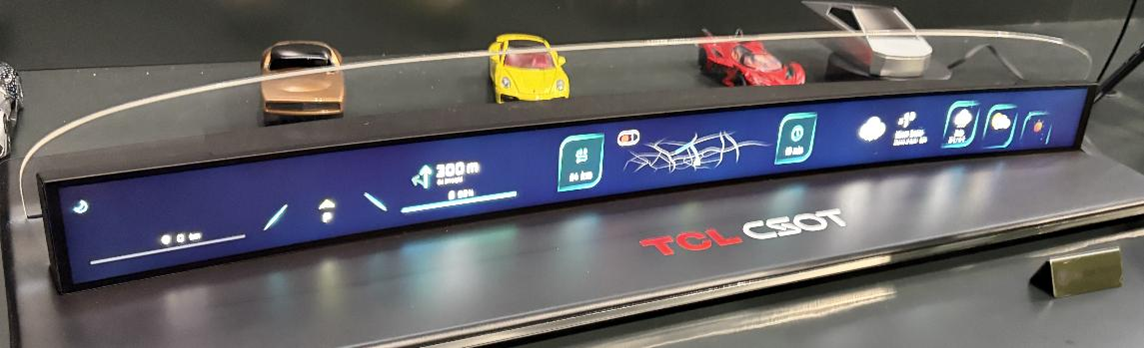
A generous portion of the booth was devoted to automotive display technologies. The first display shown here has an innovative panel drive structure, which allows a single IC to drive the 8K (7680 x 520) resolution panel. CSOT described this as a “far display”, indicating a windscreen application. The display had a radius of curvature of 5,000 mm.
CSOT chose the automotive HUD application for its MicroLED technology with a 14.3” display with 1700 x 650 resolution (127 PPI) capable of 100,000 nits of brightness. CSOT called this a “fully transparent” windshield display. A second MicroLED for AR HUD had a 4.6” screen with 1280 x 720 resolution (319 PPI) and 200,000 nits of brightness. CSOT said it was suitable for navigation and media applications with brightness of 25,000 nits to the eye and more than 6,000 nits in sunglass mode. The AR-HUD had an impressive field of view of 15.4 x 7.7 degrees.
For IT display applications, CSOT flexed its green credentials. It demonstrated a 27” QHD (2560 x 1600) LCD, which it called “PFAS-free” with zero addition in the manufacturing process of what are called “forever chemicals”. CSOT claimed the panel was made with 75% recycled content. A 14” notebook display with in-cell touch and 1920 x 1200 resolution was also PFAS-free and contained 40% recycled content.
CSOT also demonstrated what it claimed to be the “world’s lowest refresh rate” notebook display, a 14” LCD panel with an ultra-low frequency driver in the 0.01 Hz-120 Hz range. The lowest frequency represents one frame per 100 seconds. CSOT claimed that the panel with an oxide backplane achieves a 20%-50% power reduction.
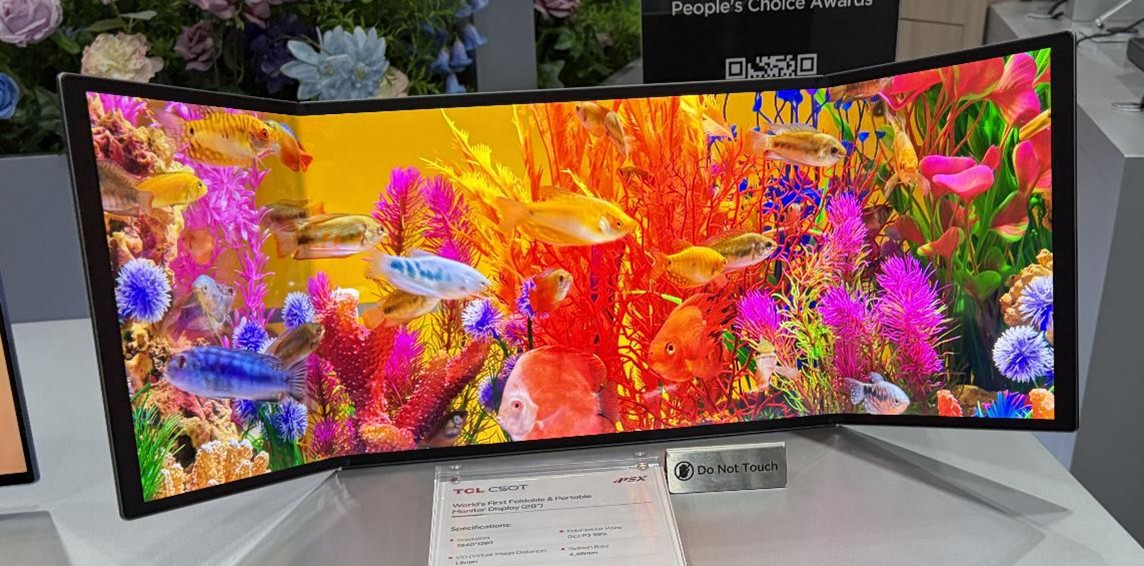
CSOT demonstrated a neat concept for a portable monitor display, a 28” OLED panel with 3840 x 1280 resolution (a 3:1 aspect ratio) in a tri-fold design. The panel has an unfolded thickness of 4.48 mm and a compact 16” size when folded. The storyboard of the tri-fold monitor demo had at least one error, claiming a refresh rate of 4.48 mm.
Whereas CSOT’s demonstration at CES 2026 highlighted the range of products for its inkjet-printing (IJP) OLED technology, the IJP demonstrations at Display Week 2026 were more targeted at specific products. One such demonstration was a 14” tablet display, which the company called “Eye-Care”, with a “tunable” blue light design to mitigate the harmful effects of blue light.
A second IJP OLED demo included a 27” monitor panel with “oxide internal compensation technology” with 3840 x 2160 resolution and a 240 Hz frame rate. Whereas OLED panels with LTPS backplanes require external compensation, this oxide panel has the compensation integrated into the pixel design.
CSOT has branded its IJP OLED technology as “APEX”, which stands for:
- Amazing display experience
- Protective of eye health
- Eco-friendly to build and use
- X-unlimited imaginative potential
One final TV display at the booth was described as the “world’s highest image quality” ultra-LCD TV display. The 85” display had 3840 x 2160 resolution with a four-primary-color design, adding a cyan sub-pixel. CSOT claimed the display delivered 131% of the BT-2020 color area, and an ultra-low reflectivity of 0.7%.
Category
Industry
Display
Service
Display Market Trends
Report Type
Report
Time Period
Weekly
Receive our insightful weekly newsletter and stay ahead of the competition.
Author
Bob Obrien
Robert J (Bob) O’Brien joined Counterpoint Research as part of its acquisition of DSCC, where he was Co-Founder, Principal and CFO of DSCC. Bob has decades of experience turning market and business analysis into strategic insights in the display and electronics industries. At DSCC, Bob takes the lead role in analysis of display materials, including glass and AMOLED materials, and covers developments in TV and other large-screen display applications. He is the principal author of DSCC’s AMOLED Material Report, the Advanced TV Shipment Report, and the Display Glass Report, and Bob contributes regularly to the DSCC Weekly Review.