As we have done each year since 2019, in the first edition of our Weekly Review for 2026, we have some predictions for the year ahead. These predictions focus on developments important to the display industry. Here goes:
#1: LCD TV Panel Prices Will Not Drop Below the Levels of December 2025
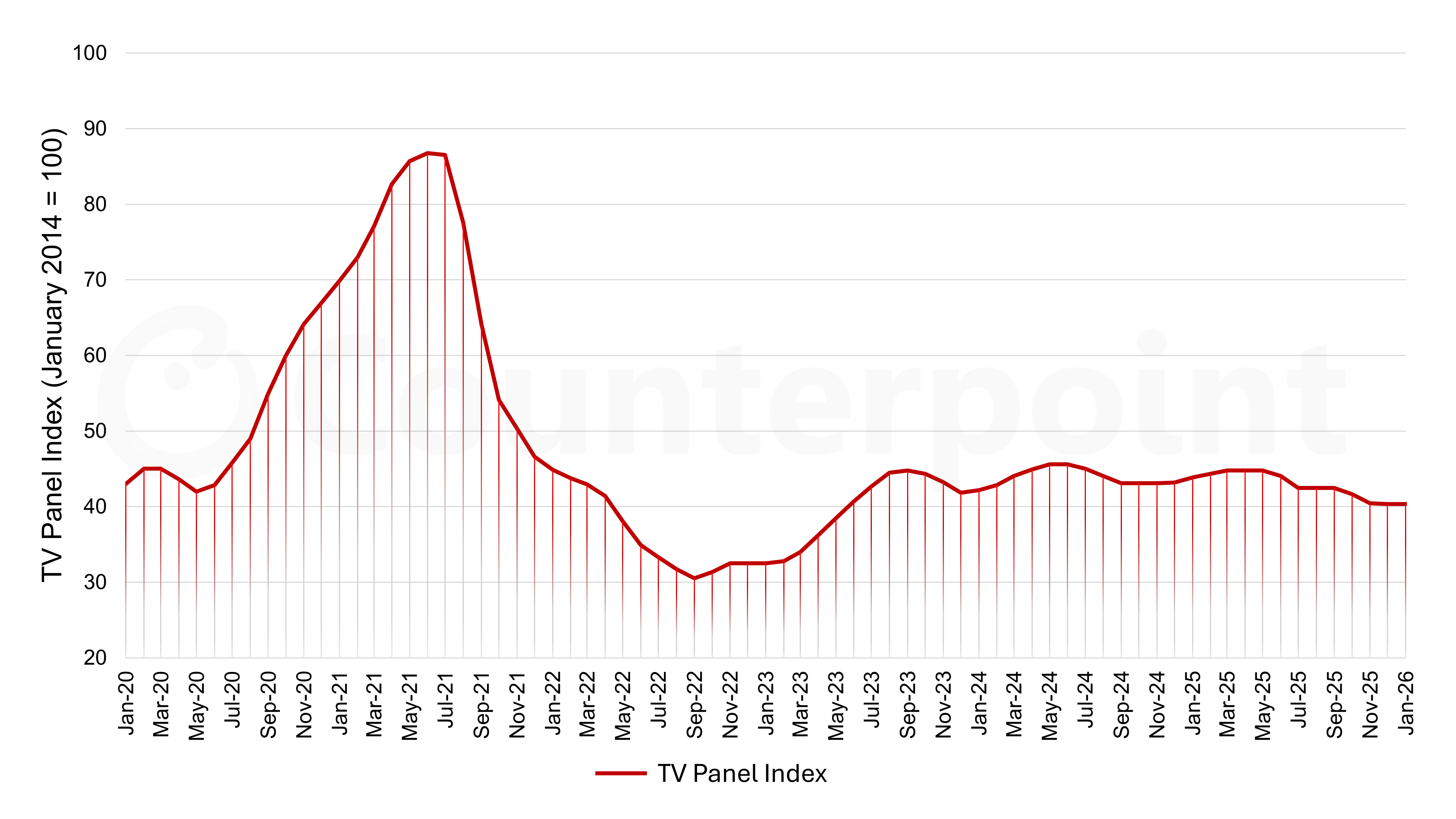
While there are a few important companies in the display industry that have stopped making LCD TV panels, notably the two South Korean firms, LCD TV panel prices remain an important indicator for the rest of the industry. We have been tracking these prices since 2014, and our TV panel price index has shown the waves of oversupply and shortage that characterized the Crystal Cycle.
Whereas our price index showed wild swings in the 2010s, and even wilder swings in the boom and bust cycle of the pandemic, since 2023, the index has become dramatically less volatile. We attribute this change to the concentration of LCD supply in China, and specifically among the three biggest companies – BOE, China Star and HKC. These companies have cleverly managed the general oversupply in the industry, slowing down their utilization when prices were falling and ramping up when prices were rising.
LCD TV Panel Price Index, January 2020-March 2026(E)
Source: Counterpoint Research.
The result, as seen on the chart here, is that prices have effectively stabilized within a tight range. For our TV price index, that range has been from 40.4 to 45.6. As a real-world example, that means that prices for 32” TV panels have stayed in the range of $32 to $38, and 65” TV panels have stayed in the range of $162 to $179.
While it’s possible that a surge in TV demand could make prices spike higher, the industry has plenty of capacity to supply a passing gear to keep a lid on prices. Similarly, while demand softness or an inventory train wreck could lead to prices falling, the willingness of the three Chinese panel makers to manage utilization will prevent prices from falling too far.
As shown on the chart, we have hit a recent minimum in December 2025 and expect prices to increase in Q1 2026. Judging from the past few years, the price rally will not extend more than 2-3 quarters, and prices are likely to fall in the back half of the year. But if they fall, they will not fall below the levels of December 2025.
#2: Phosphorescent Blue OLED Emitters Will Have Minimal Impact
A more efficient blue emitter has been the “Holy Grail” of OLED materials companies for more than a decade. Until recently, phosphorescent blue had been regarded as the main next-generation evaporation material through 2025. However, the lifetime issue of phosphorescent blue has still not been overcome, and the outlook at the end of 2024 — that mass production of OLED panels using phosphorescent blue would be difficult even in 2025 — remains valid. As a result, deuterated fluorescent blue is projected to account for most of the blue-related revenue in 2026 as well.
That said, development efforts are actively underway in several directions – improving the short lifetime of phosphorescent blue through hybrid tandem structures that combine phosphorescent blue with HF (hyperfluorescent) blue or fluorescent blue, as well as through competing blue technologies such as Thermally Activated Delayed Fluorescence (TADF) and HF. However, none of these technologies has yet demonstrated meaningful results in blue applications, making it unlikely that they will achieve commercial success in 2026.
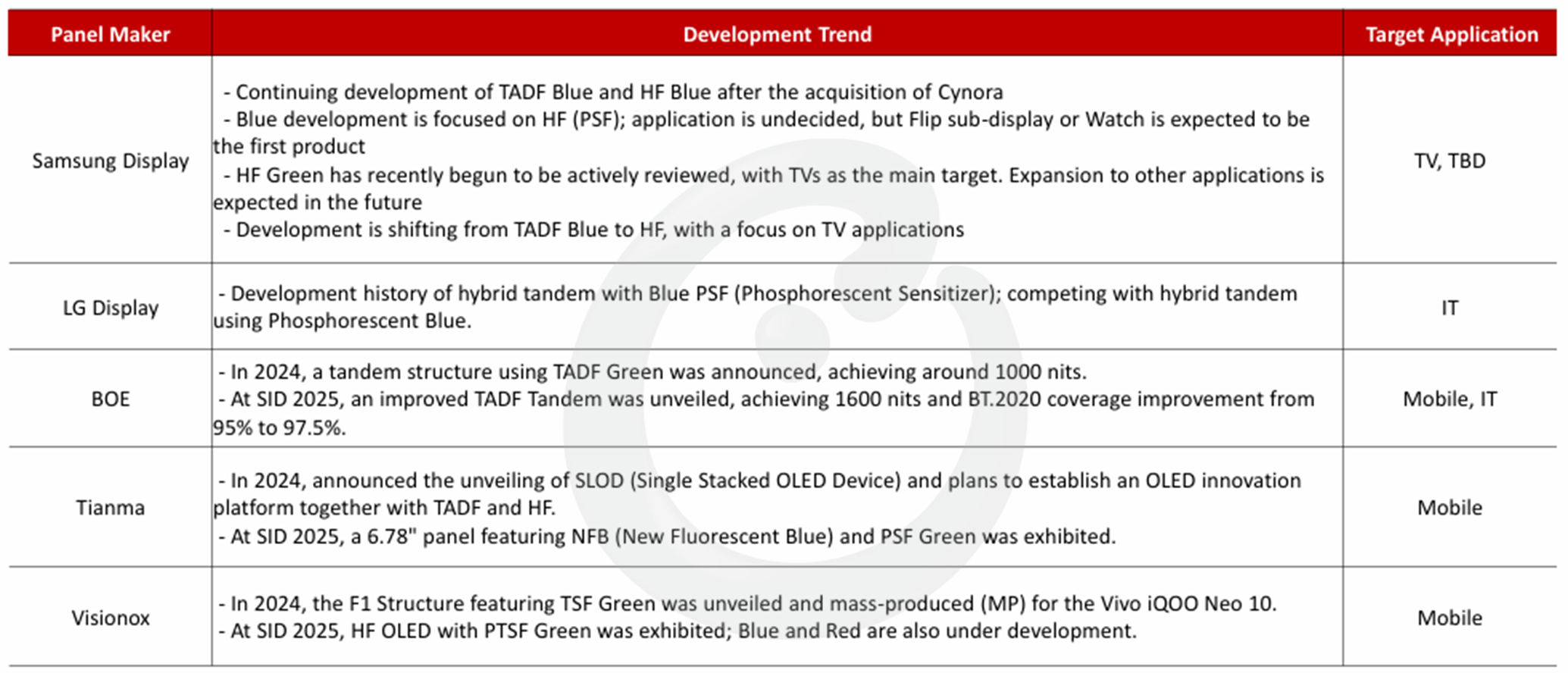
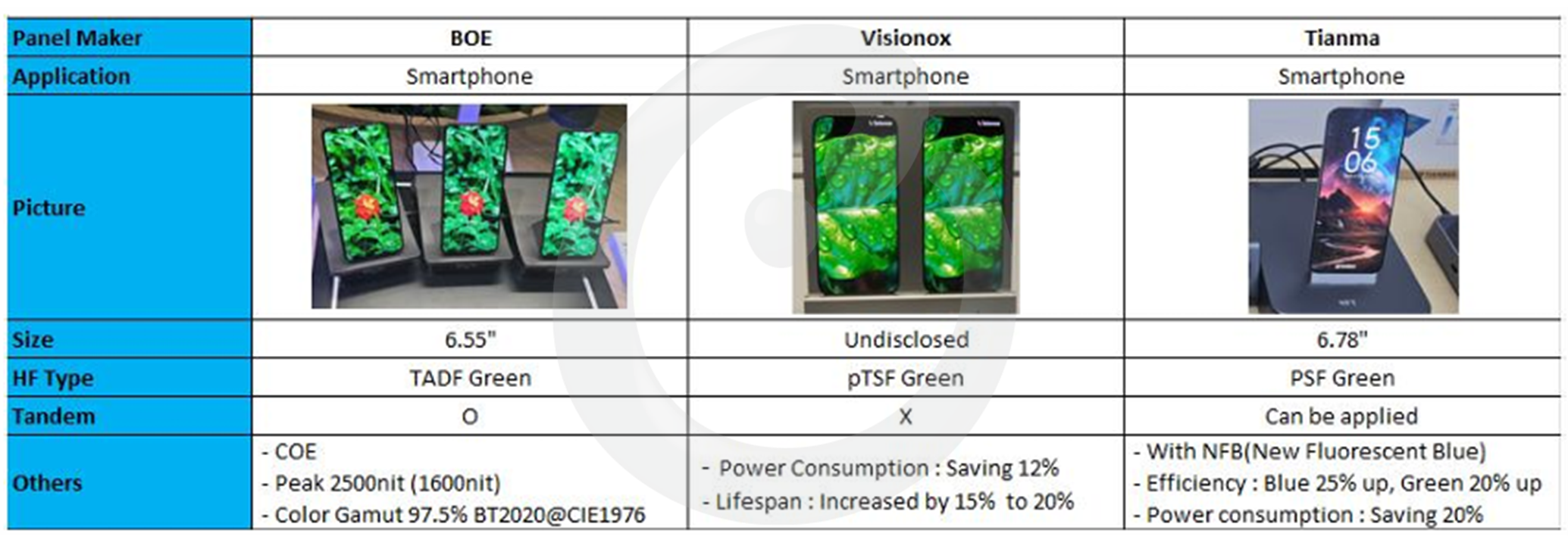
In contrast, HF technology is showing meaningful progress in green. Starting with the unveiling and mass production of the F1 structure featuring TSF green for the vivo iQOO Neo 10 at the end of 2024, TADF and HF technologies have been actively showcased and promoted by Chinese panel makers at SID 2025. In addition, at the end of 2025, Huawei’s Mate 80 RS Ultimate model implemented a tandem structure combining TSF and phosphorescent green, achieving a peak brightness of 8,000 nits and BT.2020 color gamut coverage.
In 2026, the number of models incorporating HF technology — primarily from Chinese manufacturers — is expected to increase, although shipment volumes are likely to remain limited. Nevertheless, if the adoption of HF-based models continues to expand, it could bring about significant mid- to long-term structural changes in the evaporation material market, which has traditionally been centered on phosphorescent materials.
New Evaporation Materials Development by Panel Makers
Source: Semi-Annual AMOLED Materials Report Aug 2025 New Evaporation Materials Developments at SID 2025
Source: Semi-Annual AMOLED Materials Report, August 2025
To quantify this prediction, we predict that UDC sales of phosphorescent blue emitter material will be less than $10 million in 2026. Because the Q4 2026 sales will not be disclosed until February 2027, we will count the four quarters from Q4 2025 to Q3 2026. For comparison, UDC sales of blue emitter material from Q4 2024 to Q3 2025 were $4.2 million out of a total of $351 million in material sales.
#3: India’s First Display Fab Announcement Will Happen in Early 2026
For the third year in a row, we are expecting to see an announcement about an FPD fab in India. We have been wrong twice, but as they say, the third time is the charm. The reasons to expect FPD production to arise in India are compelling:
The domestic TV market in India is the third largest country market in the world after China and the US, but unlike China and the US, the Indian market is continuing to grow.
China and South Korea together account for nearly 100% of global OLED production capacity, while China and Taiwan control about 95% of global LCD capacity. This unprecedented concentration has made displays one of the most geopolitically exposed components in the electronics supply chain.
Over the past three years, global OEMs have aggressively pursued China+1 and Korea+1 sourcing strategies to mitigate geopolitical, tariff and supply-continuity risks. While semiconductors have been the initial focus, displays are now the next logical and unavoidable frontier.
Since the launch of the India Semiconductor Mission (ISM 1.0) in December 2021, India has attracted several major semiconductor and OSAT investments. However, the FPD industry, despite being the single largest cost component after chips in most electronic products, has remained absent from India’s manufacturing roadmap.
India today commands ~9% of global FPD revenue, yet 100% of its display demand is imported. Smartphones and TVs alone contribute nearly 80% of domestic FPD consumption, while IT displays and automotive panels are poised for sustained growth as vehicle digitalization and local electronics manufacturing deepen. These dynamic underscores a striking imbalance as India has become a powerhouse of consumer demand, particularly in TVs, yet it remains entirely dependent on imported display panels.
From a China+1/Korea+1 perspective, India stands out on multiple fronts:
Large demand that can anchor fab utilization from day one
Rapidly maturing electronics assembly ecosystem across mobile, TV, IT and automotive
Policy-backed incentives already proven viable through semiconductor investments
Export potential as global OEMs actively seek non-China, non-Korea display supply options
With ISM 2.0 expected to be announced in early 2026, it is increasingly likely that:
The incentives for FPD fabs will be enhanced
One or more global panel makers, initially LCD-focused with OLED migration over time, will evaluate India as a China+1/Korea+1 production base
We predict this announcement will come in the first half of 2026.
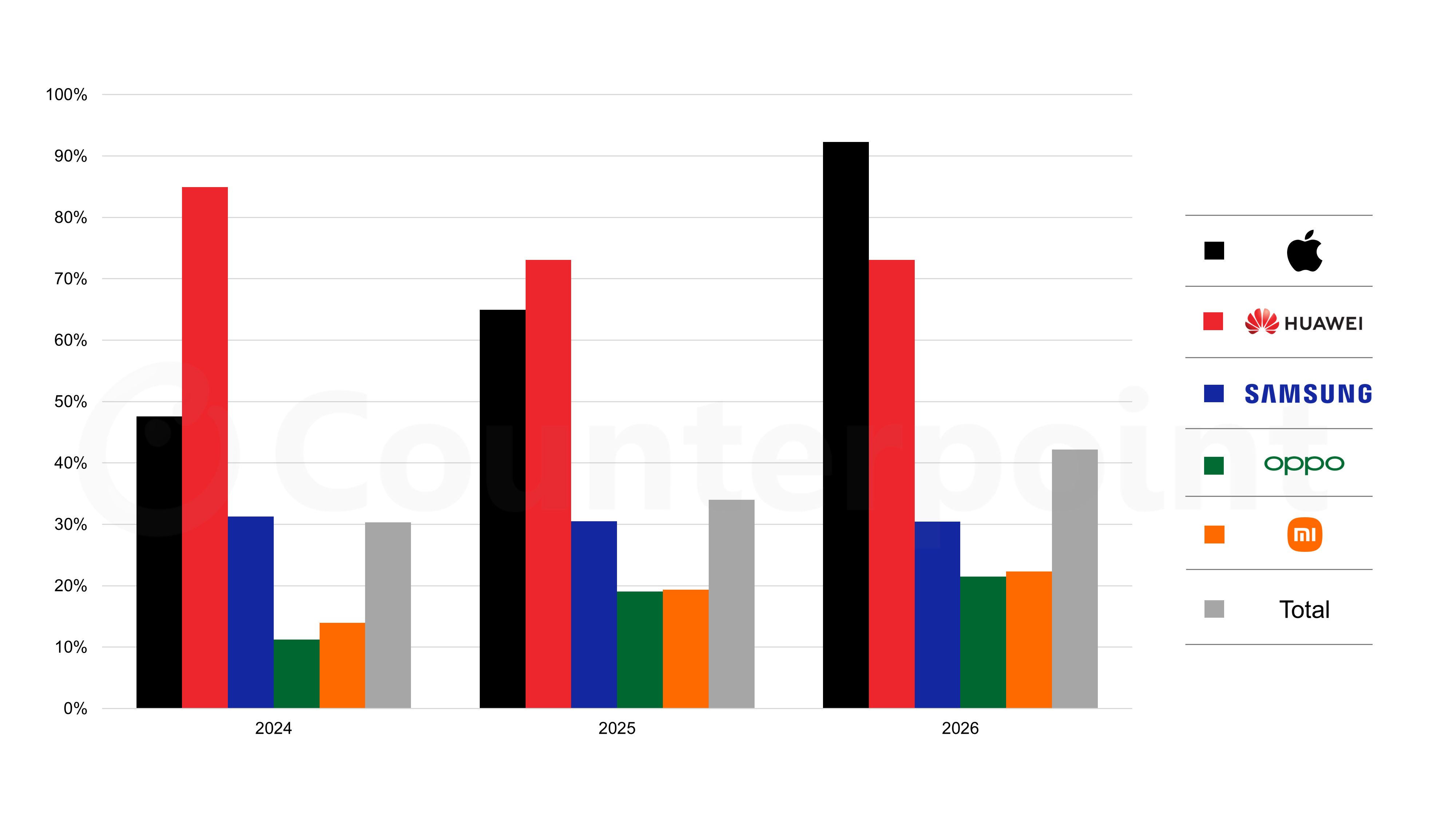
#4: LTPO Backplanes Will Increasingly Dominate High-End Smartphones and Grow to More Than 40% of OLED Smartphone Panels
LTPO backplanes and 144/165Hz refresh rates have become the standard in premium OLED smartphones, as OEMs prioritize power efficiency, smoother UX, and premium differentiation.
As smartphone OEMs increasingly prioritize power efficiency, adaptive refresh rates and premium user experience, LTPO’s ability to dynamically scale refresh rates, while reducing power consumption, makes it the preferred solution, particularly for mid-to-high-end devices. With LTPO costs continuing to decline and panel makers expanding LTPO capacity, adoption is now moving rapidly beyond flagship models.
In parallel, 144Hz and 165Hz OLED displays will emerge as the new mainstream performance standard. What began as a gaming-centric feature is now becoming a broader differentiation lever across smartphones, driven by smoother UI experiences, AI-enhanced content and increasingly powerful application processors capable of sustaining higher frame rates. As panel yields improve, higher refresh rates are quickly transitioning from niche to necessity.
% LTPO BackplanesforSelected Smartphone Brands
Source: Counterpoint Research Quarterly OLED Shipment Report
#5: Ultra-Slim Smartphone Designs Will Wither Based on Weak Demand
2025 saw the introduction of a new category in smartphones as Samsung introduced its Galaxy S25 Edge and Apple launched the iPhone Air. Billed as the thinnest iPhone ever, Apple calls the Air “impossibly thin and light” at 5.6 mm and 165 gm. The Air beats the Edge for thinness by a margin of 0.2 mm, but the Edge is 2 gm lighter.
In both cases, the new thin products have some trade-offs that appear to diminish their appeal to consumers. Comparing the S25 Edge to the S25+, both phones have the same display and the Edge is 1.5 mm thinner and 27 gm lighter. For that extra thickness and weight, though, consumers get an additional rear camera (three instead of two) and a 25% larger battery. Furthermore, the Plus buyers get to keep $100 since the Edge is more expensive.
Similarly, when comparing the iPhone Air with the iPhone 17, the 17 can’t compete on thinness since it is 2.3 mm thicker, but the difference in weight is only 12 gm. The screen on the Air is 3% larger but otherwise the displays are comparable. Like the comparable Samsung models, the Air has one fewer camera option but has a shorter battery life and is more expensive (by $200 in Apple’s case).
Most consumers have concluded that slim and light is not worth the extra cost and diminished features. Counterpoint estimates that the Air represented less than 10% of iPhone 17 series panel shipments in 2025, while the Edge represented only about 8% of Galaxy S25 series panel shipments.
As a result, although we believe that both Apple and Samsung have prepared successors to their thin and light models, we predict that neither the Galaxy S26 Edge nor the iPhone 18 Air will be introduced in 2026.
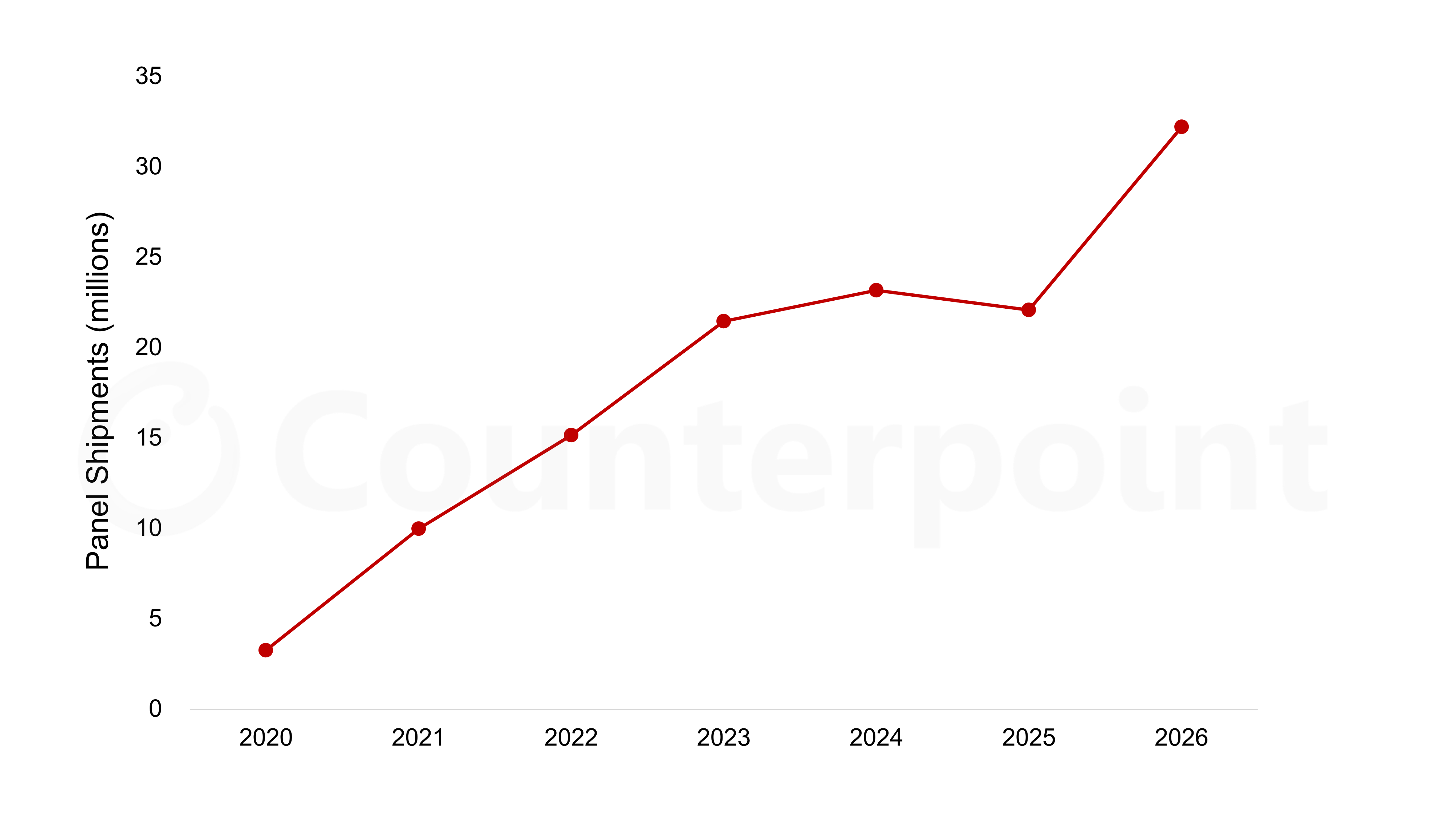
#6: Foldable Smartphone Panel Shipments Will Increase by 50%
We correctly predicted that foldable smartphone panel shipments would decrease in 2025, the first year that the segment did not grow since Samsung introduced the category in 2019. A part of the downturn was related to a dearth of new models, but another factor may have been an expectation of Apple’s entry into the category.
OLED Panel Shipments for Foldable Smartphones
Source: Counterpoint Research Quarterly OLED Shipment Report
We expect Apple to introduce a foldable phone as part of its fall product launch. Our sources expect an in-fold type with a 7.6” OLED screen with a resolution of 2160 x 1916 for an aspect ratio of 8:9. We don’t know what Apple will call its foldable phone, but we expect it to quickly rise to the top of the charts, becoming the highest-volume foldable phone for the full year 2026 in only four months of sales, assuming its introduction in September.
Apple’s launch of a foldable will boost the whole category, and as a result, we predict that foldable panel shipments will increase by more than 50% in 2026.
#7 – New LCD Capacity Will Be Planned
We had this prediction in 2025 and we were right, but the underlying dynamic has not changed, so we are predicting another round in 2026.
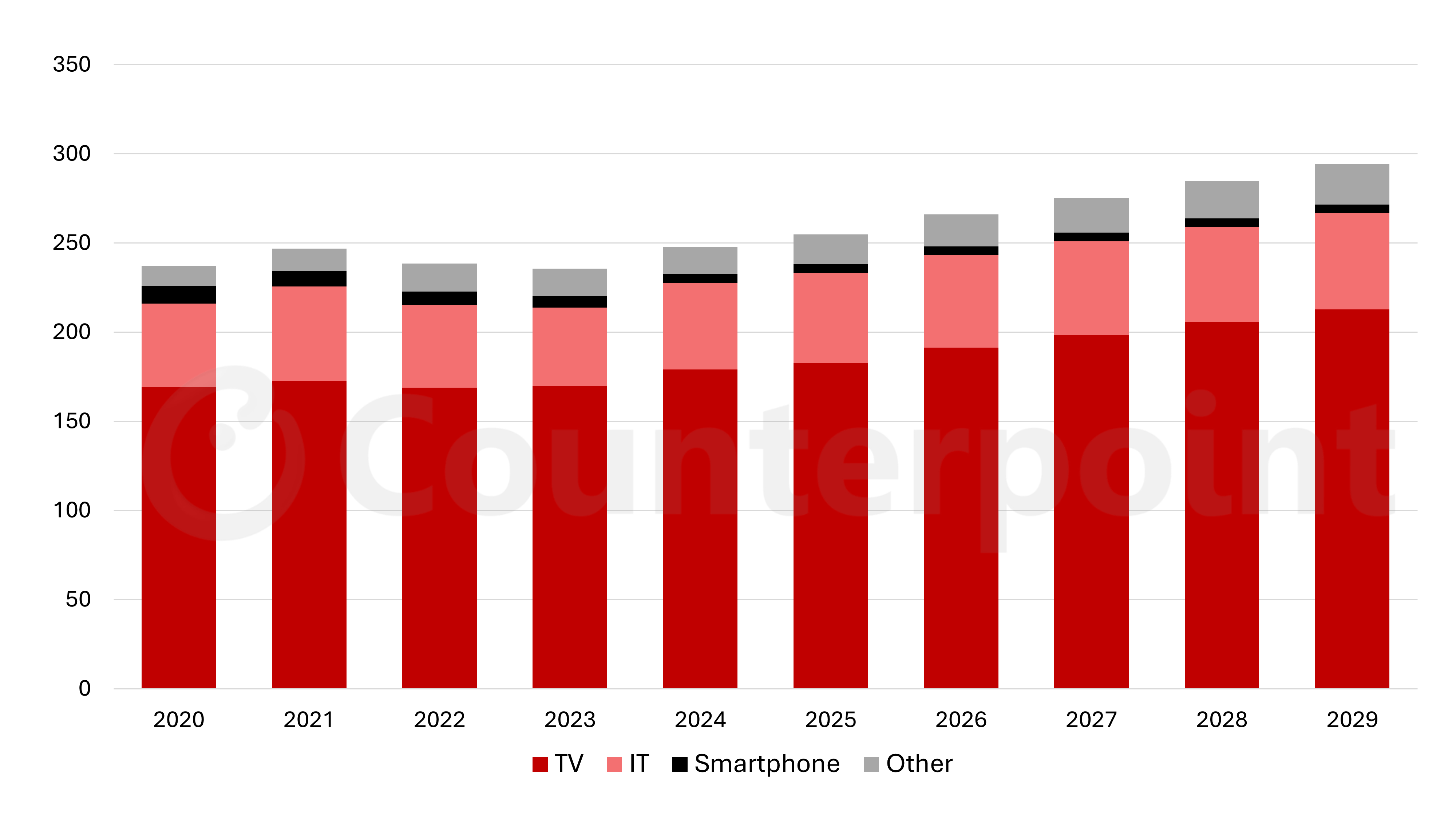
Although OLED investments get the most attention and the most substantial technology programs are in that technology, LCD continues to serve as the overwhelming majority of FPDs. This is especially true in TVs; although OLEDs serve the market’s top end, they account for less than 3% of TV units, and, with the current capacity in place, they cannot compete with LCDs in sizes bigger than 83”.
LCD Demand by Application Group, 2020-2029
Source: Counterpoint Research FPD Forecast Report
That is exactly the segment that is growing the fastest in the TV market. Shipments of TVs with screen sizes 90” and larger more than doubled in 2024 and appear to have doubled again in 2025. The two largest TV brands in China – TCL and Hisense – have aggressively promoted these very large screens and have succeeded in capturing a foothold in the premium TV space. During Black Friday in November 2025, both companies offered 98” TVs for only $999.
The growth in the ultra-large TV market supports our forecast that TV area will continue to increase at a low-to-mid single digit % without significant growth in unit volumes. The average TV screen size will continue to increase, and therefore LCD demand area will continue to increase.
We do not expect any big new LCD fabs. There are four Gen 10.5 fabs operating now, and we don’t expect a fifth one. We do expect that Chinese panel makers will plan incremental expansions of existing lines, which will boost capacity in Gen 8.5 and larger fabs. This was the pattern in 2025, and we expect it again in 2026.
#8 RGB MiniLED Volumes Will be Minimal
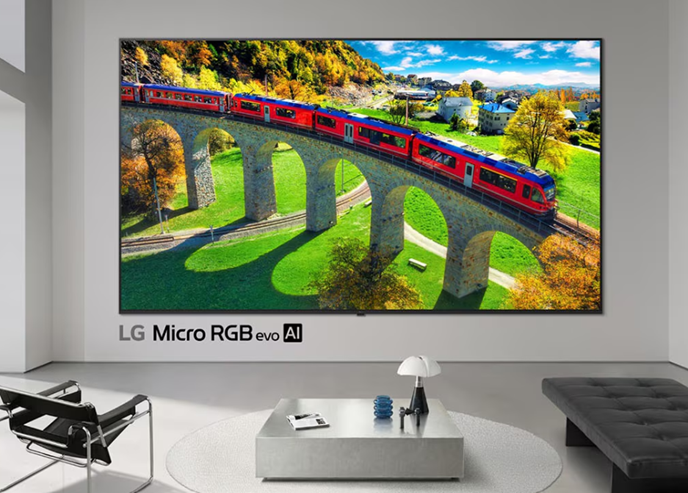
RGB MiniLED is expected to be the flagship TV technology at CES this week. Each brand has a different name for the technology – Samsung calls it MicroRGB, LG calls it Micro RGB evo and Hisense calls it RGB-MiniLED, but these are all the same basic technology. Displays with this technology employ red, green and blue LEDs in a backlight matrix, so that individual colors are modulated by both the backlight and the LCD cell.
LG Micro RGB evo TV
Source: LG Electronics
Both Hisense and Samsung introduced this technology at CES 2025, but each company offered only flagship models that were prohibitively priced. Hisense’s 116UX lists for $24,999 and its smaller sibling, the 100UX, is $9,999. Samsung’s 115” Micro RGB TV lists for $29,999.
Samsung has announced that it will broaden its product line to include six sizes, down to as small as 55”. While LG and Hisense have not revealed their product lines, we expect them to include multiple models as well. Similarly, we expect that TCL will introduce the technology in 2026, so the competition for the top four brands will be intense.
Although we project that the 2026 prices will be substantially lower than the 2025 flagships, we expect that RGB MiniLED TVs by all brands will continue to be offered only at premium prices. We think that Samsung will set RGB MiniLED as its top tier in each screen size. In 2025, Samsung’s top 55” TV (excluding its Lifestyle series) was a QD-OLED TV with a recommended price of $2,399, and its top 65” TV was the Neo QLED (i.e. MiniLED) 8K TV at $5,499.
The problem these products face is that the market for TVs at prices higher than $3,000 is tiny. According to Counterpoint’s Advanced TV Shipment and Forecast Report, in 2024, only 557,000 TVs across all screen sizes and all technologies sold for more than $3,000, and this figure is not expected to increase in the coming years. For these high-end consumers, RGB MiniLED will need to compete with OLED TVs as well as conventional MiniLED TVs. For that reason, we predict that the volumes for RGB MiniLED TVs will be less than one million in 2026. In order to judge whether we are right at the end of the year, we will consider only the actual shipments for Q1-Q3; we expect these will be less than 500,000.
#9 MiniLED TV Growth Will Continue to Outpace OLED TV
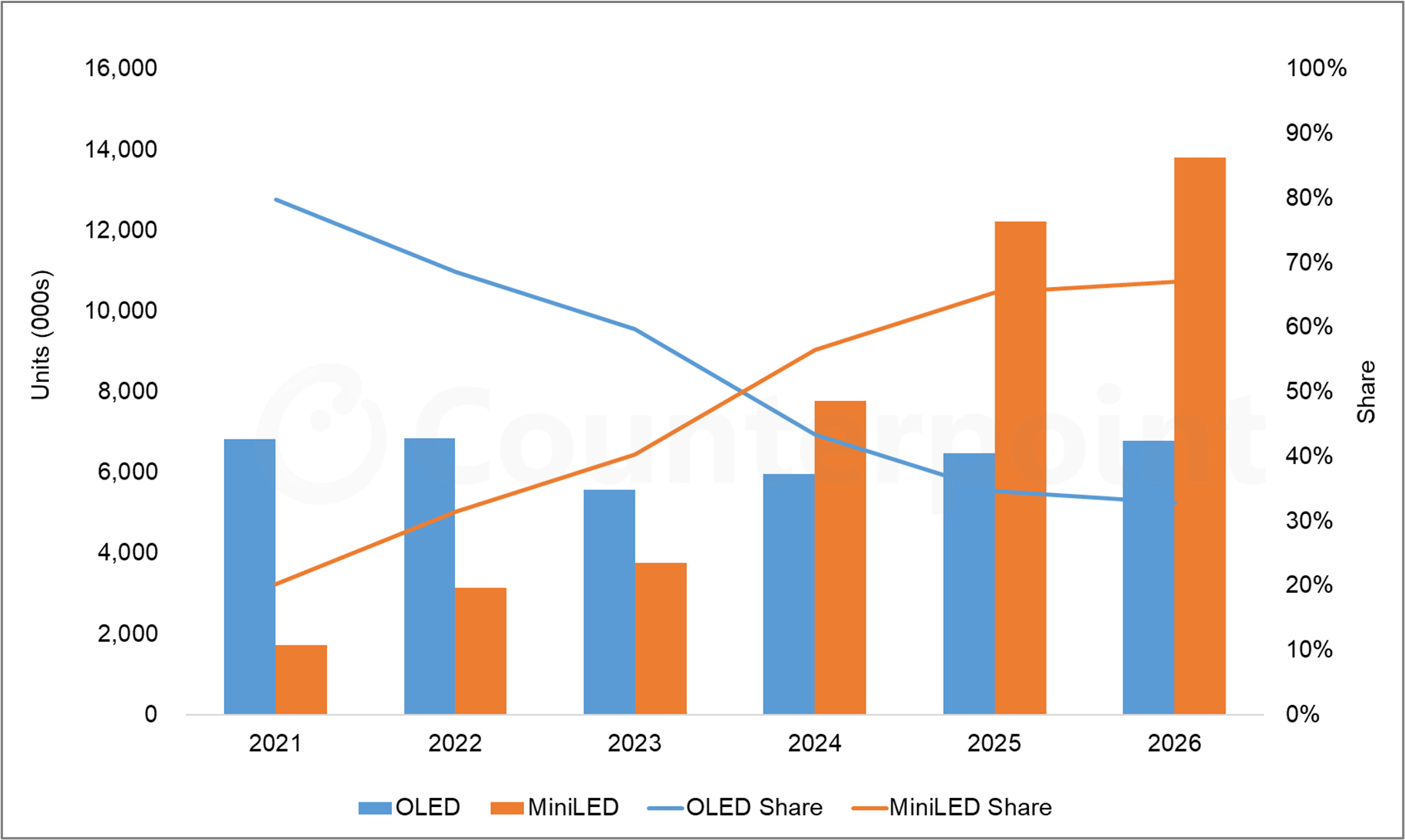
OLED TVs captured the top spot in the premium TV market when they were introduced more than 10 years ago, and for a long time dominated the high-end TV space. MiniLED TVs were first introduced by TCL in 2019, but their shipments remained minimal until Samsung launched its Neo QLED series in 2021. Samsung dominated the MiniLED category through 2023 but kept prices relatively high to sustain its profitability while also offering TVs with QD-OLED panels.
This changed in 2024 when TCL and Hisense started to aggressively promote MiniLED TVs at ultra-large screen sizes (85” and larger) and at low price points. The two Chinese brands had been disadvantaged in OLED TVs since the only suppliers of OLED TV panels were (and still are) the South Korean duo of LG Display and Samsung Display. So TCL and Hisense pivoted to their strength – close connections with LCD makers in mainland China, China Star and BOE, respectively.
Ultra-Premium TV Shipments, MiniLED vs OLED
Source: Counterpoint Research Advanced TV Shipment and Forecast Report
Both of the Chinese brands surpassed Samsung in MiniLED TV sales in 2024 and extended their lead in 2025 by offering more models in a wider range of screen sizes, especially taking advantage of Gen 10.5 fabs to make ultra-large TV panels economically. Meanwhile, OLED TVs saw limited screen size growth since the fabs for both LG and Samsung are Gen 8.5.
We believe the trend of MiniLED TV growth outpacing OLED TV growth will continue in 2026. MiniLED will continue to gain share in the ultra-premium TV space.
#10AR Glasses with a Single-Panel Full-Color MicroLED Light Engine Will Start Shipping
Chinese OEMs such as Even Realities, Rokid and Meizu are increasingly adopting MicroLED light engines for AR glasses. In 2025, we also saw Alibaba launch its first smart glasses featuring two MicroLED displays. However, most of these devices are still based on monochrome green panels because full-color MicroLED is not available yet. It is possible to produce a full-color light engine by combining three monochrome panels (red, blue and green) into an X-prism. The RayNeo X3 Pro is currently the only device on the market with this solution.
In 2024, Meta demonstrated its Orion glasses product concept, which also used a trio of monochrome MicroLED panels coupled directly into a waveguide. For the Meta Ray-Ban Display, the company used a custom LCoS light engine instead. Chinese OEMs will likely continue to use MicroLED technology, but there will be more pressure to upgrade to a full-color light engine.
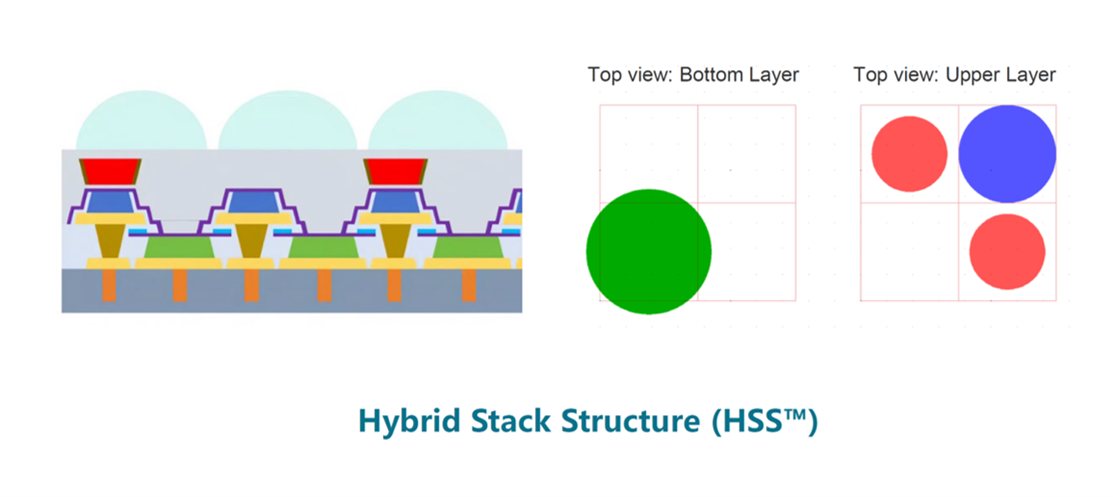
Producing a full-color MicroLED panel is not straightforward. One approach is based on stacking multiple emitters, while another is based on blue LEDs and quantum dot color conversion. A hybrid structure combining both approaches has also been demonstrated by Hongshi Intelligent Technology. While we do not expect any of these approaches to enter large-scale production this year, we can predict that at least one pair of glasses from a Chinese OEM will start shipping.
Source: Hongshi Intelligent Technology
Category
Industry
Display
Service
Display - Others
Report Type
Report
Time Period
Other
Receive our insightful weekly newsletter and stay ahead of the competition.
Author
Guillaume Chansin
Dr. Guillaume Chansin is a display analyst covering advanced and emerging display technologies. He has authored the display reports on XR and MicroLED displays. He is also a regular contributor to the Display Weekly Review Report. Guillaume has a Master’s degree in Applied Physics from INSA Toulouse and a PhD from Imperial College London.
Bob Obrien
Robert J (Bob) O’Brien joined Counterpoint Research as part of its acquisition of DSCC, where he was Co-Founder, Principal and CFO of DSCC. Bob has decades of experience turning market and business analysis into strategic insights in the display and electronics industries. At DSCC, Bob takes the lead role in analysis of display materials, including glass and AMOLED materials, and covers developments in TV and other large-screen display applications. He is the principal author of DSCC’s AMOLED Material Report, the Advanced TV Shipment Report, and the Display Glass Report, and Bob contributes regularly to the DSCC Weekly Review.
Jayden Lee
Jayden Lee joined Counterpoint Research as part of its acquisition of DSCC, where he was Director of Display Equipment and Materials. He is located in Seoul, Korea.
Jayden has around 20 years of experience working in the flat panel display. Since 2005, he was employed at Ushio Korea, a leading light source and equipment company which plays an important role in the lithography supply chain.
While at Ushio, Jayden had responsibility for light sources and related equipment used in photo and deposition processes as well as FPD substrate cleaning.
Kyle Jang
Kyle Jang joined Counterpoint Research as a Senior Analyst of Display Components and Materials following Counterpoint's acquisition of DSCC. He has 15 years of experience in the FPD industry, specializing in OLED research.
He began his career at UBI Research in 2011 as a researcher and analyst, focusing on OLED evaporation materials and components. In 2018, In 2018, he joined Dongwoo Fine-Chem, a subsidiary of Sumitomo Chemical specializing in display and semiconductor-related materials and components, where he worked in the Market Intelligence Team. His primary focus has been on OLED evaporation materials and display fab utilization.
Nikhil Kishor
With a decade of experience in the display technology sector, Nikhil currently leads the Display 360 platform in India at Counterpoint Research, where he supports display industry clients through a combination of sales leadership, strategic consulting, and market intelligence. His expertise lies in cost modeling for display panels, supply chain analysis, and providing actionable insights across the smartphone, IT, and TV segments. Previously, he worked at Kearney, where he led cost-reduction strategies for display clients, and at Applied Materials as a Technical Lead – New Product Manufacturing Engineer, focusing on display fabrication equipment and supplier optimization.