Memory Crisis to Accelerate 5G Adoption in Mainstream Smartphone SoCs in 2026
- The ongoing memory crisis will accelerate the adoption of 5G SoCs in mainstream smartphones (<$300), with penetration expected to exceed 50% in 2026.
- The acceleration will be driven by a reduction in prices of 5G smartphone SoCs and 4G SoCs configured around a legacy memory interface.
- Smartphone SoC players with a larger share of the mainstream segment will likely be negatively impacted.
- Smartphone OEMs are adopting older-generation SoCs and downgrading specs to maintain their margins.
- The ongoing memory crisis will delay the node migration of mainstream SoCs to 5/4nm and the availability of on-device GenAI.
The ongoing global memory crisis will create a structural shift in the mainstream smartphone SoC segment (<$300). We expect 5G penetration to exceed 50% for the first time in this segment in 2026, driven by reduced prices for entry-level 5G SoCs, the availability of 5G SoCs with LPDDR5, and telcos increasing their 5G coverage across regions. The migration will likely be led by MediaTek’s Dimensity 6000 series, Qualcomm’s Snapdragon 400 and 600 series, and UNISOC’s T8300, as the ASP of these SoCs are comparable to their nearest 4G SoCs.
One of the major reasons accelerating the transition to 5G is the phasing-out of legacy memory interfaces (LPDDR4) to upgrade production-lines to newer memory types. Memory players are phasing-out legacy memory to transition to (LP)DDR5 and HBM to cater to the growing data center demand. 4G SoCs are almost all configured around legacy memory. Migrating them to LPDDR5 would necessitate a costly and uneconomic re-design. Therefore, SoC vendors will likely phase out 4G SoCs and rely instead on newer configuration 5G SoCs based on LPDDR5.
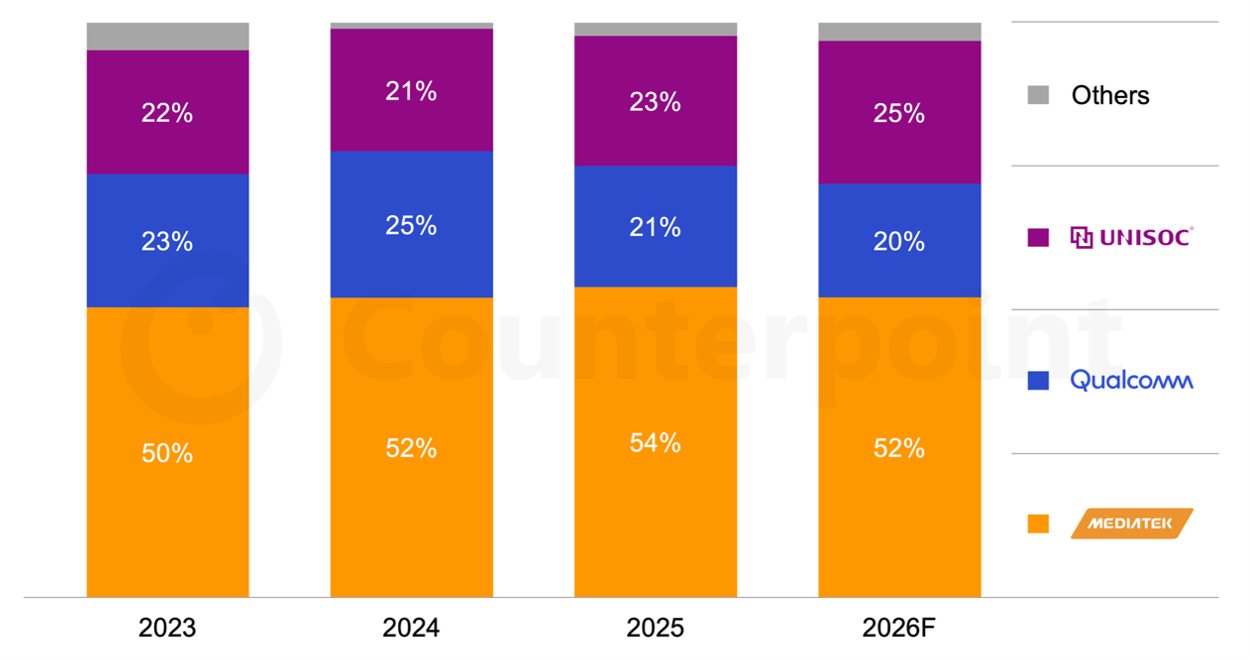
MediaTek, UNISOC, and Qualcomm, which account for the majority of SoC shipments in the mainstream price bands will have to configure their portfolios to optimize for the current memory landscape. However, they face a dilemma. Not only will they have to rework their entry and mid-range chipsets, but the volume of shipments into the mainstream is likely to be significantly lower in 2026 and 2027 – this double-whammy will strain volumes and profitability.
MediaTek’s Dimensity 7000 series fully supports LPDDR5, whereas its Dimensity 6000 series can only support LPDDR4. We, therefore, expect MediaTek to launch a revised Dimensity 6000 series supporting LPDDR5 that should allow it to retain share in the mainstream segments. Qualcomm has less exposure to legacy memory having already migrated most of its newer Snapdragon 400 and 600 series models to LPDDR5.
Going forward, the memory crisis will likely accelerate the phasing out of 4G SoCs but may also slow the migration to higher-featured mainstream 5G SoCs, as SoC vendors balance the competing demands of cost-competitiveness with potential for node migrations and the inclusion of AI-supporting features such as dedicated NPUs and the higher memory capacity and bandwidths to support them.
5G Adoption in the Mainstream Segment
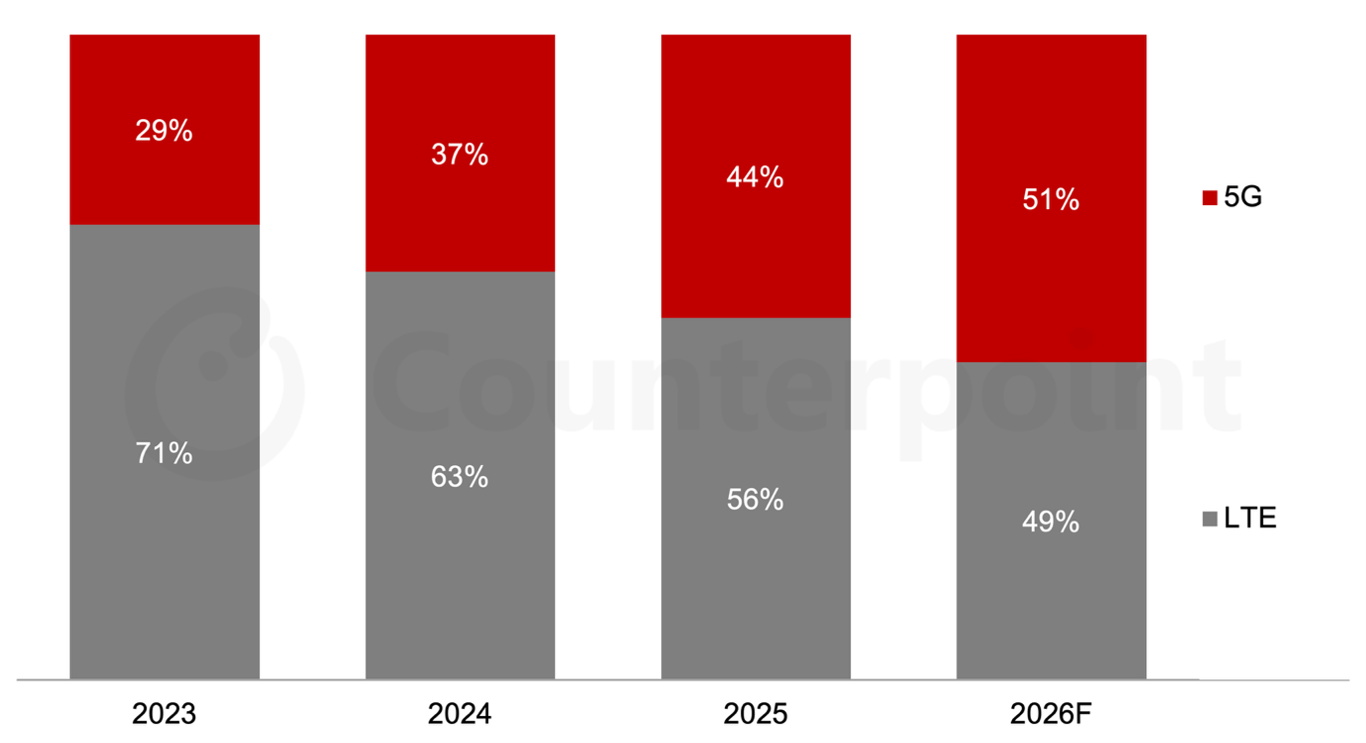
The proportion of 5G SoC in the mainstream segment increased from 29% in 2024 to 44% in 2025. The pace of migration is likely to receive a further boost in 2026 and exceed 50% for the first time. There are several reasons why this is happening:
- 5G SoCs are getting cheaper.
- Most existing 4G SoCs only support LPDDR4 memory, which is not only becoming costly, but availability is also diminishing.
- 5G network rollouts are reaching scale, even in emerging markets.
- Strategic choices by SoC vendors.
Let us look at each in turn:
5G SoC Pricing
The price difference between 4G and 5G SoC has reduced, which enables smartphone OEMs to offer 5G devices at lower price ranges. For example, MediaTek’s Dimensity 6300 (5G SoC) has an ASP of ~$18, whereas MediaTek’s 4G Helio G100 has an ASP of ~$16. The Dimensity 6300 is the best-selling SoC in the segment, commanding 27% share in 2025, followed by Dimensity 7300 with a 12% share.
Global Smartphone SoC Shipment Share by Network Type for the Mainstream Segment
Source: Counterpoint Research Global Smartphone SoC Shipments Tracker
To increase the adoption of 5G in the mainstream segment, smartphone SoC vendors are even launching 5G SoCs at lower price ranges to target entry-level smartphones. For example, Qualcomm launched the Snapdragon 4s Gen 2 priced at ~$14 to target sub-$150 smartphones.
4G Hitting a Memory Wall
While 5G penetration in the mainstream segment is increasing, the segment’s shipment share in the overall smartphone SoC market is declining, slipping to around 53% in 2026 from around 57% in 2025. The mainstream segment is being significantly impacted by the fast-rising memory prices combined with falling availability of LPDDR4 memory. The price of both LPDDR4 and LPDDR5 memory interfaces for smartphones has increased by nearly three times over the past year. Consequently, memory’s share of the bill of materials is reaching unsustainable levels for products positioned for the mainstream segment.
Smartphone Memory Price Increase by Memory Interface (QoQ)
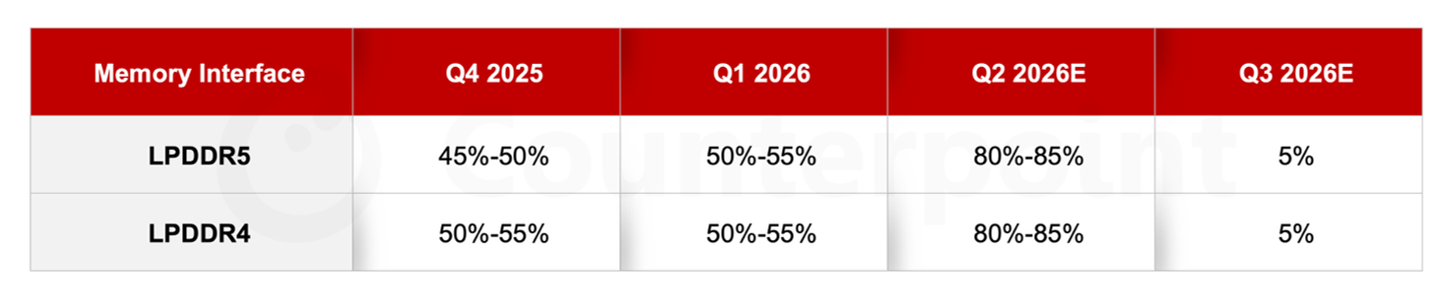
Memory players are prioritizing to cater to the increasing demand for data centers and AI as they offer higher margins as compared to consumer-grade memories, which has led to a legacy memory supply crunch, along with a reduced supply of LPDDR5 for smartphones. Chinese memory player CXMT will increase production for LPDDR4, but it will take some time for the supply to normalize for the segment.
5G Network Rollouts
The installation of 5G networks in emerging markets has lagged developed markets, but the gap is closing, as operators in emerging markets, such as MEA, LATAM, APAC are offering 5G services to their customers. Furthermore, many networks are opting to enhance their 5G networks with 5G-Advanced capabilities that enhances connectivity and offers richer features. Mainstream SoC players are offering Rel.17 (pre 5G-A) to give the users better connectivity as compared to the initial 5G release.
SoC Vendor Strategic Choices
Due to the changing market environment, SoC vendors are making changes to their portfolios in efforts to gain or maintain market share.
Global Smartphone SoC Shipment Share by SoC Vendor for the Mainstream Segment
Source: Counterpoint Research Global Smartphone SoC Shipments Tracker
LTE SoCs were designed based on legacy memory, and SoC vendors are unlikely to migrate to the designs to support LPDDR5 as it will require a costly redesign that makes no economic sense. In the regions where LTE has been the main network, telcos are increasing 5G coverage; if they do not do so, they will start to see subscribers struggle to maintain connectivity as devices age and are not replaced.
SoC vendors are transitioning their 5G portfolios to LPDDR5 memory interface. For example, Qualcomm’s Snapdragon 600 series and the latest-generation SoCs in the Snapdragon 400 series, and MediaTek’s Dimensity 7000 series, all support LPDDR5. However, the Dimensity 6000 series, which dominates the mainstream 5G segment, cannot work with LPDDR5. We, therefore, expect MediaTek to rapidly address this portfolio gap.
Impact on Smartphone OEMs: Portfolio Rationalization and Margin Compression
Smartphone OEMs were already operating on thin margins in the mainstream segment before the cost of memory started to skyrocket. In the face of dramatically higher costs, smartphone OEMs are optimizing their portfolios, reducing new product launches, reducing the memory variants to consolidate procurement volumes and improve supplier leverage. Smartphone OEMs are also downgrading the specifications in their mainstream segment products – for example replacing OLED screens with LCD, 120Hz with 60Hz or 90Hz, and reducing the camera composition and image sensors. Some are opting for older generation or a lower generation SoC to maintain the product cost. To reduce the storage cost, some OEMs have even started offering external storage options via memory card.
What is certain is that it will become increasingly difficult to continue to support the lower end of the mainstream segment profitably as ASPs will rise and the market will contract.
Impact on Smartphone SoC Vendors
Mainstream smartphone SoC shipments are expected to decline by 25% in 2026, with most of the impact being faced by UNISOC and MediaTek as a larger share of their mainstream portfolios uses legacy memory. Although the increasing memory prices will have major impact on the mainstream segment shipments for SoC vendors, this will prompt vendors to optimize their portfolio and launch newer models with newer and better specs.
To soften the impact of increasing BoM for smartphone OEMs, SoC vendors are lowering the prices of some SoCs and are even launching SoCs with downgraded specs. For example, Qualcomm has downgraded the Snapdragon 4 Gen 5’s memory spec to LPDDR4X compared to Snapdragon 4 Gen 4 with LPDDR5 to reduce the price of the SoC.
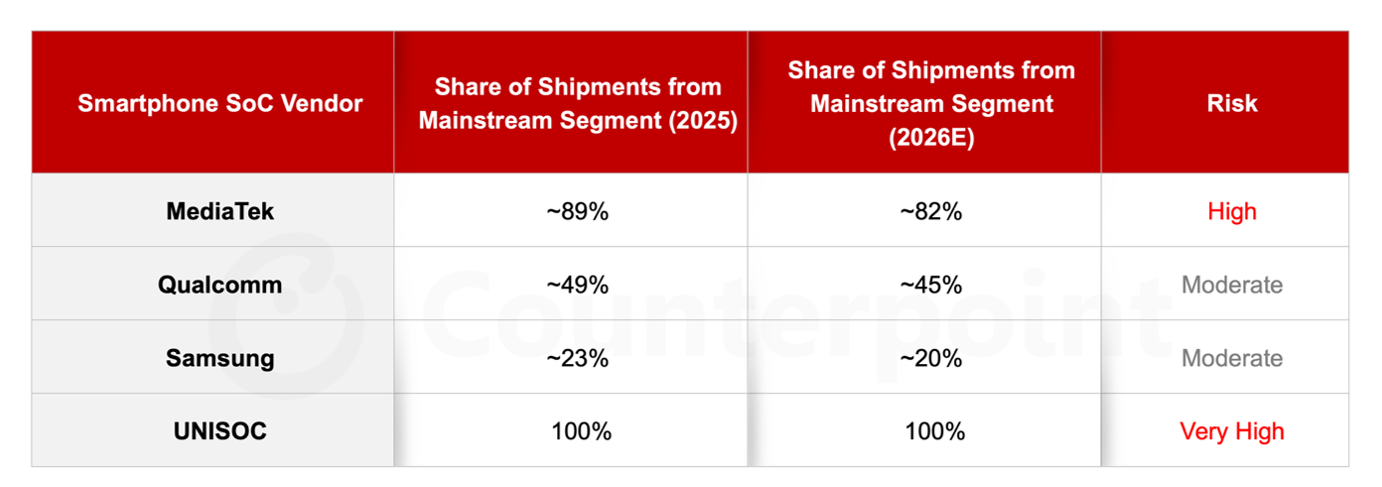
- MediaTek: MediaTek’s mainstream SoC shipments will be constrained due to the memory crisis. In terms of shipment share by memory interface, legacy memory constitutes more than 82% of the mainstream shipments share, whereas the share of advanced memory was 18% and we expect it will further increase to ~22% in 2026. MediaTek’s Dimensity 7000 series supports LPDDR5 memory, whereas the MediaTek Dimensity 6000 series does not. MediaTek’s 4G portfolio is expected to gradually ramp down as the supply of LPDDR4 also diminishes.
When it comes to long-term implications, MediaTek is likely to gain the most, as its 5G SoC prices are lower as compared to the competitors, and offers better features and performance than UNISOC, which will likely drive smartphone OEMs to adopt MediaTek’s SoCs.
- UNISOC: UNISOC will likely gain share in the near term, as smartphone OEMs will likely utilize its SoCs to minimize the increase in the BoM cost, especially for the 5G segment, but the gradual phasing-out of legacy memory will have a major impact; UNISOC’s entire portfolio is based on legacy memory. UNISOC will have to migrate its portfolio and launch newer 4G and 5G SoCs based on LPDDR5. However, this is expected to be challenging and could reduce the price gap that it enjoys with MediaTek.
- Qualcomm: Qualcomm will likely be more moderately affected by the memory crisis in terms of SoC shipments, as Qualcomm is reducing its focus on legacy memory, and instead migrating to LPDDR5 memory. Qualcomm is likely to launch all newer SoCs in the mainstream segment based on the LPDDR5 memory interface.
The brand is reducing its dependency on legacy memory, as the share of legacy memory will likely decrease to ~28% in 2026 from 45% in 2025.
- Samsung, Apple, Google, and Huawei: Samsung, Apple, Google, and Huawei will be the least affected brands from the memory crisis, as their portfolios entirely feature LPDDR5, and these players mostly focus on the high-end segment (>$300 smartphone wholesale price). The main exception is Samsung’s Exynos 1330 which is equipped in Samsung’s mid-range smartphones including the Galaxy A17 series. It only supports the LPDDR4 interface, but Samsung’s vertical integration and supply chain management are likely to minimize the impact.
Outlook
- Sunset of 4G Smartphone SoCs: The phasing-out of legacy memory and transitioning to advanced memory will effectively lead to the forced discontinuation of 4G Smartphone SoCs. Since 4G SoCs across MediaTek, UNISOC, and Qualcomm are configured on legacy memory, the discontinuation of LPDDR4 will make these SoCs unsustainable, unless the vendors launch newer SoCs based on LPDDR5. However, that will likely lead to an increase in the price of the SoC and effectively the device.
- Delay in Mode Migration: Another consequence of the memory crisis is the delay in node migration for mainstream 5G SoCs. Mature nodes constitute more than 79% of the mainstream SoC shipments share, mostly led by 4G SoCs, whereas 5G SoCs constituted ~52% of the shipments share. Mainstream 5G SoCs from MediaTek and UNISOC are made on mature nodes (7/6nm), and the delay in SoC refresh cycle to 2027 will further delay their migration to advanced nodes (5/4nm), limiting the SoC enhancements with newer features and advanced capabilities.
- Delayed GenAI Roll-out in Mainstream Segment: Due to the delay in node migration, the widespread availability of on-device GenAI capability will be further delayed, and these capabilities will be limited to premium SoCs for the upcoming period. On-device GenAI capabilities, which require a dedicated NPU with at least 20 TOPS, and higher memory configuration and bandwidth – conflicting with the memory crisis, as smartphone OEMs are reducing the memory configuration in the mainstream segment and are not integrating advanced NPUs, delaying GenAI availability by as much as two to three years.
Conclusion
The memory crisis will lead to a strategic shift in the smartphone SoC industry, creating some distinct winners and losers, which will re-shape the SoC market for the coming period. The memory crisis has accelerated the transition of 4G to 5G and forced SoC vendors to work on re-designing their SoCs at the architecture level, and not re-launch existing SoCs with minor upgradation.
Category
Industry
Semiconductors
Service
Premium
Report Type
Report
Time Period
Other
Receive our insightful weekly newsletter and stay ahead of the competition.
Author
Akash Jatwala

Akash Jatwala is a Research Analyst at Counterpoint, specializing in Smartphone AP/SoC, Smart TVs, and 5G Networks Infrastructure. With a PGDM in Finance from IMT Nagpur, and a B.Com from Calcutta University, Akash brings over 5 years of experience in analyzing technological advancements and market trends within the device ecosystem.