LCD TV Panel Prices Start to Decline in July
LCD TV panel prices, which reached a temporary plateau in Q2 2026, will be falling starting in July and continuing through Q3 2026.
The downturn has been postponed by strong TV demand related to the World Cup. Global TV shipments increased 3% YoY in Q1 2026 and another 8% YoY in April, according to Counterpoint’s Global TV Shipments Monthly Tracker. Demand in April was particularly strong in football-mad Western Europe, up 48% YoY, and continued to be strong in the host regions, North America and Latin America.
With the World Cup winding up in July, demand is softening in Q3 2026. This has also been observed in previous World Cup (and Olympics) years. The demand from the sporting event is mostly pulled-forward demand, which is taken from the second half of the year. Now, there are a few demand drivers until the fourth quarter.
The first chart here highlights our latest TV panel price update with a forecast through September 2026. Since the beginning of 2024, we have been through two cycles of rally and slump, and the third cycle is happening in 2026.
Prices in June came in higher than our expectations. We expected prices across all sizes to be down by $1-$3, but instead, prices were stable compared to May; thus, prices were stable across Q2. For July 2026, we expect prices for all screen sizes to be down by $1-$3.
LCD TV Panel Prices, January 2024 – September 2026
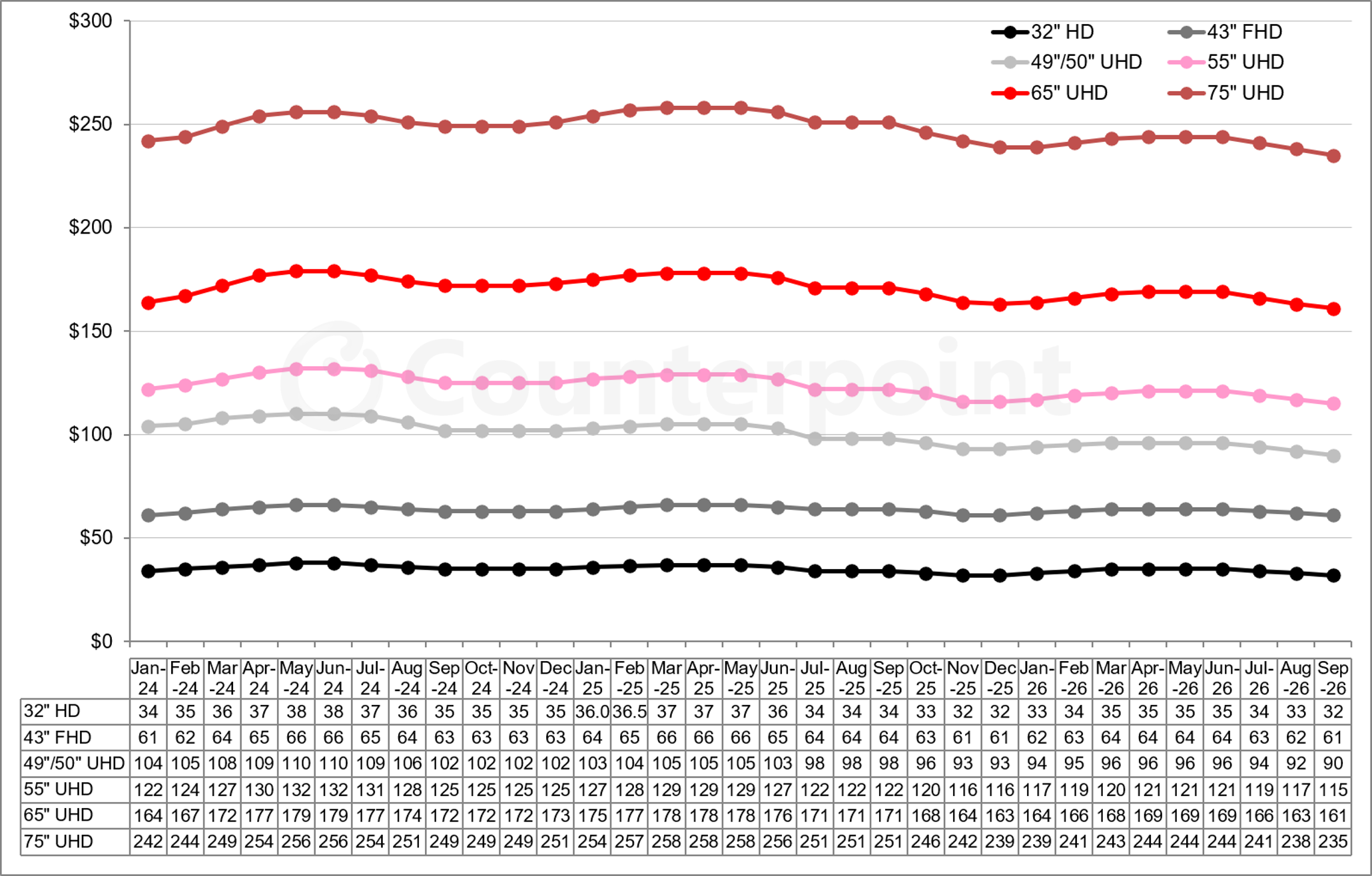
Prices in Q1 2026 were higher sequentially by 1.1% on average, and because prices in April were at a higher starting point than in January, average prices were up 1.5% QoQ in Q2 2026, even though they were flat throughout the quarter.
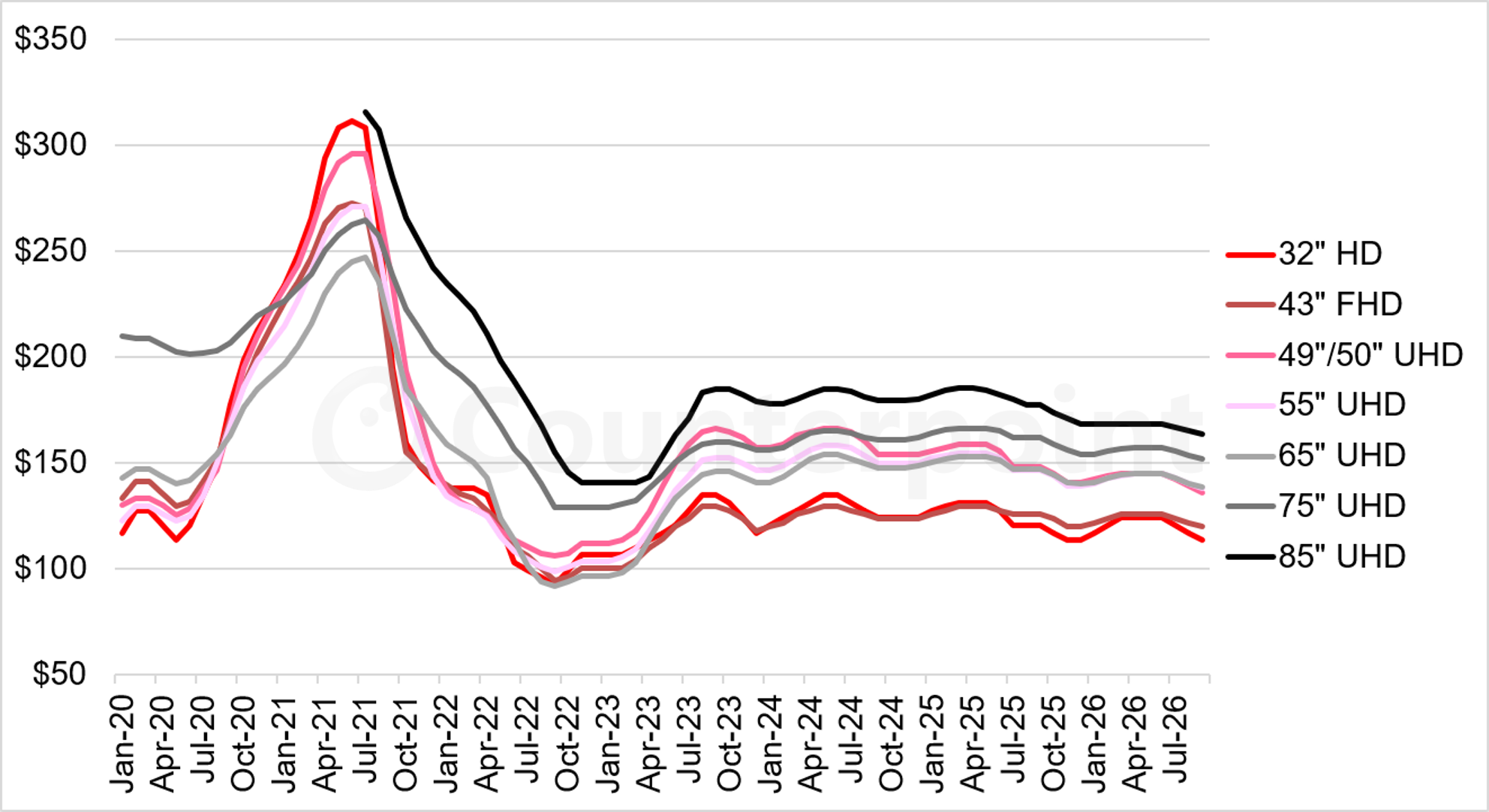
- The lowest-priced products are 32” and 43”, the most commoditized sizes. 32” panels seem to be the first size to increase, but also the first size to decline, and we are seeing that in the first half of 2026 as 32” prices had the biggest percentage increase in Q1 and are expected to have the biggest percentage decrease in Q3. These two products are efficient 18 cuts per substrate on Gen 8.5 (32”) and Gen 10.5 (43”). During the whole period from July 2023 to our forecast out to September 2026, the price of 43” panels has stayed between $118 and $129 per square meter. The 32” panel hit a new post-pandemic low of $113 per square meter in November/December but increased to $124 per square meter in March, and is expected to fall to $113 per square meter in September.
- The mid-tier products are 49”/50”, 55” and 65”, with the largest size usually coming at the highest price. These sizes are also made efficiently on Gen 8.5 (49”/50” 8-up and 55” 6-up) and Gen 10.5 (65” 8-up). These panels have fluctuated between $139 and $167 per square meter and fell near the bottom of that range in December. Prices for each size increased in Q1, but we expect that they will fall to a new low of $137-$138 by September.
- The premium products are 75” and 85”. The 75” panel briefly fell to the mid-tier level in 2023 but has regained a premium of ~$13 over the smaller sizes. In 2025, the 85” panel maintained a premium of $15-$20 per square meter over the 75” panel, but that premium appears to have eroded to about $12 in 2026.
Monthly Area Prices Per Square Meter for LCD TV Panels, January 2020 – September 2026
Our final chart in this sequence shows our LCD TV panel price index, taking a longer view from 2015 through September 2026. It appears that with each successive wave of price, the peak and trough are a little lower than the previous wave. The price increase in Q1 2025 brought our index up to a peak of 44.8 in March 2025, not quite as high as the peak in 2024 but still 47% higher than the all-time low of September 2022. Prices declined to a low of 40.4 in December, the lowest point since May 2023. We saw the index rising modestly to 42.2 in April 2026 and holding at that level through June, but we expect it to edge down to 39.9 in September 2026.
LCD TV Panel Price Index, January 2015 – September 2026
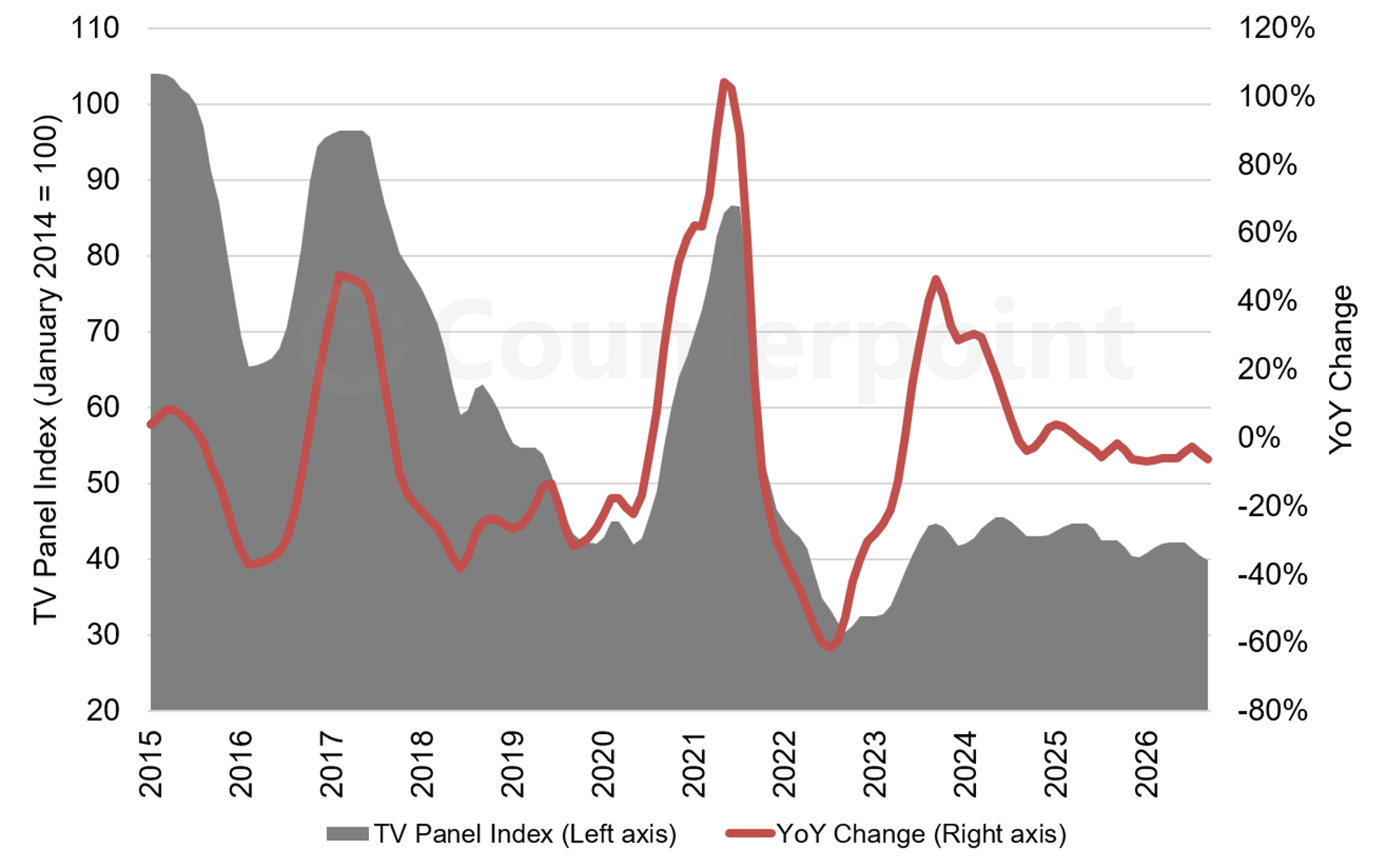
Following the grey area in the chart, we can see that the period from mid-2023 to today is radically different than the period from 2015 to 2023. We no longer have wild swings in prices. As of June 2026, our price index remained within a relatively tight range of 40.4 to 45.6 for 34 months. If our forecast bears out, the price index will break below 40.4 in September, testing the bottom of the range.
Panel prices have been fluctuating around a level that allows the Chinese panel makers, with a cost advantage from government subsidies, to make a small profit, while Taiwanese panel makers come close to breakeven. The profitability of both the Chinese and Taiwanese panel makers increased in the first quarter of 2026, with Innolux reporting its first quarterly operating profit after six consecutive quarterly losses, while AUO just missed breakeven with an operating margin of -1%. With panel prices holding flat in June, these panel makers are likely to show slightly improved margins in Q2 2026.
Category
Industry
Display
Service
Standard
Report Type
Report
Time Period
Other
Receive our insightful weekly newsletter and stay ahead of the competition.
Author
Bob Obrien
Robert J (Bob) O’Brien joined Counterpoint Research as part of its acquisition of DSCC, where he was Co-Founder, Principal and CFO of DSCC. Bob has decades of experience turning market and business analysis into strategic insights in the display and electronics industries. At DSCC, Bob takes the lead role in analysis of display materials, including glass and AMOLED materials, and covers developments in TV and other large-screen display applications. He is the principal author of DSCC’s AMOLED Material Report, the Advanced TV Shipment Report, and the Display Glass Report, and Bob contributes regularly to the DSCC Weekly Review.
Yoshio Tamura

Yoshio Tamura joined Counterpoint Research following its acquisition of DSCC, where he served as Co-Founder and President of Asian Operations at DSCC (Display Supply Chain Consultants), based in Tokyo, Japan. He has more than 30 years of experience in display market research and consulting and is widely recognized as one of the leading authorities in the display industry. He began covering the display market in 1991 at TSR, where he significantly expanded the company’s research activities in this field. In 2000, he was invited to join DisplaySearch and was later promoted to Senior Vice President. Through his strong industry relationships, DisplaySearch expanded its presence across Asia by recruiting top talent in Japan, Korea, Taiwan, and China. In 2005, DisplaySearch became the world’s leading display research company and was acquired by NPD (USA). In 2014, NPD’s DisplaySearch business was acquired by IHS (UK). In October 2016, he co-founded DSCC. In August 2023, DSCC was acquired by Counterpoint Research. He can be reached at [email protected]