India Smart TV Shipments Fall 3% in Q1 2026; Large Screens and MiniLED Buck the Trend
- India’s smart TV shipments declined 3% YoY in Q1 2026, as the current macroeconomic and geopolitical situation puts pressure on household budgets.
- Larger screen sizes continued to gain momentum during the quarter, with 55” and above TVs growing the fastest and now accounting for nearly one-third of total shipments.
- QLED accounted for around 30% of the market share, within which the INR 20,000 - INR 30,000 price segment witnessed strong growth.
- MiniLED remained the fastest-growing display technology, showing over 13x YoY growth, but from a relatively small base. 55” and above TV segment remained the key growth driver for it.
India’s smart TV shipments declined by 3% YoY in Q1 2026, according to Counterpoint’s TV Service, mainly due to weaker demand in the entry-level segment. Many households faced financial strain during the quarter, due to the macroeconomic uncertainties such as the LPG crisis, war tensions and rupee depreciation, which affected their monthly budgets. As a result, consumers became more cautious about spending and were delaying purchases of big appliances like TVs. At the same time, brands also slowed down on new launches due to the subdued market outlook.
India Smart TV Shipment Share by Display Technology, Q1 2025 vs Q1 2026
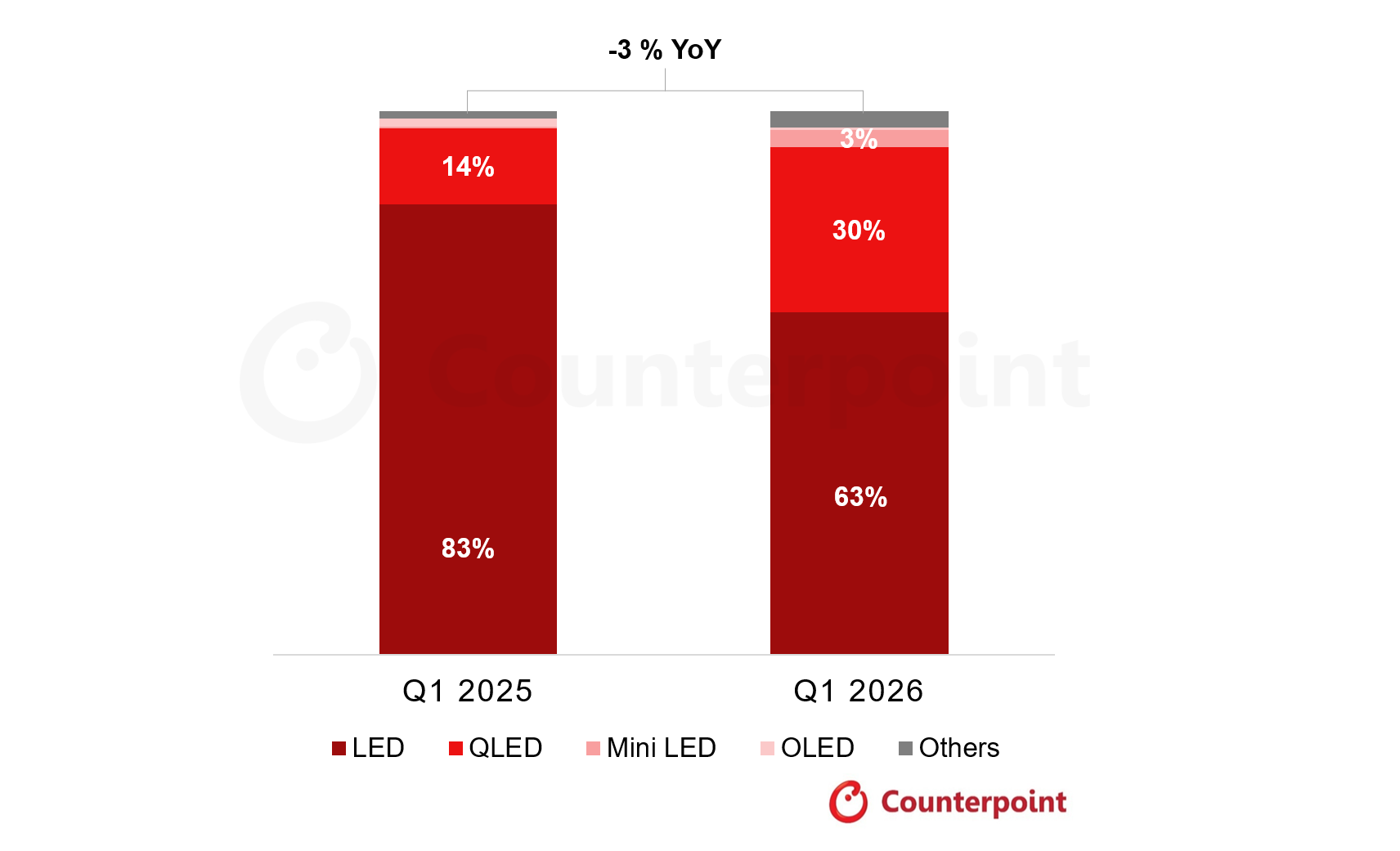
Note: Others Include QNED and Nanocell
Despite the market facing a slowdown, demand for larger screen TVs remained strong, with 55” and above models emerging as the fastest-growing category and contributing nearly one-third of total shipments. Easy financing options and a wider range of affordable large-screen models continued to drive this adoption. The INR 40,000 - INR 50,000 price segment remained the sweet spot, offering balanced mix of screen size, features and value.
QLED TVs accounted for around 30% of the market in Q1 2026 with its shipments tripling in the INR 20,000 - INR 30,000 segment. The availability of a wider portfolio, along with growing consumer aspirations for an elevated home entertainment experience, drives growth in this category. TCL and Samsung maintained leadership in QLED, while Xiaomi recorded significant growth.
Interestingly, MiniLED was the fastest-growing display technology, seeing around 13x YoY growth, but from a relatively small base. Demand is largely concentrated in 55” and above TVs priced above INR 40,000. As consumers actively seek premium TV experiences, brands are positioning MiniLED as a more affordable alternative to OLED, helping expand it across the premium segment.
Memory price increases had a limited impact during Q1 2026 as leading brands utilised existing inventory to absorb costs. However, price hikes became visible from April onwards, particularly in entry-level 32” TVs, which saw around a 14-15% increase. While larger screen sizes experienced relatively lower impact, we expect, moving forward, the rising component cost could make it harder for brands to maintain aggressive pricing, especially in the highly competitive budget segment.
Overall, while we may see a demand slowdown in the near future, the broader direction of the market has become quite clear. Consumers are increasingly upgrading to larger screens and are looking for advanced display technologies such as QLED and MiniLED to enhance their viewing experience. This premiumization trend will continue to shape the Indian smart TV market and is likely to remain the key growth driver over the next few years.
The Consumer IoT research relies on sell-in (shipments) estimates based on India imports and local manufacturing data, triangulated with OEM feedback, channel feedback and secondary research.
Feel free to contact us at [email protected] for questions regarding our latest research and insights.
You can also visit our Data Section (updated quarterly) to view the other CIoT market insights across regions/countries.
Category
Industry
IoT
Service
Premium
Report Type
Report
Time Period
Other
Receive our insightful weekly newsletter and stay ahead of the competition.
Author
Umang Jain

Umang is a Research Associate at Counterpoint Technology Market Research, specializing in the Consumer IoT domain, with expertise in Smart TVs, Smart Homes, and Laptops. In his current role, he plays a key part in analysing market trends and driving insights in this rapidly evolving sector. Before joining Counterpoint, Umang worked as an Associate Business Analyst at Infosys, where he contributed to projects in the E-Commerce and Telecom industries. His passion lies in expanding his expertise within the Consumer IoT and Automotive sectors. Academically, Umang holds a Bachelor's degree from SRM Institute of Science and Technology and a Master's degree from Delhi College of Engineering (Delhi Technological University).
Anshika Jain

Anshika is a Principal Analyst at Counterpoint Research with over 13 years of experience in market research and business intelligence. She currently leads the Global Consumer IoT domain, focusing on wearables, hearables, smart home, and emerging technologies. Previously, she managed various research and consulting projects across sectors such as BFSI and Telecom. Additionally, she has significant client-handling experience with major multinational companies. Anshika holds an MBA in Finance from IMT Ghaziabad and a Bachelor’s degree in Economics from Hansraj College, Delhi University.