Electronic Displays Conference – Keynote Speakers
The latest Electronic Displays Conference was held at Nuremberg in Germany on March 11-12, as a part of the larger Embedded World conference held in that city’s Messe (convention center). I was one of the speakers in the keynote session on March 11, and in this article, I will review and summarize all the keynote presentations.
The first presenter was Fred Cui, Vice President of Tianma Microelectronics. Cui started by introducing his company as the number one automotive display supplier and claimed it was also number one in instrument panel and HUD displays. Cui showed a market forecast slide which accords with Counterpoint’s view of the auto display market – there will be more displays per vehicle, with larger area per display, and greater functionality, including brightness and flexible form factors.
Cui then described some of the implications for system architecture:
- Centralized computing: Consolidation of processing to cockpit domain controllers
- Integration complexity: HMI, sensors, multiple displays
- Performance constraints: Data bandwidth, power consumption
He then described Tianma’s technology roadmap with this slide:
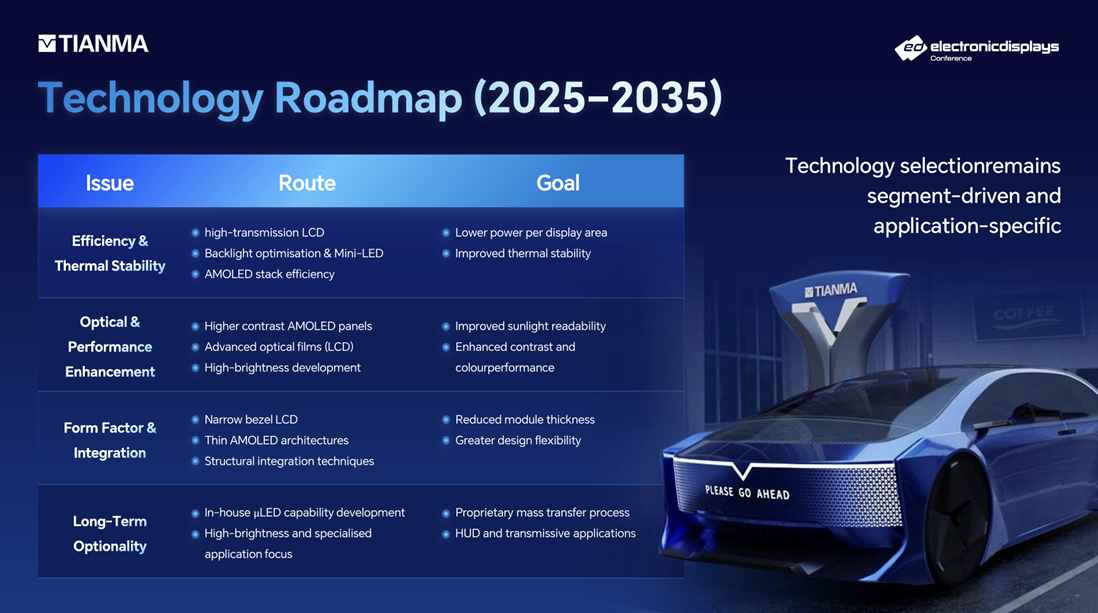
Cui described the current environment of the industry as a conflict between efficiency and regionalization, with the observation that “the strategic challenge is balancing industrial efficiency with geopolitical resilience”. He said that Tianma’s strategic response will rely on a focused China fab strategy to achieve economic scale, panel and component banking to mitigate short-term volatility, and local supply chain support, among other items. He concluded by labeling Tianma’s approach as “Vision Advanced, Future Activated”.
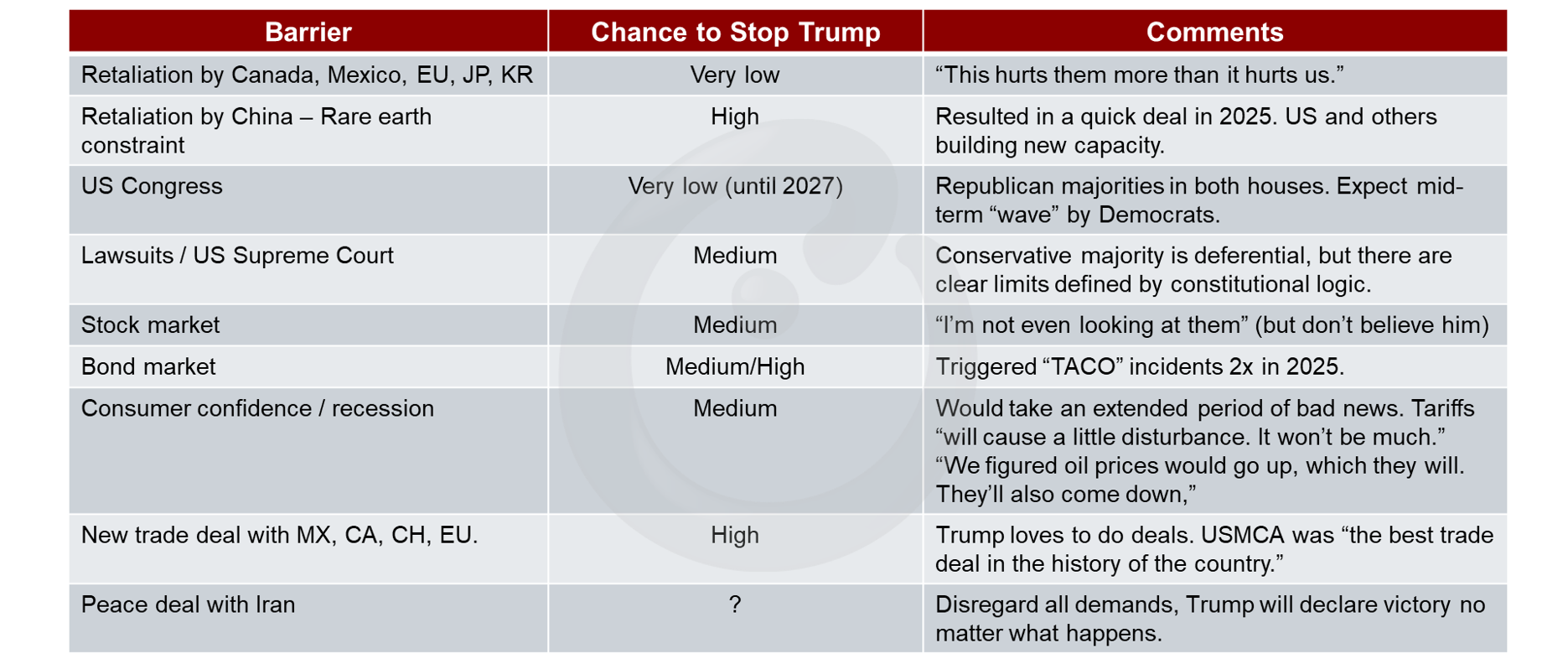
My presentation came after Cui’s, and for the most part, my material has been covered previously in this newsletter. One area that has not been covered here was my view on “What’s Next on Tariffs”. As the only American among the keynote speakers, I felt an obligation to the audience to give a perspective on the Trump trade policy and how it may affect the display and the wider electronics industry. I updated a slide from my 2025 presentation, which took place before Trump’s tariffs were in place, but correctly predicted the recent Supreme Court ruling. This table, originally developed for tariffs, may also be applied to the Iran war.
Following my talk came Lisa Li of Sigmaintell, who described the impact of AI on the display market in 2026. With AI installations leading to a memory shortage, the higher cost of memory will spill over to all consumer electronics products, leading to a slowdown in volume across all CE applications.
After Li, Franziska Braun of the Fraunhofer Institute described “How Automation Rewrites In-Car Media Demand”. Braun focused on the mid-points of the five-point automation scale for autos – stages 2 and 3 – which represent partial automation and conditional automation. She delved into the topic of how these stages affect the desire for in-car media.
Braun’s approach was “Let’s bust some myths”, and she proceeded to counter some expectations of media demand with increasing automation:
- Myth: More automation means the passenger wants in-car features. Reality: Young people have an average of 42 apps on their mobile phones. Only one-third of them are regularly used. Users will want more customization, not more applications.
- Myth: Cluster is dead. People will prefer the HUD. Reality: There is an unnecessary duplication of information. HMI designers should show users only the information that is truly relevant – where they need it, when they need it.
- Myth: People want to use hands-off time for power naps. Reality: If you only have 1 second to assess the situation and take over driving, it is impossible (and dangerous) to sleep. A better approach is to create real value in small situations that occur frequently.
- Myth: Voice will replace buttons as AI understands everything. Reality: Voice doesn’t always work well in the auto. Voice will become more and more important, but you also need silent solutions.
The final keynote came from Ian Hendy, my former colleague at Philips. Hendy described the “consolidation of the chessboard” in the display industry, noting the tie-ups between Sony and TCL and between BOE and TPV. Hendy asserted that the “leadership board” is changing as Mainland Chinese panel makers gain technology prowess and the Japanese fade away.
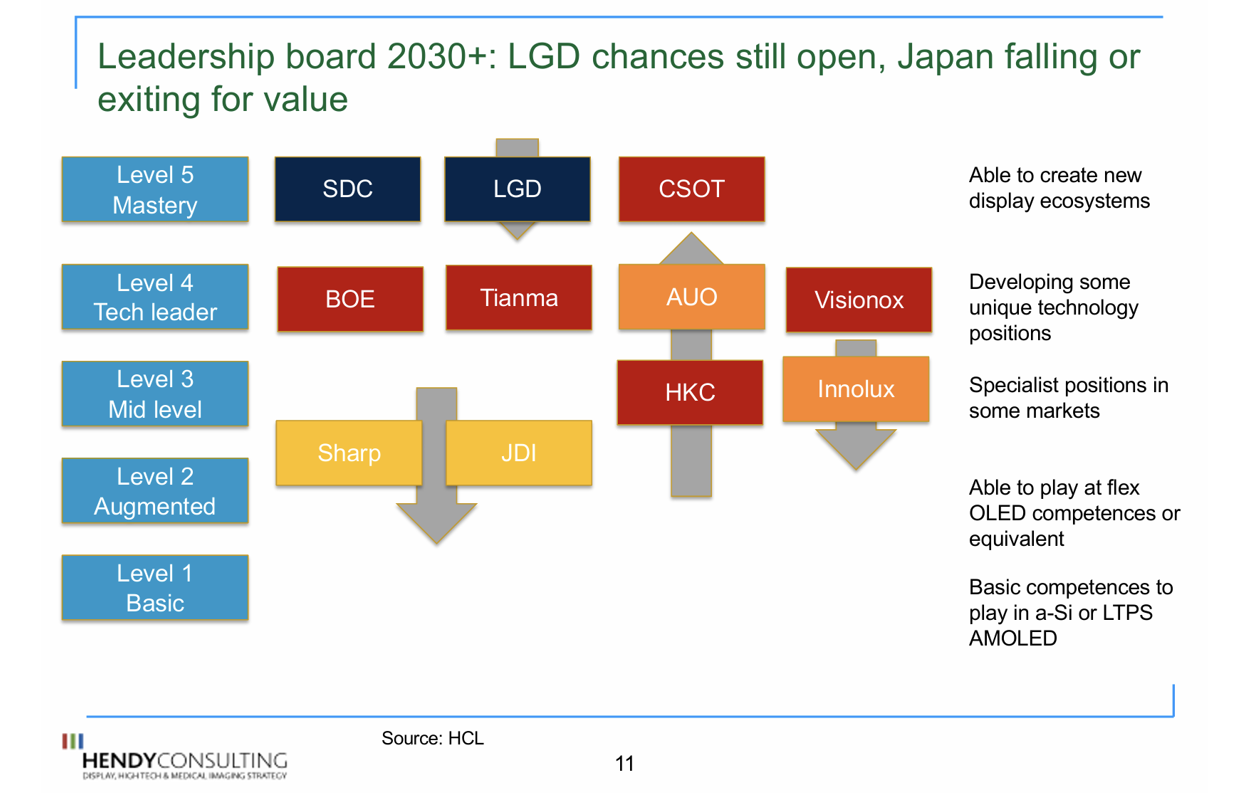
Hendy then noted that the next wave of Gen 8 OLED fabs is heterogeneous – no two fabs are alike, with different choices of backplane, deposition and stack configuration. Finally, he addressed the question of geopolitical risk – with the concentration of flat panel display capacity in China, a war in the Taiwan Strait could be devastating. He ended with this advice for Europe – stick to our knitting. Europe’s strengths are in novel technologies and materials.
Category
Industry
Automotive
Service
Standard
Report Type
Report
Time Period
Other
Receive our insightful weekly newsletter and stay ahead of the competition.
Author
Bob Obrien
Robert J (Bob) O’Brien joined Counterpoint Research as part of its acquisition of DSCC, where he was Co-Founder, Principal and CFO of DSCC. Bob has decades of experience turning market and business analysis into strategic insights in the display and electronics industries. At DSCC, Bob takes the lead role in analysis of display materials, including glass and AMOLED materials, and covers developments in TV and other large-screen display applications. He is the principal author of DSCC’s AMOLED Material Report, the Advanced TV Shipment Report, and the Display Glass Report, and Bob contributes regularly to the DSCC Weekly Review.