Connected Car Revenue Gap: Strong Volumes, Uneven Monetization
- GM generated $2.7 billion in recognized connected-services revenue in 2025, making it the only Western OEM to report connected services revenue.
- More than 80% of the top-15 OEM groups by global connected car sales disclose no connected-services revenue at all, including Toyota, the world's largest connected-car seller.
- Extended free-trial periods are structurally delaying when paid recurring revenue can even begin. Regardless of how successful adoption has been, monetization on this installed base is pushed years into the future.
- China's top OEM groups disclose no consumer subscription revenue either. In China, connectivity is built into the vehicle as a standard, not a separate layer still waiting to be monetized.
- Safety and security subscriptions, select ADAS features, and telematics-based insurance are generating durable, high-margin revenue today; the broader SaaS-style transformation promised a few years back remains too early to call.
In 2021 and 2022, several automakers used their investor days to make the same announcement: connected-car services, over-the-air software updates, and in-vehicle subscriptions would transform the vehicle from a one-time hardware sale into a recurring-revenue platform.
General Motors, at its October 2021 Investor Day, projected a $20-25 billion annual opportunity in software and services by 2030, based on a projected 30 million connected vehicles in the United States. Stellantis was even more ambitious, targeting approximately $23 billion in incremental annual revenue from software-enabled vehicles, related services, and subscriptions by 2030 at its December 2021 Software Day, with an interim goal of roughly $4.5 billion by 2026. Volkswagen poured billions into CARIAD. The reference point at that time was Tesla, proof that software-defined vehicles could command technology-company valuations.
The underlying assumption was that automotive consumers would behave like SaaS customers, accepting recurring charges for features delivered to a product they had already purchased. Five years later, the question is how much of that ambition has materialized in passenger vehicle connected services.
Global Connected Car Landscape
Global sales of connected cars grew 9% YoY in 2025, according to Counterpoint’s Global Connected Car Tracker, with embedded cellular connectivity now in more than three-quarters of all new vehicles sold worldwide. This embedded connectivity enables a range of services, from real-time navigation and predictive diagnostics to immersive infotainment and safety services. For automakers, connectivity has shifted from a differentiator to the foundational layer of competitiveness, upon which they are building new services and revenue streams.
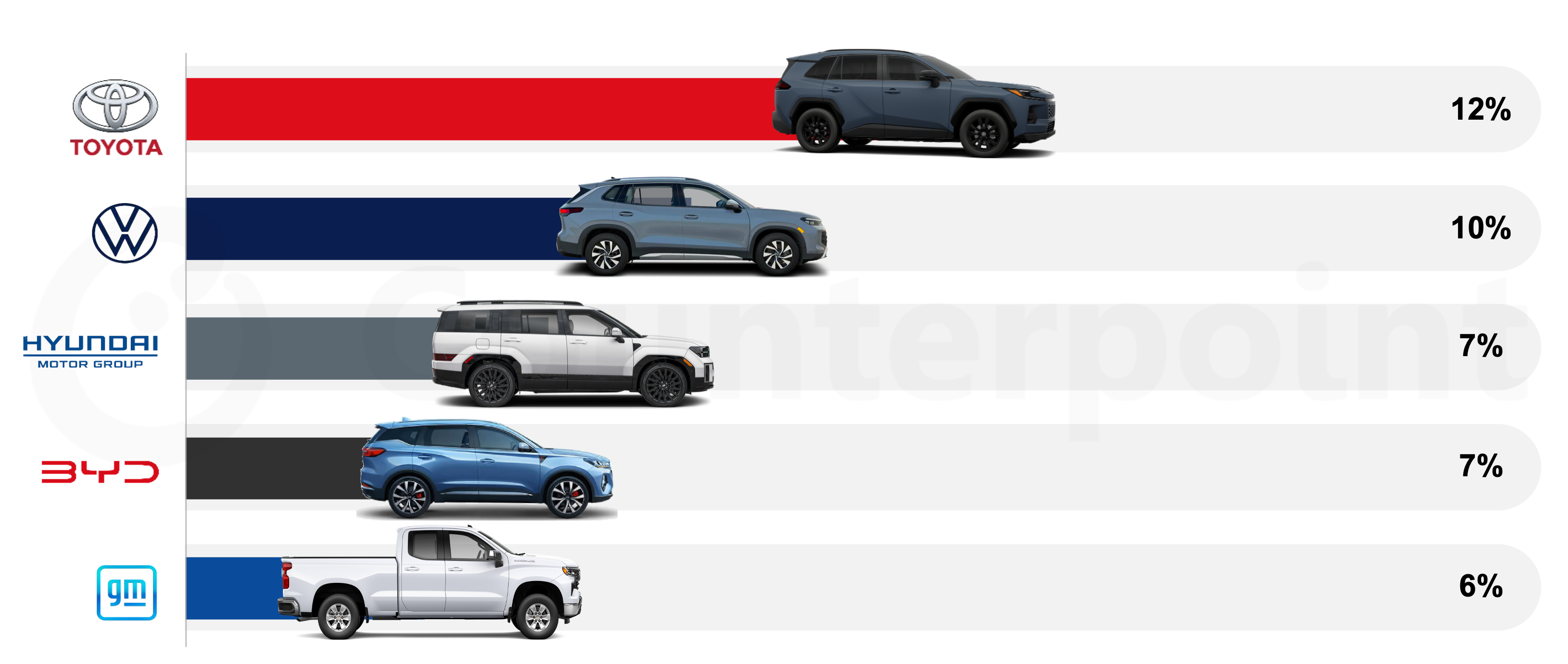
Toyota, Volkswagen Group, Hyundai-Kia, BYD, and GM together accounted for more than 40% of global connected passenger vehicle sales. These five groups represent the largest installed bases available for monetization efforts. Regional patterns show meaningful variation, with China leading in both volume and the speed of connected car deployment.
Share of Global Connected Car Sales by Automotive Group, 2025
For this analysis, connected-car monetization refers to recurring revenue from features that require or enable vehicle connectivity, such as safety services, remote access, ADAS subscriptions, OTA update-delivered feature unlocks, telematics-based insurance, and similar services.
There is a huge gap between volumes sold and actual monetization figures available. Toyota, the world’s largest connected-car seller, has made no material disclosure of connected services revenue. GM, fifth by sales share, is the only Western OEM with a verifiable (though notably successful) recurring revenue model. The majority of the top 15 automotive groups, which accounted for more than 80% of global connected car sales in 2025, have not disclosed any connected services revenue figures in their investor relations reports.
The gap between connected vehicle volume and actual recurring revenue becomes clearest when examining individual OEMs. Disclosure quality varies dramatically, which is itself an important signal of the maturity of monetization efforts.
GM Group is the only traditional Western OEM to report connected services revenue. In 2025, GM generated $2.7 billion in recognized revenue from OnStar, Super Cruise, and related software services, with $5.4 billion in deferred revenue at year-end (targeting ~$7.5 billion in 2026). The company ended 2025 with 12 million global OnStar subscribers, representing 34% YoY growth. Connected services gross margins are approximately 70%, in line with the software industry. This is notable, though, given that margins in the automotive industry are far lower, with automakers typically aiming for gross margins between 10 and 20%. GM’s approach combines long free periods for certain connected services along with higher tiers of paid services; core OnStar features are now included with the purchase of a new car for eight years in 2025 and newer vehicles in the US market, for example. In addition, GM has built a sizable subscriber base for its Super Cruise ADAS feature set. As of year-end 2025, the number of vehicle owners subscribing to GM’s Super Cruise service doubled, reaching approximately 625,000 active subscribers. Revenue for Super Cruise subscriptions passed the $200 million mark in 2025, according to the automaker. GM is the benchmark OEM, where connected services constitute a verifiable, growing business and are no longer an aspiration
Hyundai-Kia Automotive Group has built one of the largest subscriber bases, reaching 10 million global connected car service subscribers by mid-2023 and targeting 20 million by the end of 2026. However, it has taken a deliberate strategic approach in its largest market: the United States. Hyundai made Bluelink+ largely free for owners of 2024 and newer models. Hyundai made a deliberate call: adoption over revenue, for now, in North America. Connectivity is used as a competitive differentiator and a vehicle sales driver, not as a post-purchase revenue generation mechanism. The group has committed around $12.5 billion to SDV development by 2030, making clear this is an investment phase, not a monetization phase. Hyundai Group has not yet disclosed any revenue from connected services.
Tesla has achieved the highest volume of ADAS-related subscriptions, with active Full Self-Driving (FSD) subscriptions reaching 1.28 million in Q1 2026, up 51% YoY. This figure includes both subscription-only users and outright purchasers; Tesla moved to a subscription-only model in February 2026. The OEM offers its set of free connected services for eight years and Premium Connectivity on a paid monthly or annual basis. The automaker also offers a free trial of Premium Connectivity. While Tesla does not isolate FSD and connectivity revenue from its broader “Services and Other” category, the growth demonstrates clear demand for advanced driver assistance features delivered through connectivity. Tesla’s “Services and Other” revenue reached $12.5 billion in FY2025, up 19% YoY. While total automotive sales fell 10% in FY2025, the software, maintenance, and energy ecosystems experienced explosive counter-growth. Tesla designed FSD as a revenue-generating feature from inception, on a platform built for software monetization. Legacy OEMs retrofitted subscriptions onto hardware-first vehicles.
Volkswagen Group reports around $2 billion through CARIAD in 2025, but this is primarily internal licensing rather than direct consumer subscriptions. The company doesn’t disclose subscriber counts for its connected services, such as for VW Connect in Germany or for the connected services packages it offers in the US market.
Stellantis made the industry’s largest absolute software revenue commitment in 2021 but has not yet disclosed current consumer connected services revenue figures. While they haven't disclosed exact, isolated consumer-connected revenue, Stellantis confirmed in 2024 that global software revenue has grown 2.5 times since 2021. Against a monetizable connected car parc of 13.8 million vehicles, Stellantis reported 5 million subscription-based service users in 2024, a 36% attach rate. Stellantis has adopted a simplified, two-tier go-to-market structure in its major regions, centered on extended free access to core services. In both the US and Europe, Connect ONE, a comprehensive package of essential connected features, is included at no additional cost for 10 years from the date of vehicle purchase or lease. The premium Connect PLUS tier is available by subscription following a trial period and adds other premium features.
Mercedes-Benz Group’s Drive Pilot, a SAE Level 3 autonomous-driving subscription at $2,500 per year, is commercially available in California, Nevada, and Germany and is the most technically significant connected-car subscription product in any Western market. No subscriber count is disclosed for this subscription. Mercedes reported over $1 billion in software-based revenue in 2022 and targeted $2 billion from its connected car parc by 2025. No current revenue breakdown is available in its investor relations filings. Drive Pilot’s significance is precedent-setting regardless of current scale: a Level 3 autonomous capability delivered and monetized as a subscription is the template the industry is watching.
Beyond Drive Pilot, Mercedes sells Digital Extras, an à la carte marketplace, on its app and store offering individual upgrades like Acceleration Increase and Digital Light animations, each on a one-to-three-year complimentary trial before renewal. It's dozens of discrete purchases, not one plan. Tesla's FSD is a single subscription at a single price; Mercedes' and most legacy OEMs' offerings are a menu instead, and that simplicity gap may be an underrated reason Tesla converts better.
BMW Group. The My BMW and MINI apps are used by over 13 million customers globally as of 2024, with 7.4 million vehicles capable of full OTA upgrades, the largest OTA-capable fleet outside GM in any Western market. Yet BMW Group discloses no ConnectedDrive revenue. The 2022 heated seat subscription controversy remains the defining case study for European consumer resistance: attempting to charge recurring fees for hardware already installed in the vehicle generated legislative and public backlash sufficient to force a reversal.
European OEMs face structural constraints that their US counterparts do not. Consumer unwillingness to pay for hardware unlocks is one; GDPR, which structurally limits the data monetization layer that would otherwise offset it, is another. A third is regulatory fragmentation: national telecom rules on SIM registration, data retention, and lawful access vary by Member State, so a service launched across five countries can require five separate compliance processes rather than one EU-wide rollout. A fourth is cybersecurity compliance: UN R155 and R156 already govern vehicle-level cybersecurity and software-update management, and the EU Cyber Resilience Act now extends obligations into the wider software supply chain, cloud services, aftermarket connected devices, supplier components, with reporting duties starting September 2026 and full compliance required by December 2027. Each layer adds cost and timeline risk on top of the underlying consumer-resistance problem.
Connected Car Subscriber / User Base for Select OEMs
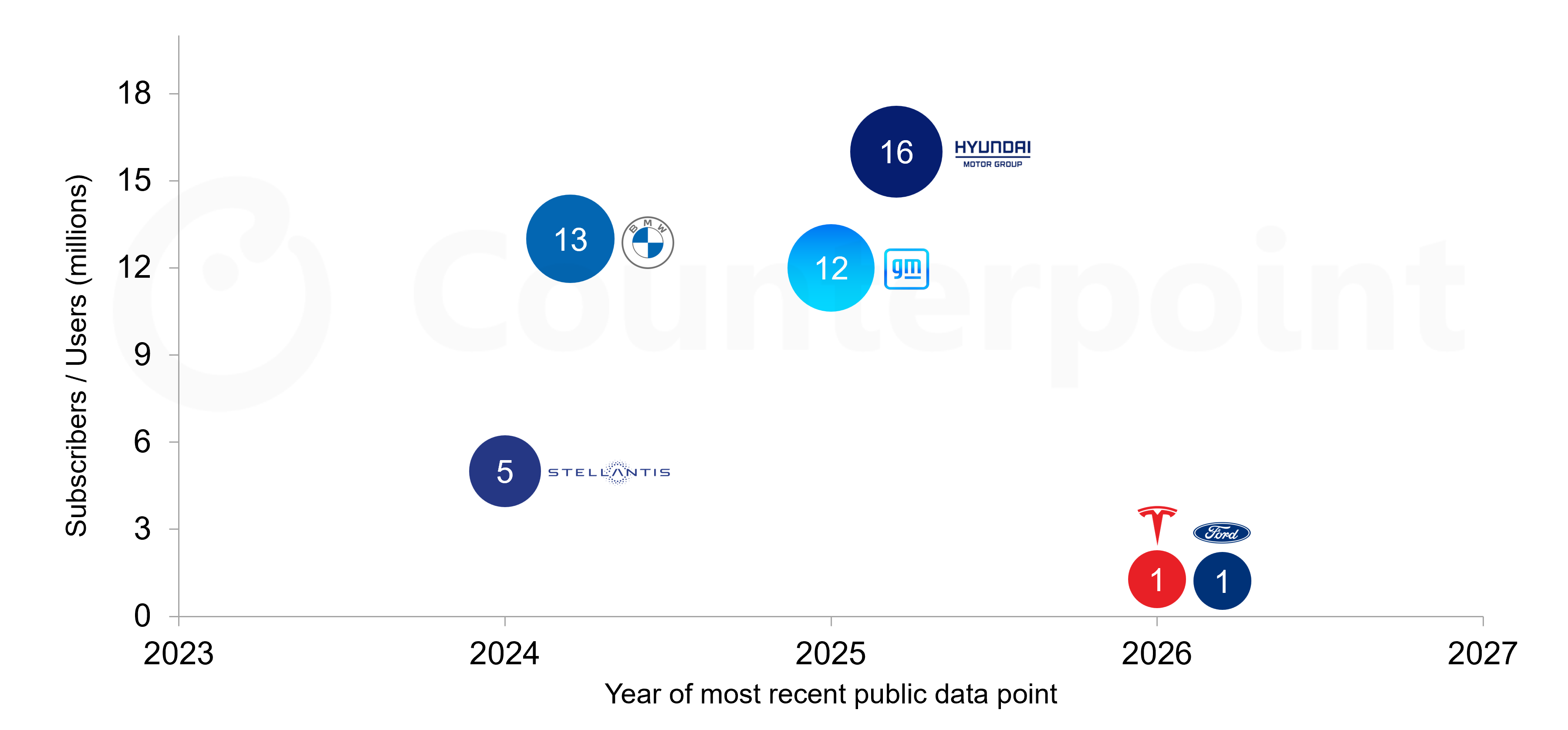
Most other OEMs with large connected vehicle installed bases provide significantly less visibility. Toyota Group (the highest connected car sales share at 12%) does not disclose connected services revenue or subscriber numbers. Toyota Connected North America describes its platform as serving “tens of millions” of vehicle owners globally; no precise figure is published. Ford’s BlueCruise had over 1.22 million equipped vehicles globally as of early 2026, up 80% YoY, logging 3.8 million hours of hands-free driving in 2025. Equipped vehicles and paying subscribers are not the same metric, and Ford does not disclose the conversion rate from trial to subscription. No standalone passenger connected services revenue is publicly disclosed. Renault-Nissan’s extended NissanConnect trial periods, from 6-months to 3-years, for the 2024 model year Premium Package. It signals conversion difficulty rather than subscription momentum; no subscriber count or revenue is disclosed. Honda offers no material connected car monetization story for passenger vehicles.
China’s four OEM groups in the global top 15 (BYD, Geely, Changan, Chery Groups) disclose no consumer subscription revenue. Chinese OEMs treat connectivity as a competitive standard embedded in the vehicle’s purchase price, a feature that sells cars rather than one that generates revenue after the sale. Geely is a partial exception through ECARX, its listed software subsidiary. It recorded $762 million in FY2024 B2B revenue, EBITDA breakeven in Q4 2024, deploying technology across 8.1 million vehicles. It is a platform business, not a consumer subscription model, but it is the closest China has to a transparent, connected-car software revenue.
The Monetization Delay from Long Free Trials
A critical but often overlooked factor is the length of free trial periods offered by OEMs. Many manufacturers offer extended free access to core/basic connected features, significantly delaying the start of paid recurring revenue. Toyota and Stellantis offer 10-years of free basic connected services in the US. GM offers 8 years of free OnStar Core on 2025 and newer model-year vehicles. Hyundai-Kia offers Bluelink+ free for the lifetime of first ownership in the US. Ford’s BlueCruise at 90 days is the outlier and the fastest path to paid conversion among the OEMs. In the US, Ford also offers several connected services free of charge through its Ford mobile app.
Connected Car Services: Free Trial Duration by OEM Group and Market
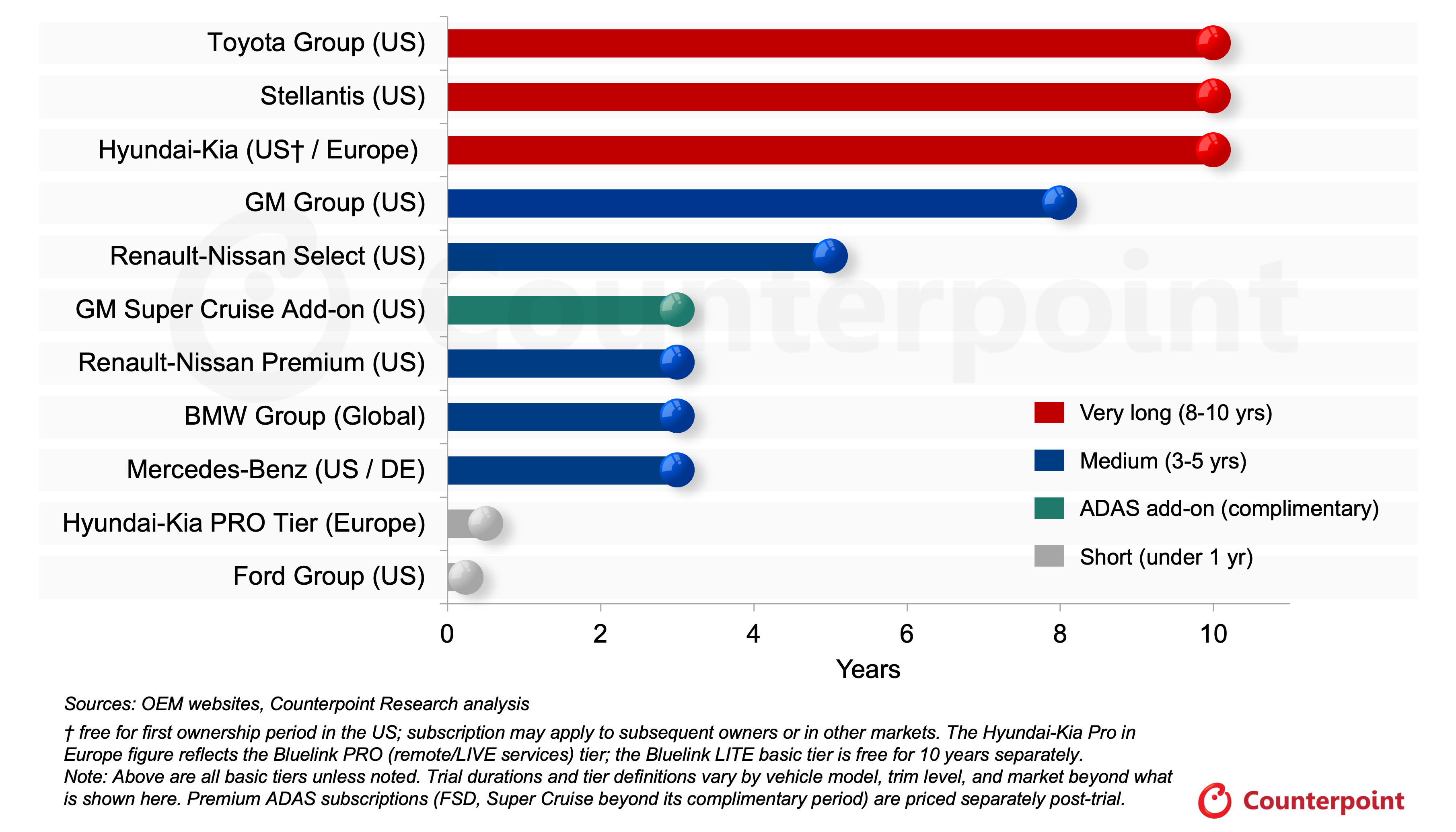
These extended free periods mean that actual monetization is pushed several years into the future for a large portion of the connected vehicle parc. This makes it significantly harder for OEMs to hit ambitious near-term revenue targets unless they achieve strong conversion on paid premium features (Super Cruise, FSD, etc.) after the trial ends. Long free trials help build habit and scale, but they also substantially delay revenue recognition.
What Is Actually Generating Revenue
Three connected car revenue models have demonstrated real, recurring, and growing revenue across the industry.
Safety and security subscriptions. OnStar has been in operation for nearly three decades. Emergency response and stolen vehicle services address needs so acute that the willingness to pay holds through economic cycles and subscription fatigue, making them the most durable connected-car revenue model in the industry.
ADAS and autonomous driving subscriptions. Tesla FSD, GM Super Cruise, and Ford BlueCruise demonstrate that consumers are willing to pay for hands-free capability when the technology delivers. Mercedes Drive Pilot establishes the Level 3 precedent. These are capabilities absent from the base vehicle, so these are genuine software additions, not hardware unlocks.
Telematics-based insurance. GM OnStar Insurance uses driving data to personalize pricing, making the vehicle the underwriting instrument. Higher ARPU potential than most direct subscription products and a genuine value exchange rather than a pure fee.
What has not worked: hardware feature gating, broad post-trial conversion on standard remote access services in markets with strong consumer protection expectations, and the assumption that OTA delivery alone creates consumer willingness to pay.
Is the Monetization real, a bubble, or too early to say?
Connected car monetization is real and already generating material recurring revenue with attractive margins in specific categories (most clearly safety/security subscriptions and certain ADAS features). It is not a bubble. However, for the broader industry, it remains too early to declare transformative success.
Large, connected installed bases have been built, but conversion into predictable, high-margin recurring revenue remains limited outside a few proven use cases and is often significantly delayed by long free-trial periods. The pure SaaS analogy overstated both the speed and the universality of the opportunity in passenger vehicles.
Analyst Take
The monetization opportunity will concentrate rather than disappear. OEM groups with proven infrastructure, led by GM, will expand; most others will spend years building that infrastructure before monetization becomes a meaningful conversation for investors. Near- to medium-term growth is most likely in insurance and ADAS subscriptions.
The Chinese market is following a faster software-defined path with different competitive dynamics. Chinese automakers expanding into other markets will need to localize their approach to connectivity, which is a major challenge, especially in highly regulated markets such as Europe.
For OEMs, the priority should be deepening proven models while being selective about new feature subscriptions. Product architecture may matter as much as the underlying technology here: Tesla converts a single subscription at a single price, while Mercedes and most legacy OEMs sell a menu of dozens of discrete upgrades. That simplicity gap is worth closing before OEMs add further subscription complexity to models that are not yet converting well.
Connected services are becoming a meaningful supplementary revenue stream for well-positioned players, but they are unlikely to fundamentally transform the economics of the passenger vehicle business as projected a few years ago.
The data shows real monetization progress in specific areas, supported by large and growing connected installed bases. However, long free-trial periods significantly delay revenue realization for many OEMs, and converting to predictable recurring revenue remains highly uneven. The next three to five years will separate those executing effectively on proven models from those still relying primarily on narrative.
Category
Industry
Automotive
Service
Premium
Report Type
Report
Time Period
Other
Receive our insightful weekly newsletter and stay ahead of the competition.
Author
Abhilash Gupta


Dr. Abhilash Gupta is a Senior Research Analyst at Counterpoint Technology Market Research, specializing in the rapidly evolving automotive sector and its surrounding ecosystem. With over 9 years of experience spanning industry, research, and academia, he possesses deep expertise in market research, data analytics, and the integration of emerging technologies such as 5G and AI into the automotive industry. His extensive research background allows him to offer strategic insights that drive the future of connected vehicles and smart mobility solutions. Dr. Gupta holds a Ph.D. in Electrical Engineering from Malaviya National Institute of Technology Jaipur, a Master’s degree in Control Systems from the National Institute of Technology Patna, and a Bachelor’s degree in Electrical Engineering from Rajasthan Technical University.