CES 2026: RGB MiniLED New Battleground for Premium TV
RGB MiniLED technology was introduced a year ago at CES 2025, but it had a much greater presence at CES 2026, with the top four global TV brands all showcasing products featuring the new technology. Each company had a different approach to the new technology, raising questions about which approach will be most successful.
Please note that we use the term RGB MiniLED to describe displays with red, green and blue LEDs independently driven in a backlight matrix driving an LCD screen. MiniLED means a backlight in our definition, while MicroLED means a direct-view display. Both Samsung and LG are labeling their products “MicroLED;” we will refer to these as branding efforts and not technology descriptions.
Samsung showed the largest flat panel TV ever, a 130”, which it called Micro RGB. We have covered this in another article (see ‘Samsung Reasserts TV Leadership at CES 2026’ in this issue).
Hisense made RGB MiniLED a centerpiece of its press event, jumping on the theme of color gamut as the focus of the brand. Unlike its competitors, Hisense features short-throw laser-projection products under the XR10 branding, and since lasers are monochromatic, they have an inherently wide color gamut.
Hisense pledged to introduce RGB MiniLED in 2026 in “More Sizes, More Price Points, More Homes”, with an emphasis on affordability in addition to performance. On the performance end, in its RGB MiniLED evo series, Hisense is introducing a fourth primary color, a sky-blue sub-pixel to go along with the standard red, green and blue sub-pixels. Hisense claims that this achieves up to 110% of the BT.2020 color coverage, over 30% more than OLED.
Curiously, in its 163” MicroLED product demonstration, Hisense also uses a four-color primary system, but in this case, the extra color is a yellow sub-pixel.
Hisense Graphic Describing Four Primary-Color RGB MiniLED evo
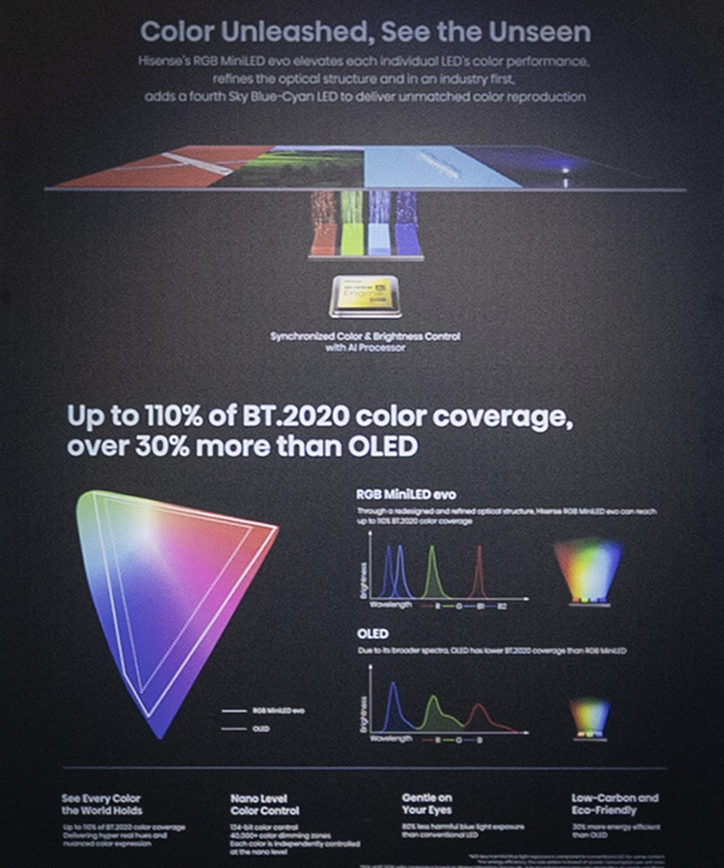
The claim to achieve 110% of BT-2020 is questionable at best. While on a color chart, a TV might achieve the area of a polygon that has 110% of the area of the BT-2020 triangle, this does not necessarily lead to better color. A video product that is mastered to the BT-2020 standard will have content within the BT-2020 triangle, and any reproduction on a TV that is outside the color triangle is a distortion from the original content.
Hisense is not the first TV brand to attempt to use a four-color primary system. Years ago, Sharp developed Quattron, LCD TVs that added a yellow sub-pixel. Quattron did little to lift Sharp’s position in the LCD race or as a top TV brand. We will see whether Hisense fares any better with the concept.
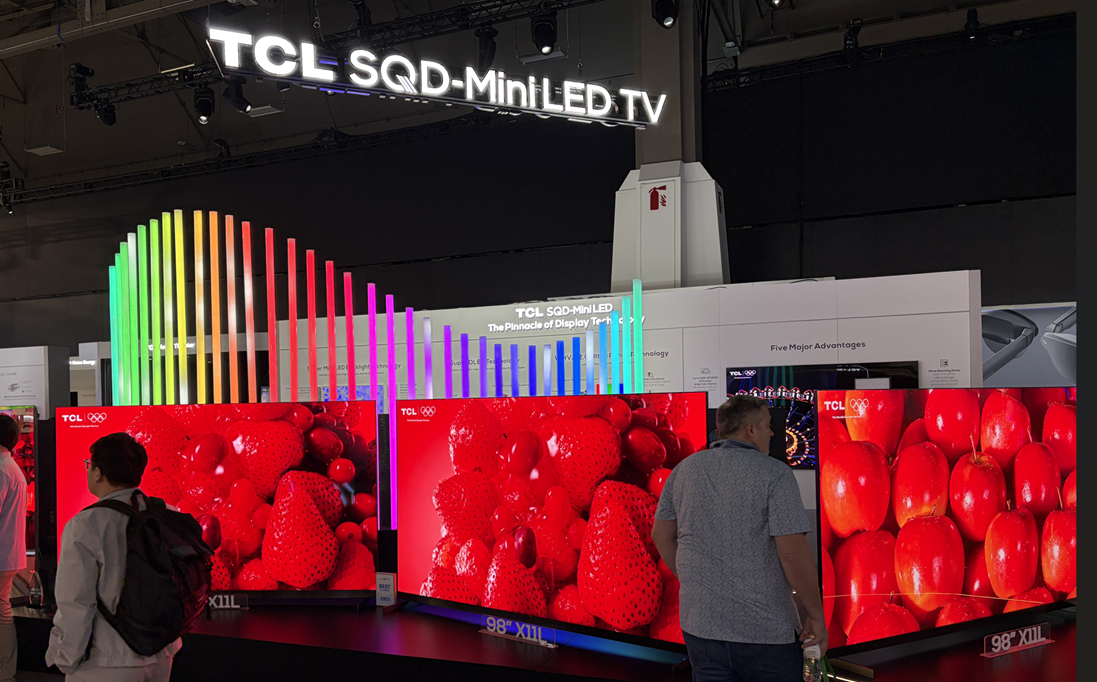
TCL will have RGB MiniLED TVs, but not at the top of its product portfolio. TCL has the SQD MiniLED as its flagship with blue LEDs and a quantum dot diffuser. TCL describes the SQD MiniLED as the “Ultimate Choice for Flagship MiniLED TVs”. The company uses what it calls Super QLED crystals, QDs with peak emission at 440nm, 530nm and 630nm for blue, green and red, respectively. TCL claims that it achieves “up to 100% BT 2020” which is at least plausible and the SQD has “No Color Crosstalk”. TCL also highlighted that its QD approach allowed for more dimming zones, higher brightness and a thinner profile.
TCL Flagship SQD MiniLED TVs Feature Quantum Dots
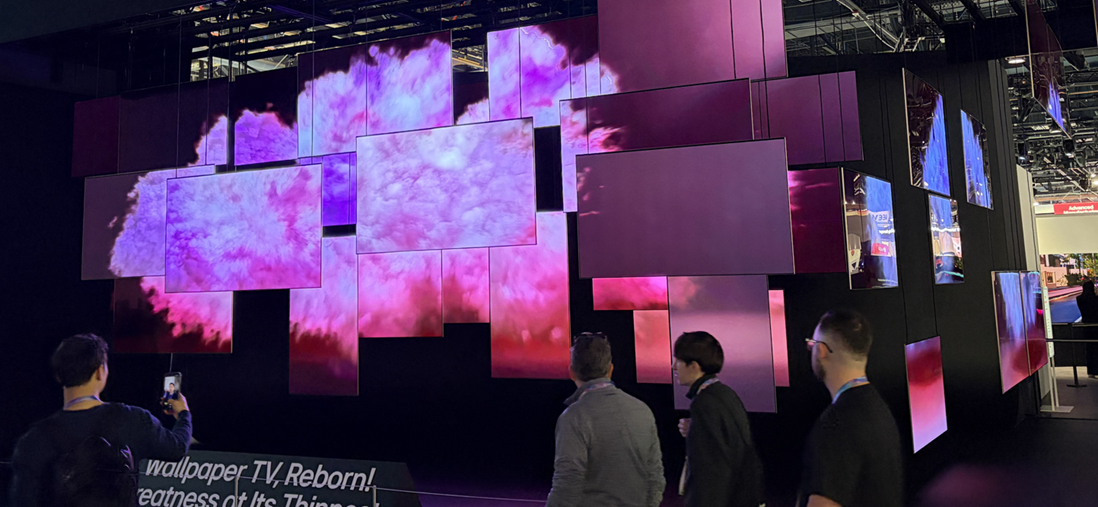
Finally, LG Electronics will introduce a product line which it labels ‘Micro RGB evo’, but LG clearly indicated that this product line would be a tier below its flagship OLED TVs. LG’s top-tier launch in 2026 was the Wallpaper OLED TV, an improvement over a similar product launched in 2018, as the new product is only 9 mm thick and operates wirelessly. In describing the Micro RGB evo product line, LG claimed it was certified for 100% coverage under BT-2020, DCI-P3 and Adobe RGB.
LG’s Wallpaper OLED TVs Populated the Entryway to its Exhibit
Finally, outside of the Las Vegas Convention Center, LG Display, which makes OLED TV panels but does not make LCD TV panels (and thus does not benefit if RGB MiniLED succeeds), had a critical view of the new technology with a clever demonstration of “color crosstalk”, also identified by TCL as a problem with RGB MiniLED. Color crosstalk happens when a single-color backlight generates a colored halo at sharp edges, as shown in a simple color bar test screen. LGD made an excellent video of the problem, available
here.
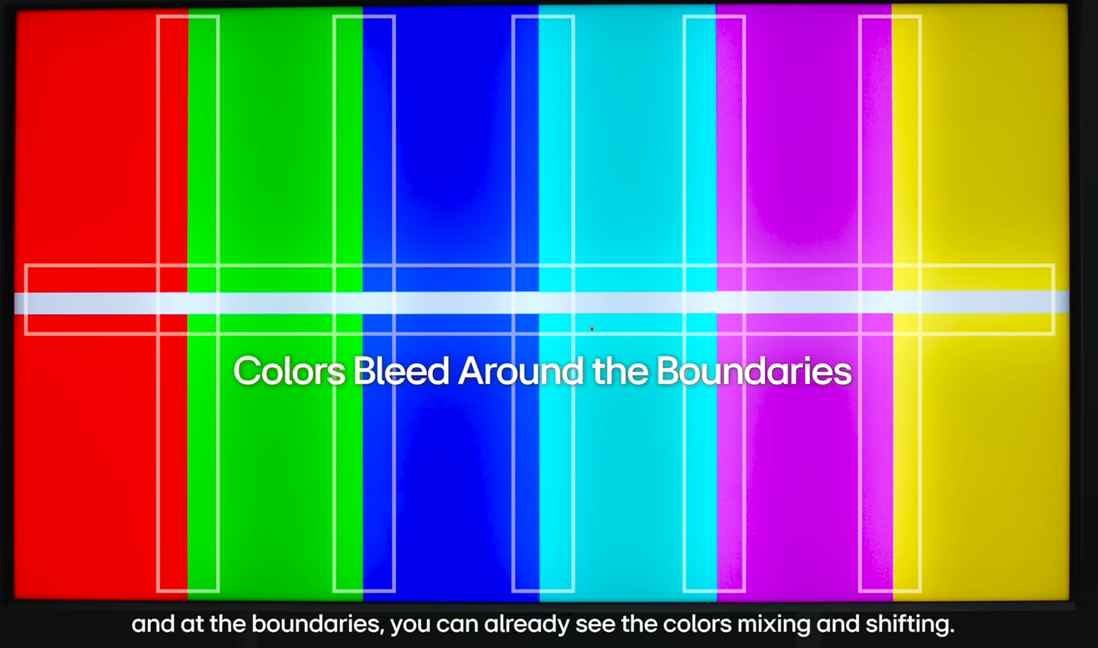
LGD conceded that brands and retailers would be unwilling to highlight this problem, as it would lead to lower sales of profitable products, but unless TV makers find a solution, it may reduce the appeal of RGB MiniLED for premium consumers.
Category
Industry
Display
Service
Display - Others
Report Type
Report
Time Period
Other
Receive our insightful weekly newsletter and stay ahead of the competition.
Author
Bob Obrien
Robert J (Bob) O’Brien joined Counterpoint Research as part of its acquisition of DSCC, where he was Co-Founder, Principal and CFO of DSCC. Bob has decades of experience turning market and business analysis into strategic insights in the display and electronics industries. At DSCC, Bob takes the lead role in analysis of display materials, including glass and AMOLED materials, and covers developments in TV and other large-screen display applications. He is the principal author of DSCC’s AMOLED Material Report, the Advanced TV Shipment Report, and the Display Glass Report, and Bob contributes regularly to the DSCC Weekly Review.