Advanced TV Shipments to Exceed 43 Million Units in 2026
The advanced TV market is forecast to grow by 9% YoY to more than 43 million units in shipments and by 1% YoY in revenues in 2026, according to the latest release of Counterpoint Research’s Quarterly Advanced TV Shipment and Forecast Report. Global advanced TV shipments are forecast to increase at a 10% CAGR during 2024-2030, while revenues are projected to decrease at a 3% CAGR during 2026-2030 as price declines more than offset unit increases.
The report covers the global premium TV market, including the most advanced TV technologies – White OLED, QD-OLED, QD-LCD, MiniLED and Nanocell with 4K and 8K resolutions. The report includes history by quarter from 2020 through Q1 2026 and a forecast by quarter through 2030, covering shipments and revenues by technology, region, brand, resolution and size.
After a post-pandemic hangover in 2023 as shipments decreased 2% YoY, advanced TV shipments have seen two years of tremendous growth with a 44% increase in 2024 and another 29% increase in 2025. We expect growth to gradually decelerate during 2026-2030, starting with a 9% YoY increase in 2026. Revenues, which also increased at double-digit % rates in both 2024 and 2025, are expected to increase by 1% in 2026.
Advanced LCD TV Shipments, 2022-2030(E)
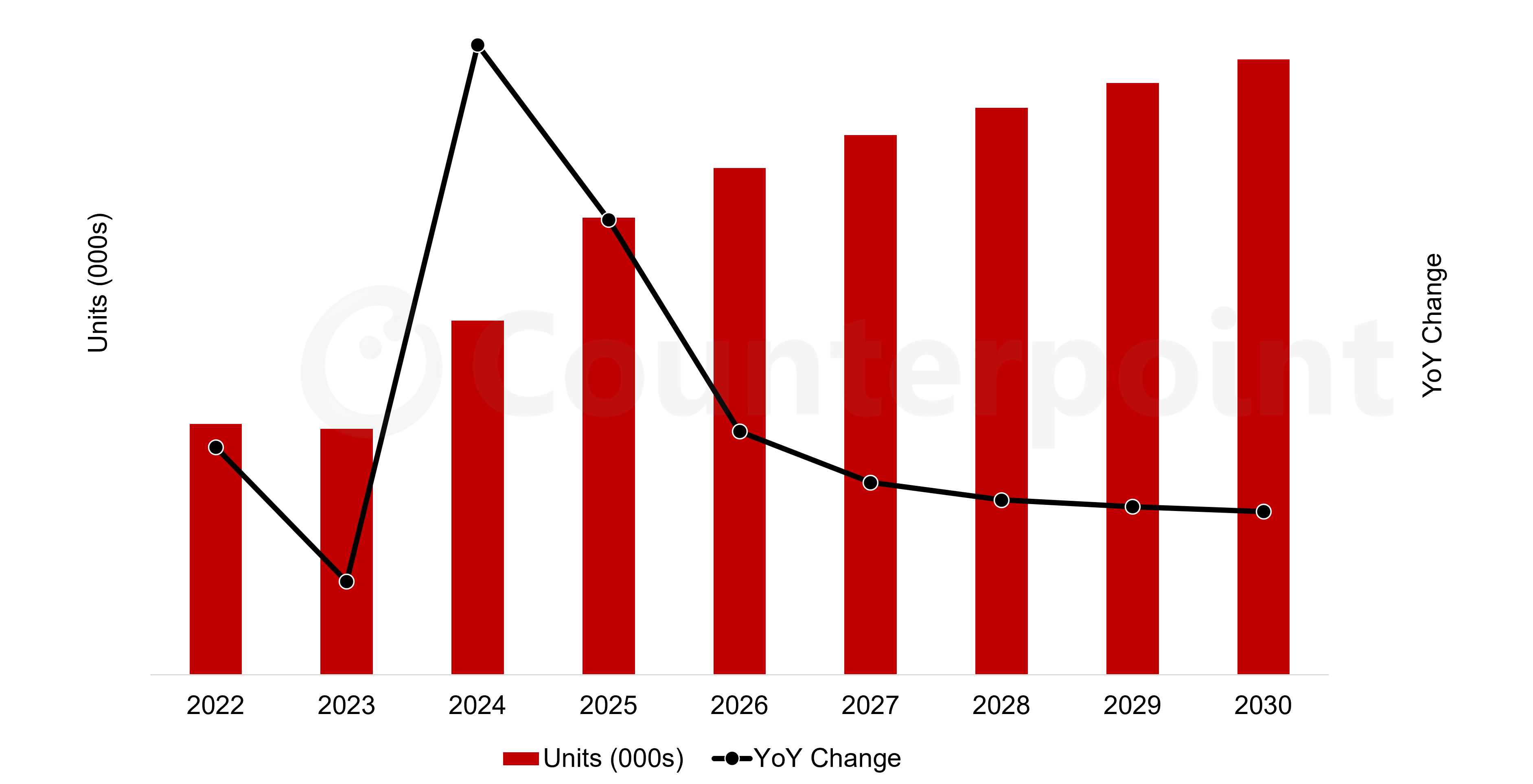
In Western Europe, advanced TV shipments are forecast to increase by 5% YoY in 2026, while revenues are forecast to decrease by 2% YoY. We expect that Western Europe will see a 7% CAGR during 2024-2030. Revenues peaked in 2025 and are expected to decline in the coming years. In North America, advanced TV shipments are forecast to increase by 20% YoY in 2026 with revenues increasing by 9%. We expect North America to have a 10% CAGR during 2024-2030, while revenues are forecast to peak in 2027 and to decline thereafter.
The last two years saw exceptional growth in very large-sized (80” and larger) TVs, and we expect that trend to continue, primarily in advanced LCD TVs, because OLED TV fabs have limited capability to make such large-sized panels. Advanced LCD TV shipments are expected to increase at an 11% CAGR during 2024-2030, with 80”+ advanced LCD TV shipments forecast to increase at a 13% CAGR.
Advanced LCD TV Shipments by Screen Size, 2021-2030(E)
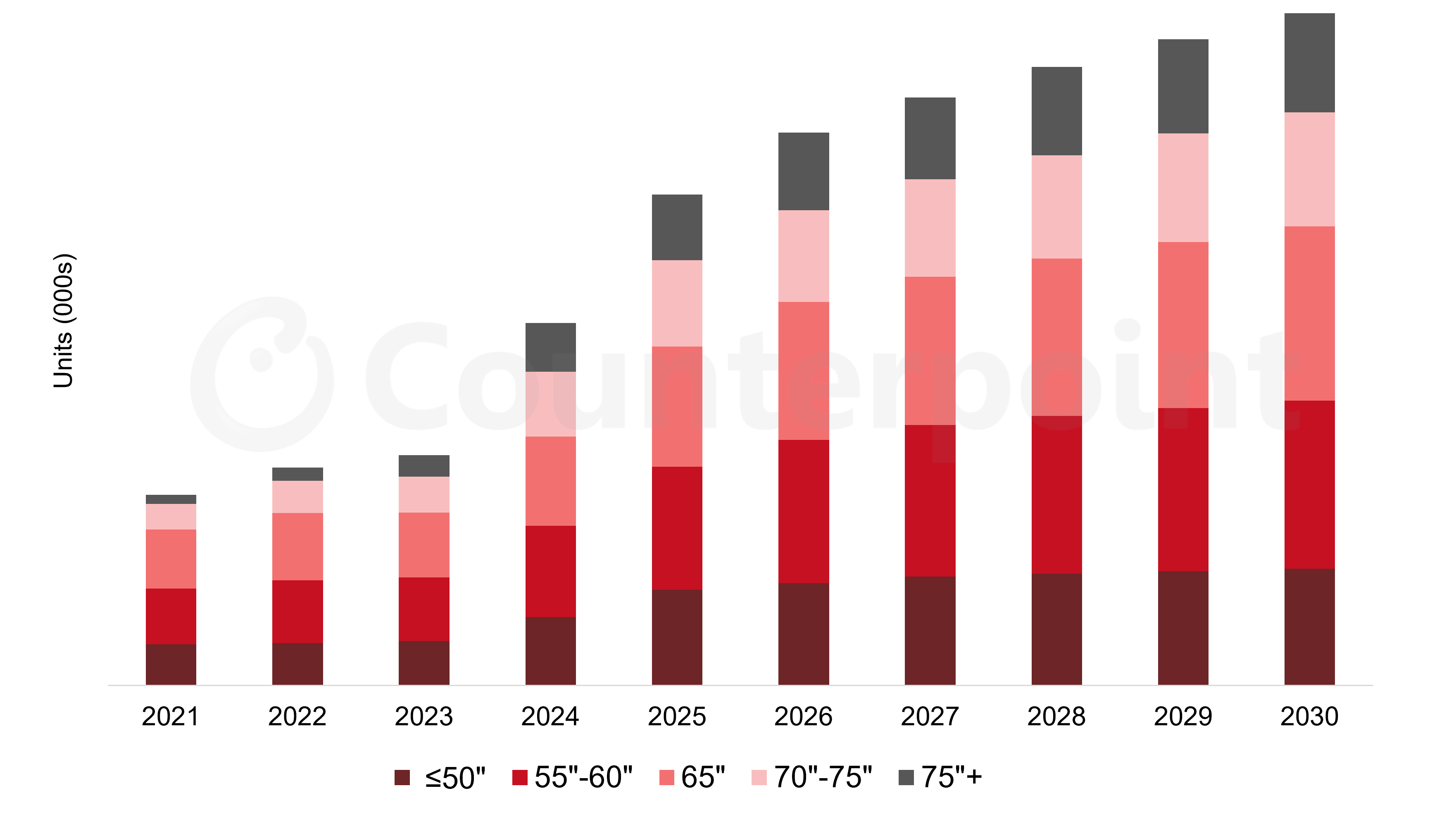
The forecast for OLED TVs is less sanguine. OLED TV shipments are expected to increase at a 4% CAGR during 2024-2030. Shipments for 77” and larger OLED TVs are expected to increase at an 8% CAGR over the same period, but most of these will be 77”. We expect shipments of 83” OLED TVs to represent only 4% of advanced TV shipments over 80”.
In the “super-premium” category, which comprises OLED and MiniLED TVs, MiniLED TVs overtook OLED TVs in 2024 and are expected to continue to gain share in terms of both units and revenues. MiniLED TV shipments are expected to increase at an 18% CAGR during 2024-2030, compared to OLED TVs with a 4% CAGR. MiniLED TV revenues are expected to continue to increase at an 8% CAGR, while OLED revenues are projected to decline during 2026-2030.
Within the OLED TV category, our forecast does not expect a bright road ahead for QD-OLED. QD-OLED shipments are forecast to plateau during 2026-2030. Additional shipments of QD-OLED monitors will fill Samsung Display’s capacity for QD-OLED, and Samsung is not expected to expand its capacity. QD-OLED revenues are expected to decline at a 10% CAGR during 2024-2030 as selling prices are expected to decline continuously.
The forecast for white OLEDs is modestly more promising but hardly optimistic. White OLED TV shipments are forecast to grow at a 5% CAGR during 2024-2030. Shipments for screen sizes larger than 77” (LGD makes 83” and 98” 4K panels and has made 88” 8K panels) are expected to plateau. Total white OLED TV shipments are not expected to catch their previous peak reached in 2021, and white OLED TV revenues are expected to remain well below their peak of 2021. Revenues are expected to be flat YoY in 2026 but to decline thereafter.
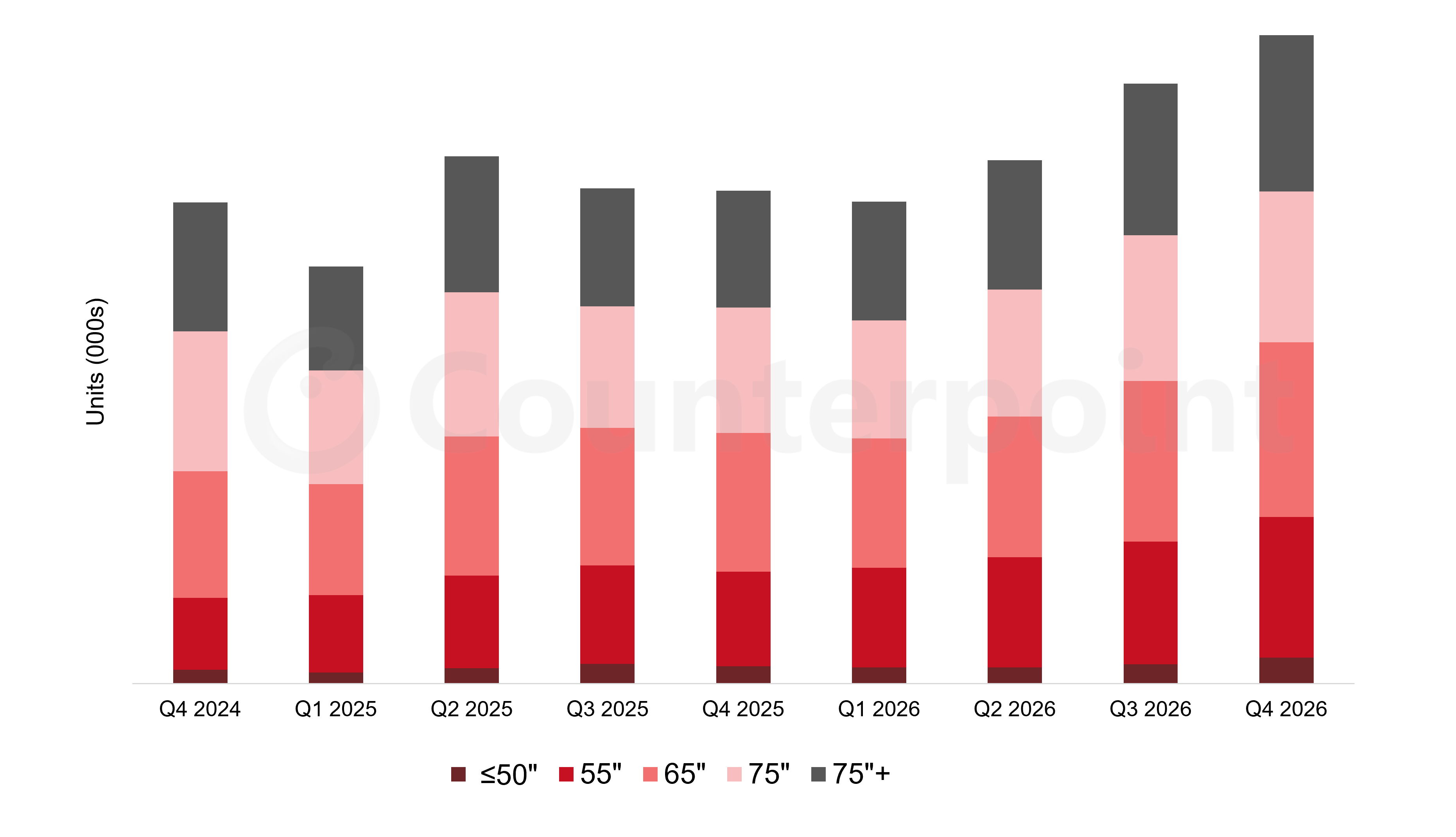
Turning attention to the near term, the biggest trend in the market has been the growth of super-large (98” and larger) TVs, driven by aggressive promotion and pricing by the two largest mainland Chinese brands, TCL and Hisense. This drove the growth of 98” and larger MiniLED TVs of more than 6x from 2023 to 2025. In 2025, Mainland China accounted for 79% of this category of large TVs, with North America a distant second, accounting for 12%.
China's growth was boosted in part by a government subsidy program in 2024-2025, which has been discontinued and which we believe will not be reinstated. As a result, we expect growth in 98”+ MiniLED TVs in China to slow to 22% in 2026, but growth will pick up in other regions. We expect worldwide shipments of 98” and larger MiniLED TVs to increase by 28% YoY in Q3 2026 and by 60% YoY in Q4 2026.
MiniLED TV Shipments by Screen Size, Q4 2024-Q4 2026(E)
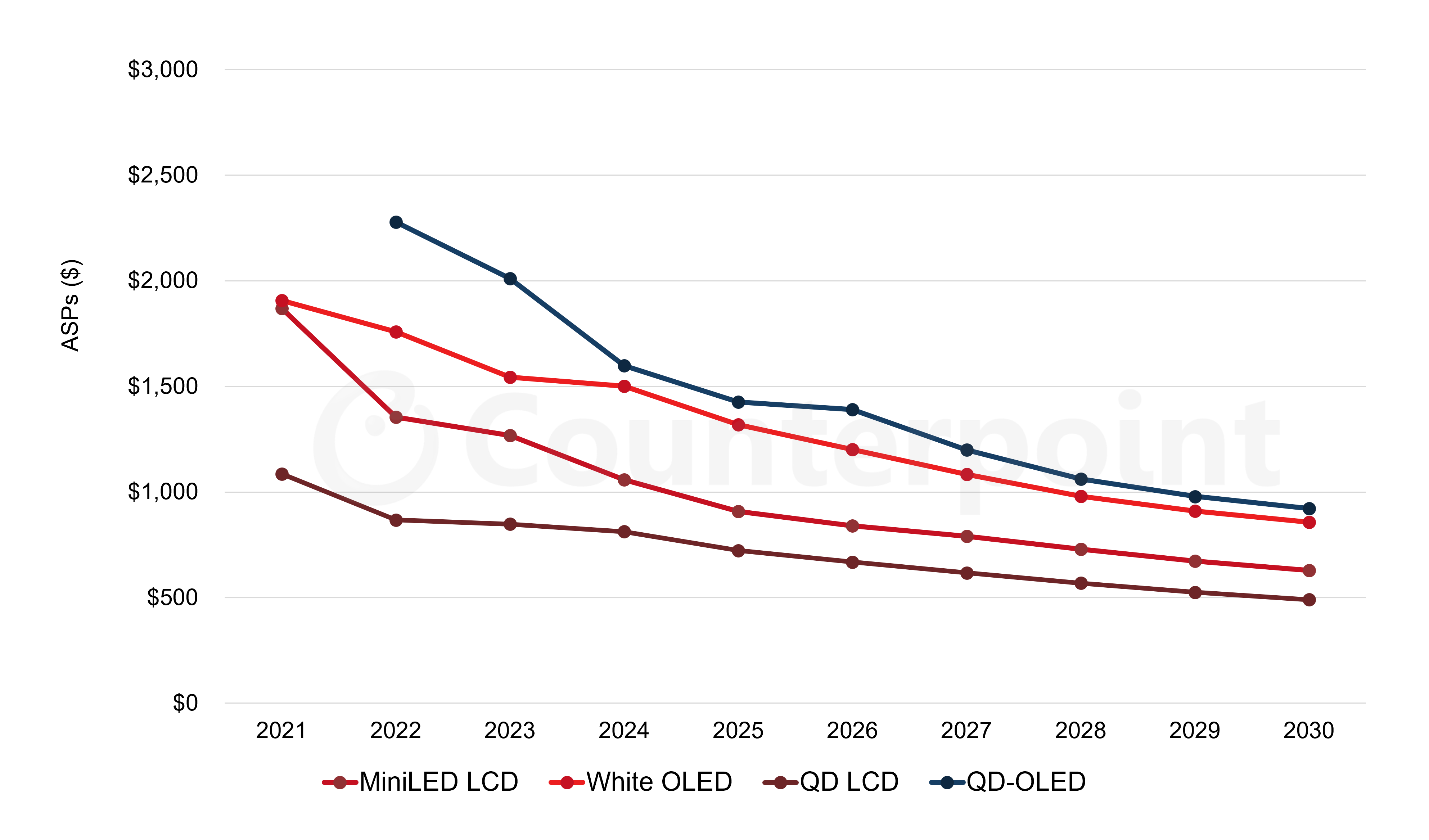
In all the analyses that go into the forecast, a critical piece rests in our understanding of display costs and which forms the basis for our forecast of TV prices. The last chart here shows our forecast for the average selling price (ASP) of 65” 4K advanced TVs with different display technologies. QD-LCDs are the lowest-priced TVs with advanced display technology. MiniLED TVs are priced 20%-30% higher than QD-LCD TVs, and OLED TVs are priced roughly 50% higher than MiniLED TVs, with QD-OLED TVs priced even higher than white OLEDs.
This pricing dynamic is the main underlying factor in the super-premium battle. Consumers have been choosing to buy MiniLED at a lower price, or instead buying a larger MiniLED TV with the same price as a smaller OLED.
Average Selling Price (ASP) of 65” 4K Advanced TVs
In addition to LCD and OLED, the Quarterly Advanced TV Shipment and Forecast Report covers MicroLED TV shipments. For years, we have been anticipating tremendous growth in the category, based on the plans of Samsung’s Visual Display business. For years, we have seen actual shipments fall short of our expectations, and prices have remained stratospheric. Actual shipments in 2025 amounted to only 144 units. Meanwhile, shipments of competing MiniLED LCD products in the same screen size range (110” and 115”) increased to 2,299 units in 2025, more than 10x MicroLED. Therefore, while we still forecast growth in the MicroLED category and we will continue to track shipments, we expect it to account for less than 0.01% of advanced TV shipments even in 2030.
Counterpoint Display Weekly Review readers interested in subscribing to the ‘Advanced TV Shipment and Forecast Report’ should contact [email protected].
Category
Industry
Display
Service
Display Market Trends
Report Type
Report
Time Period
Weekly
Receive our insightful weekly newsletter and stay ahead of the competition.
Author
Bob Obrien
Robert J (Bob) O’Brien joined Counterpoint Research as part of its acquisition of DSCC, where he was Co-Founder, Principal and CFO of DSCC. Bob has decades of experience turning market and business analysis into strategic insights in the display and electronics industries. At DSCC, Bob takes the lead role in analysis of display materials, including glass and AMOLED materials, and covers developments in TV and other large-screen display applications. He is the principal author of DSCC’s AMOLED Material Report, the Advanced TV Shipment Report, and the Display Glass Report, and Bob contributes regularly to the DSCC Weekly Review.