Global TV Shipments Flat in Q2 2026 While OLED Grows 20%, WOLED Cost Reduction Is the One to Watch
- Global TV shipments declined 4% YoY in June 2026, bringing Q2 2026 to -0.4% YoY — a relatively flat finish to the quarter.
- At the brand level, AOC, Samsung and TCL grew shipments amid intense competition in the LCD TV segment, while most other brands — including Hisense, Huawei and Changhong — underperformed.
- The OLED TV market grew 12% YoY in June 2026, closing Q2 with 20% YoY growth. LGE continued to expand its sales volume and led this growth, maintaining an overwhelming number one position with more than half of the OLED TV market.
- LGD is pursuing multiple avenues to lower WOLED TV prices, including the launch of WOLED SE and the development of a 2-stack tandem panel that reduces the stack count. Whether this translates into meaningful OLED TV market expansion remains to be seen.
Seoul, Beijing, Buenos Aires, Hong Kong, London, New Delhi, San Diego, Taipei, Tokyo – Aug 7, 2026
Global TV shipments declined 4% YoY in June 2026, according to Counterpoint Research's Monthly Global TV Tracker 2026 June. This brought Q2 2026 to -0.4% YoY, ending the quarter on a relatively flat note.
June's weakness appears to reflect a shift in timing rather than a genuine contraction in demand. World Cup promotions pulled demand forward into April 2026, and the resulting payback weighed on June shipments. By brand level, AOC, Samsung and TCL grew shipments, while most other brands — including Hisense, Huawei and Changhong - declined.
In the LCD TV segment, Samsung and TCL remain locked in a tight race. Samsung has significantly broadened its lineup with the S95H and R95H alongside its new MiniLED series, the M80H and M70H, while TCL is leading with its SQD (Super Quantum Dot) MiniLED TVs spanning the X11L, C8L and C7L. The two brands now compete head-to-head across virtually every price tier — from entry-level to ultra-premium — in MiniLED and RGB MiniLED TVs. As of June 2026, their LCD TV shipment shares stood at 13.7% for Samsung and 13.8% for TCL, a gap of just 0.1pp.
Notably, the two are pursuing divergent technology paths. Samsung is extending RGB-backlight-based TVs from its flagship down into more accessible tiers, whereas TCL has confined RGB MiniLED (RM9L) to large-format premium models and positioned SQD-MiniLED at the top of its technology stack. The result is direct competition at comparable price points with different underlying technologies.
Monthly TV Shipment YoY Growth Rate: Total TV vs OLED TV
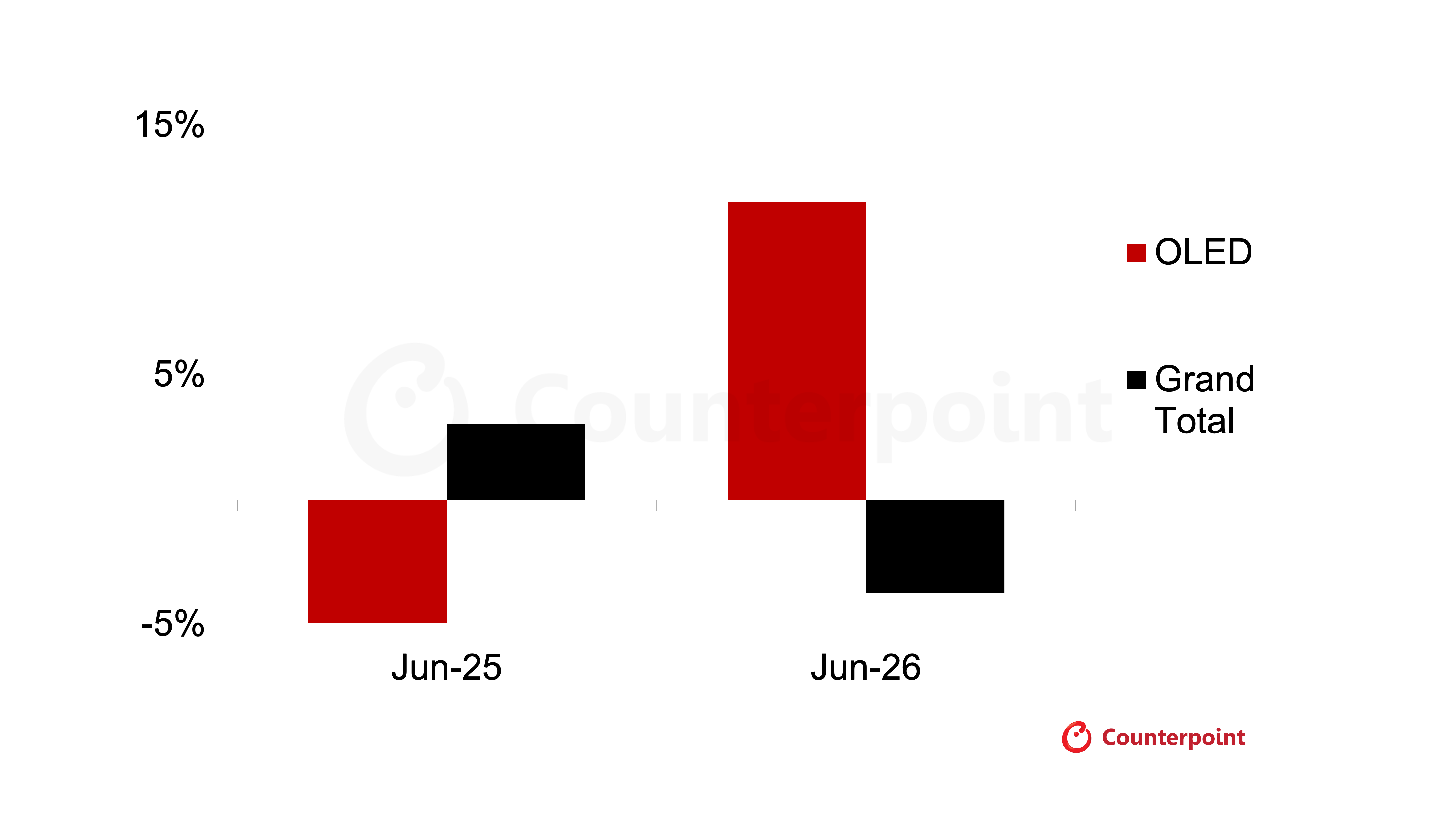
The OLED TV market maintained clear momentum. OLED TV shipments grew 12% YoY in June 2026, closing Q2 with 20% YoY growth. LGE led this expansion, holding an overwhelming number one position with more than half of the OLED TV market in both June and Q2.
The key variable ahead is WOLED's cost structure. LG Display's large panel division is currently focused on lowering the price of WOLED for TVs. The company has already launched WOLED SE, which removes the polarizer to reduce cost, and is now developing a 2-stack tandem structure that maintains or improves quality while simplifying the stack.
This goes beyond incremental cost reduction; it points to an attempt to lower the entry price of OLED TVs themselves. Whether this WOLED strategy can meaningfully broaden the OLED TV market will be the point to watch going forward.
“In recent years, OLED TVs have lost ground in the super-premium market to less-expensive MiniLED TVs,” said Bob O’Brien, Research Director of Counterpoint Research. “Consumers compared large-screen MiniLED TVs to smaller sized OLED TVs at similar price points, and many consumers chose MiniLED. LG Display is fighting that trend with the introduction of lower-cost OLED TV panels, with a good chance to win some of those customers back.”
About Counterpoint Research
Counterpoint Research is a global market research firm specializing in products across the technology ecosystem. We advise a diverse range of clients – from smartphone OEMs to chipmakers and channel players to Big Tech – through our offices located in the world's major innovation hubs, manufacturing clusters and commercial centers. Our analyst team, led by seasoned experts, engages with stakeholders across the enterprise – from the C-suite to professionals in strategy, analyst relations (AR), market intelligence (MI), business intelligence (BI), product and marketing – to deliver services spanning market data, industry thought leadership and consulting. Our core areas of coverage include AI, Automotive, Consumer Electronics, Displays, eSIM, IoT, Location Platforms, Macroeconomics, Manufacturing, Networks and Infrastructure, Semiconductors, Smartphones and Wearables. Visit our Insights page to explore our publicly available market data, insights and thought leadership, and to understand our focus, meet our analysts and start a conversation.
Follow Counterpoint Research
Receive our insightful weekly newsletter and stay ahead of the competition.
Author
Hyunwoo Kang
Hyunwoo Kang is a Research Analyst at Counterpoint Research, based in Seoul, Korea, focusing on the display and smartphone industries. His current research covers TV, automotive displays, display CapEx, and the smartphone market, with a focus on market analysis, industry trends, and technology developments. Prior to joining Counterpoint Research, he gained experience in equity research and investment analysis. He holds a bachelor’s degree in Mathematics from Kyung Hee University. He specializes in analyzing market data and industry trends to provide data-driven insights that support strategic decision-making across the technology sector.