Innolight, Coherent, Lumentum: Who Wins and Loses in the Proposed FCC Ban on Chinese Transceivers?
- A US import ban would hit hyperscalers hard, not just Chinese suppliers. Western suppliers lack the scale to replace Chinese volume in the near term, so a ban risks capacity deficits, cost escalations, and more.
- Zhongji Innolight and Eoptolink lead global data-center optical transceiver revenue, Chinese manufacturers collectively supply roughly two-thirds of global units.
- Chinese module makers rely on US-made DSPs (Broadcom, Marvell) and lasers/optical chips from Lumentum, Coherent, and Mitsubishi Electric. This ban would disrupt a genuinely interdependent system rather than separating two independent ones.
Reports that the U.S. Federal Communications Commission (FCC) is drafting a ban on imports of new Chinese optical transceiver models mark a pivotal shift in the geopolitical tech landscape. As the artificial intelligence race transitions from foundational Large Language Models (LLMs) to Agentic AI, data center architectures are undergoing massive transformations. Supercluster deployments of tens of thousands of GPUs are hitting a physical "copper wall," forcing an accelerated migration to high-speed optical interconnects to bridge rack-to-rack communications.
While regulatory & policy executives aim to secure the underlying AI infrastructure from potential supply chain risks, the market reality is complex as the AI optics supply chain is deeply intertwined between Western silicon innovation and Chinese precision manufacturing at scale.
The Market Realities: Who Commands the Optical Pipe?
Optical transceivers have evolved from commodity telecommunications components into mission-critical bottlenecks for AI cluster scaling. High-speed modules—specifically 400G, 800G, and emerging 1.6T OSFP/QSFP-DD form factors—are concentrated among a few key players capable of delivering nanometer-level alignment precision at massive yields.
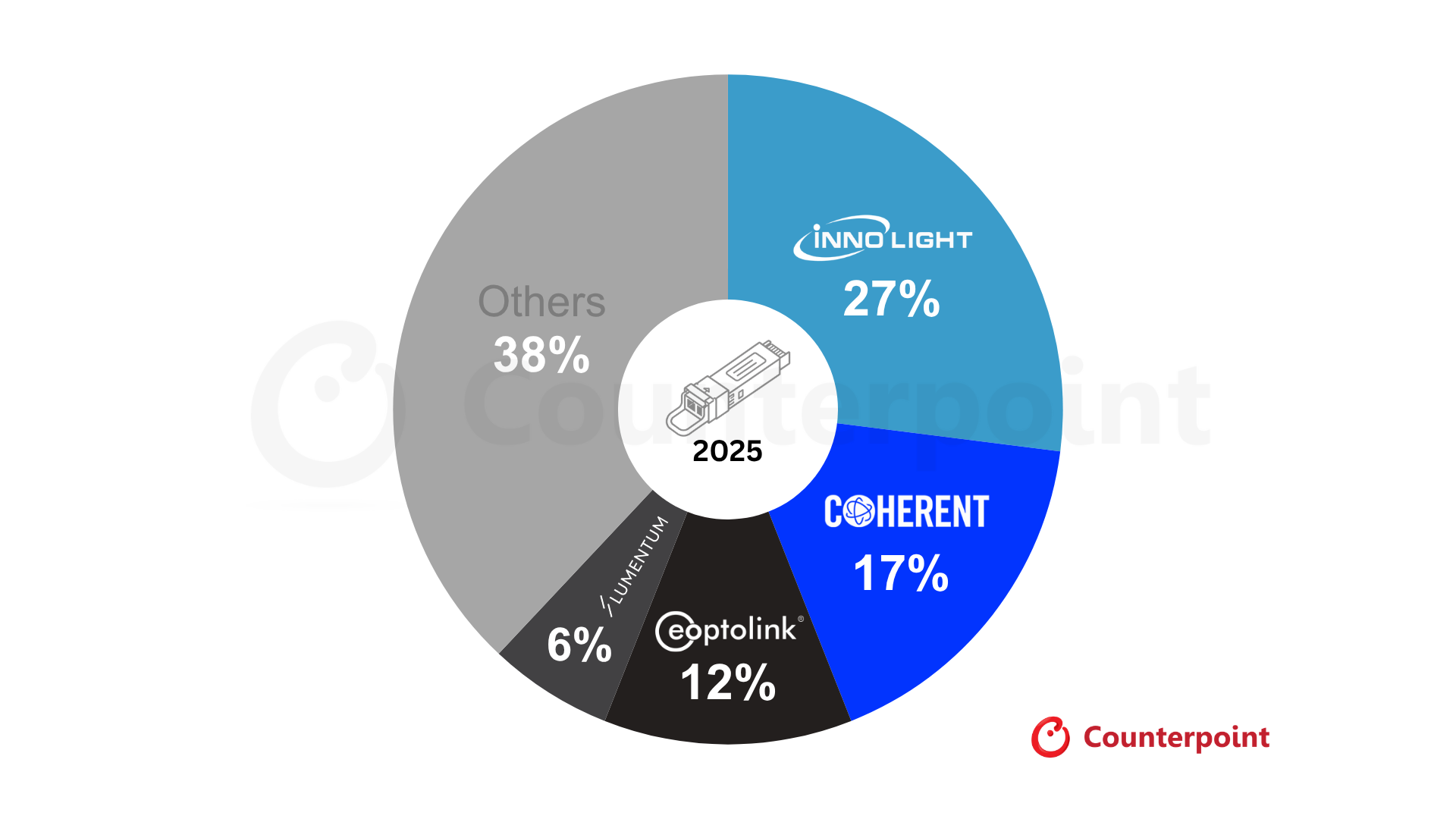
According to Counterpoint Research estimates, Zhongji Innolight leads the global data-center optical transceiver market with a ~27% revenue share, driven heavily by its dominant allocation position in 800G and early 1.6T module deployments for North American cloud giants. Coherent Corp. holds the second-largest share at ~17% from transceiver revenues, followed by Eoptolink, another rapidly expanding Chinese supplier with deep US hyperscale integration. Lumentum Holdings accounts for ~6% of finished module revenue, though it maintains a significantly higher footprint as an upstream laser component provider.
Collectively, Chinese optical module manufacturers—including Innolight, Eoptolink, Accelink, and Source Photonics—account for nearly two-thirds of global unit supply and approximately 60% of global optical datacom transceiver revenue.
Global Datacom Transceiver Modules Revenue Share by Supplier (%) 2025
1. Impact on US AI Hyperscalers: Deployment Bottlenecks and Cost Pressures
For US CSPs, Amazon Web Services (AWS), Microsoft, Meta, and Google, a blanket ban on new Chinese optical transceiver makers creates a significant near-to mid-term operational bottleneck :
- Capacity Deficit: Western competitors like Coherent and Lumentum possess advanced photonic designs, but currently lack the cleanroom capacity, automated packaging infrastructure, and yield scale required to absorb Innolight and Eoptolink's volume within a 12-to-24-month horizon.
- Cluster Turn-Up Delays: In an AI supercluster, a missing batch of optical transceivers renders billion-dollar GPU allocations idle. Constraining transceiver imports risks delaying the commercial turn-up of next-generation 800G/1.6T clusters by multiple quarters.
- Capital Cost Escalation: Restricting market supply in a hyper-growth environment will inevitably drive up bill-of-materials (BOM) costs for hyperscale data centers, forcing cloud operators to pay higher premiums for non-Chinese allocations.
2. Impact on Chinese Vendors: Geodiversification Under Scrutiny
The dynamics facing Chinese module leaders highlight an asymmetric technological landscape:
- Revenue Asymmetry: Due to US export controls on advanced AI processors (e.g., NVIDIA H100 and Blackwell series), domestic Chinese cloud operators (Alibaba, Tencent, Baidu) remain capped at lower-density clusters requiring 100G/400G configurations. Consequently, leading Chinese module makers rely on overseas buyers—primarily US hyperscalers—for 90%+ of their high-value 800G and 1.6T module revenue.
- The Southeast Asian Shield: Anticipating tariff and trade headwinds, vendors like Innolight and Eoptolink have aggressively expanded manufacturing footprints outside mainland China, setting up high-volume automated lines in Thailand. Final assembly, optical alignment, testing, and shipping for US allocations frequently take place in Southeast Asia to maintain supply continuity.
- Regulatory Exposure: If the FCC implements restrictions via its "Covered List" mechanism targeting corporate parent ownership rather than geographic point-of-origin, Chinese vendors may face hurdles even for modules produced outside mainland China, accelerating the need for corporate restructuring or joint ventures.
3. Impact on Competition and the Upstream Supply Chain
The belief that the optical transceiver market can be neatly divided geographically misinterprets how the hardware ecosystem operates:
- The Symbiotic Hardware Loop: Chinese module makers do not operate in isolation. Their market leadership is built on integrating upstream components from Western partners. Innolight and Eoptolink source high-speed Digital Signal Processors (DSPs) from the US duopoly of Broadcom and Marvell, while procuring continuous-wave (CW) lasers, Electro-absorption Modulated Lasers (EMLs), and optical chips from Lumentum, Coherent, and Japan's Mitsubishi Electric.
- System Integration as a Moat: Innolight's competitive advantage extends beyond low-cost labor. The company has evolved into a high-scale system integration platform almost analogous to Foxconn's role in consumer electronics. Mastering the thermal dissipation, nanometer alignment, and packaging yields required for 1.6T silicon photonics modules represents a substantial manufacturing moat.
- Opportunistic Gains for Western Vendors: US-based module suppliers like Coherent, Lumentum, and Applied Optoelectronics stand to gain increased procurement share and pricing power long-term. However, ramping volume to match current AI cluster buildout velocity will require substantial capital expenditure and time for qualification cycles.
Strategic Outlook
The global AI ecosystem remains heavily reliant on Chinese optical module vendors for scale execution. While policy initiatives seek to insulate critical AI supply chains, sudden regulatory shifts risk creating hardware bottlenecks that could slow down deployment schedules for the world's largest cloud operators.
Over the next 12 to 24 months, success in the optical interconnect market will be defined by manufacturing agility. Suppliers capable of delivering high-yield 1.6T silicon photonics modules while navigating complex geographic and regulatory origin frameworks will hold the keys to scaling next-generation AI infrastructure.
Contact us to learn more about Counterpoint's Cloud AI Server Analysis Service, which tracks, forecasts, and analyzes key components of AI datacenter value chain from foundry, memory, compute, networking, interconnect, cooling, servers, racks, models to AI applications.
Receive our insightful weekly newsletter and stay ahead of the competition.
Author
Neil Shah


Neil is a sought-after frequently-quoted Industry Analyst with a wide spectrum of rich multifunctional experience. He is a knowledgeable, adept, and accomplished strategist. In the last 18 years he has offered expert strategic advice that has been highly regarded across different industries especially in telecom. Prior to Counterpoint, Neil worked at Strategy Analytics as a Senior Analyst (Telecom). Neil also had an opportunity to work with Philips Electronics in multiple roles. He is also an IEEE Certified Wireless Professional with a Master of Science (Telecommunications & Business) from the University of Maryland, College Park, USA.