- NVIDIA’s strategy for robotics is a 'moonshot' approach, focusing on solving the most complex challenge first—humanoid robot development—so that the resulting AI technology advancements can cascade down to all robotics and autonomous systems.
- NVIDIA commits to being a platform player that provides essential infrastructure to accelerate the growth of the robotics ecosystem for all partners, maintaining a philosophy of collaboration that avoids vendor lock-in.
- Robot AI development is built around 'The Three Pillars' architecture—Training (DGX), Simulation (Omniverse), and Deployment (Jetson)—with the company's powerful software platform, CUDA, serving as the bedrock that accelerates this entire closed-loop process.
NVIDIA, a company synonymous with GPU-powered AI acceleration, is architecting the future of robotics through a cohesive, multi-layered strategy that spans hardware, simulation, and software ecosystems. A recent one-on-one interview with Spencer Huang, Product Line Manager at NVIDIA, leading robotics software, shed light on the company’s approach, revealing a philosophy centered on tackling the toughest problems first, fostering an open ecosystem, and leveraging its enduring competitive advantage – its proprietary CUDA.
The Humanoid Challenge: Solving the Hardest Problem First
NVIDIA’s approach to robotics is strategically counterintuitive yet fundamentally sound – solve the hardest problem first. For them, that problem is the Humanoid. This is a classic "moonshot" strategy. A general-purpose humanoid robot requires an intelligent system to perceive, reason, and act seamlessly in the unstructured, complex real world. The required advancements in vision-language-action (VLA) models training and inference are so profound that the resulting technology will naturally cascade down to simpler, more constrained robotics applications, such as factory arms, warehouse logistics, and autonomous vehicles.
This concept ties directly into the larger vision of "Physical AI," which NVIDIA views as the ultimate realization of Everything AI or World AI. It is about creating systems that can interact with and understand the physics of our world, moving beyond the digital realm and into tangible reality.
According to Counterpoint Research, the overall revenue from humanoid robots will exceed $16 billion in 2030, representing a CAGR of 51% between 2024 and 2030. China will remain the largest single market in shipment terms, while the Americas will represent a huge potential for high-spec products and fill labor shortages across the Auto and Semi manufacturing sectors. 2025 is regarded as the first year of humanoid robot commercialization, with diversified products moving to mass production and realized small-scale deployment in factories and enterprises. Looking ahead, the aging population among major global economies will generate huge demand for flexible humanoid robots. Meanwhile, special humanoid robots will be developed to replace humans doing hazardous work or collaborate with humans in rescue operations or in other specific environments.
IMAGE
The Platform Player: No Hostages, Only Collaboration
A major theme throughout the interview was NVIDIA's commitment to being a platform player and avoiding vendor lock-in.
This philosophy is crucial in the nascent, complex field of robotics. Nobody wants to be a hostage to a single technology provider. NVIDIA understands that to build a sustainable and thriving industry, it must provide the essential infrastructure that enables all players – from startups to massive enterprises – to succeed, using their own specialized knowledge.
The industry is still too young and the problems too diverse for any one company to dominate. NVIDIA acknowledges that other companies possess greater, deeper expertise in specific domains. The existence of competing ecosystems is considered a "competitive necessity," ensuring that diverse, superior solutions are found and tested across the board. NVIDIA's objective is clear – to provide superior tools to accelerate industry advancement, not to corner the market.
The Three Pillars of Technology
NVIDIA’s technical strategy is built around the concept of “The Three Computers” – the Training Server (e.g. DGX), the Simulation Server (e.g. Omniverse), and the Edge Computer (e.g. Jetson). This architecture reflects the closed-loop development cycle of modern AI, ranging from VLA model training, the production of training data and fine-tuning models for local deployment, as well as creating a complete solution to build the brain of a flexible humanoid robot:
1. Training (The DGX): AI models are developed using large clusters.
2. Simulation (The Omniverse): Models are tested, validated, and refined in virtual worlds for specific tasks or environments
3. Deployment (The Jetson): Models are run in the real world on specialized hardware.
Data remains the core challenge due to data scarcity. To overcome this, NVIDIA uses a blend of real-world and simulated data. Counter-intuitively, low simulation sensor fidelity is deemed "acceptable" during the initial, massive training phase, as the goal is to quickly pump through large volumes of data to achieve rapid learning. However, as the model approaches real-world deployment, fidelity of perception must be significantly increased to ensure safety, precision and robustness.
IMAGE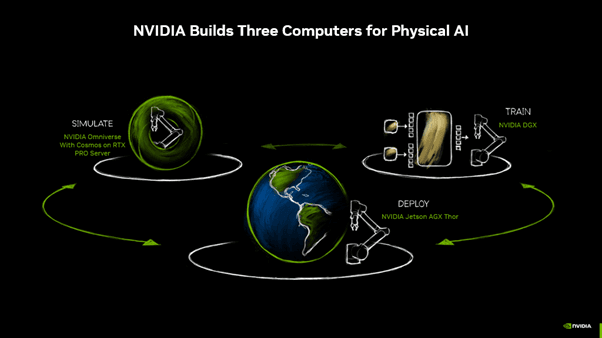
The Enduring Core: Digging Deeper with CUDA
Beneath the open ecosystem and ambitious goals, NVIDIA's true and most enduring competitive edge is its software and parallel computing platform – CUDA.
Huang’s team aims to acquire knowledge and technology that surpasses customers' current understanding in deep vertical expertise. This means that while they rely on partners, NVIDIA must sometimes dig deeper than their partners in certain areas to strengthen their platform. The knowledge gained in these deep dives is not meant to compete with partners but to optimize the core infrastructure, providing every partner with a critical performance boost.
This is where the magic of CUDA happens. The ability to control and optimize the entire stack – from the architecture of the GPU (hardware) to the parallel processing framework (CUDA and its libraries) – allows NVIDIA to accelerate AI workloads far beyond what competitors can achieve. CUDA remains the bedrock competency that enables their customers to create more advanced products within their own areas of expertise.
The roadmap is ambitious – unlock the humanoid, provide the platform, and accelerate the entire industry using the relentless power of optimized GPU computing. The market for humanoids, currently constrained by cost effectiveness, is expected to boom once industrialization and scale, driven by NVIDIA's foundational technologies, are achieved, mirroring the historical evolution of the automotive market.
