A price increase on the new iPhones is inevitable. The question is not whether Apple passes it on, but how large the final price bump is and how much of it is absorbed by tiering, services, supply chain renegotiation and leasing.
The Hypothesis:
• BoM inflation is real and memory- & storage-led, and the advanced process node-manufactured SoC has joined the party. We estimate the Bill of Materials (BoM) for the iPhone 18 Pro Max (12GB + 1TB) rises by close to US$300 versus its predecessor. The 256GB and 512GB variants of the base and Pro models see a US$200–250 increase, which is a higher percentage increase than the 512GB/1TB tiers, because Apple could use more cost-effective NAND solutions in the top variants.
BoM Cost Comparison
iPhone 17 Pro Max vs. iPhone 18 Pro Max (Estimated)
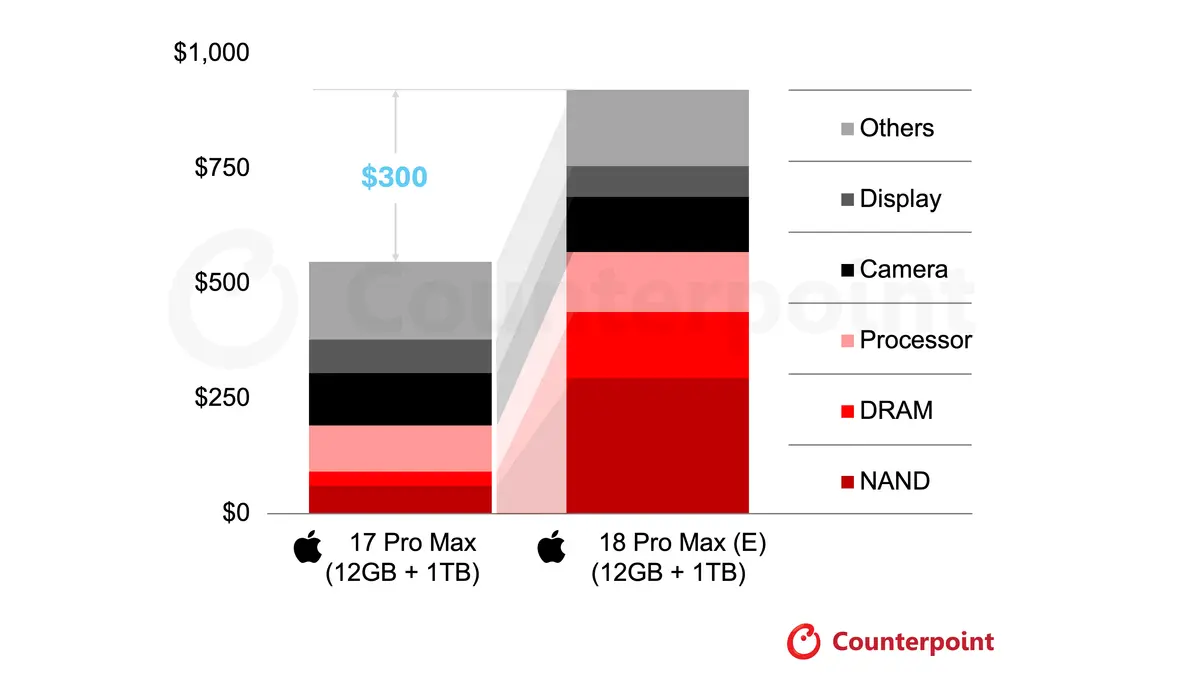
Note: The cost estimate time point is based on each product's release time.
•Holding gross margin flat implies a US$250–350 retail increase. That is the theoretical pass-through required across the line-up to preserve prior-generation gross margins. We do not expect Apple to take it in a single, uniform step; instead, we expect it to try different avenues to protect the healthy gross margins it has enjoyed for decades.
• We expect Apple to deploy a tiered, asymmetric pricing strategy. The bump could be concentrated in higher-capacity variants, which carry the more cost-effective NAND, with the base variants moving less to give less of a sticker shock. This masks the increase at the entry price point while recouping margin at the top.
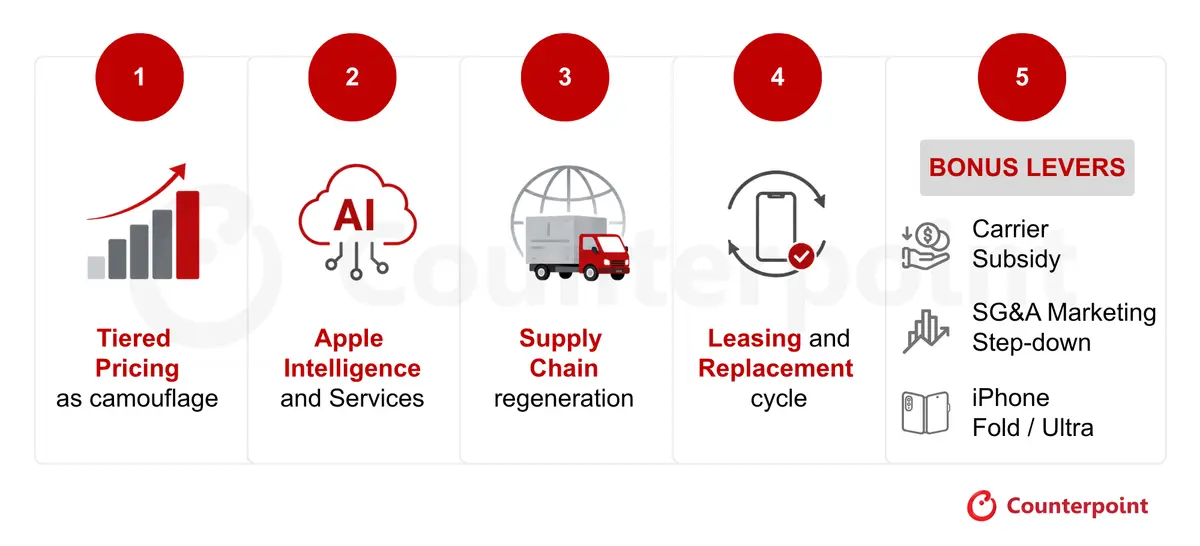
• Four to five different positive offsets
o Tiered pricing,
o Apple Intelligence and services monetization,
o Supplier renegotiation and diversification,
o Leasing – replacement cycle control
• The component cost cycle will not ease for at least 18 months and could also be a new normal for the industry and consumers.
• Allocation priority runs datacenter first, then automotive, then PC and smartphone. Smartphones are at the back of the queue.
The Math:
The speed at which memory and storage costs have risen has surpassed Apple's ability to engineer around them. According to Counterpoint’s Monthly Memory & Storage Pricing Tracker, the ASP for DRAM has gone up 400% and for NAND by more than 300% in just the last twelve months. Further, Apple is moving to 2nm-based A-series SoCs for its latest iPhone 18 series, which is one of the most expensive nodes at TSMC and wafer pricing at TSMC has already seen multiple increases across the leading nodes, putting further pressure on Apple.
Our BoM work points to roughly US$300 of incremental cost on the highest-configuration Pro Max (12GB + 1TB), and US$200–250 on the 256GB and 512GB variants across the base and Pro models.
The counterintuitive point is how Apple executes the increase to alleviate the price shock while protecting the margins. Traditionally, in percentage terms, the mid-capacity tiers get squeezed more than the 512GB/1TB tiers. Hence, it has been more profitable for Apple to sell the higher capacity SKUs. With the iPhone 18 series, Apple aims to deploy more cost-effective NAND solutions in the higher variants popular among its affluent and mature user base, maximising the margin. That asymmetry is precisely what gives Apple room to manoeuvre on price for lower-tier SKUs to go for the kill (Android phones) and not hike too much there.
The Strategy:
There are a few avenues or levers that Apple could exercise to offset the component price increase.
Lever 1: Tiered pricing as camouflage to ease the sticker shock
As we discussed, it will be prudent for Apple to load the increase onto the higher-capacity variants and avoid too large an increase at the base configuration. The logic is straightforward: the top tiers carry the more cost-effective NAND, so a larger nominal increase there is more margin-accretive than the same increase at 256GB.
Everything here banks on Apple’s intent. If the priority is sharing capture against Android, the base variants get a small bump, and the top of the range sees a higher increase with a smart mix-and-match approach to blended profitability. If the priority is margin protection, the increases are simpler and flatter across tiers. This is a strategy question rather than a cost question, and we will have to wait on what Apple chooses.
Lever 2: Services and Apple Intelligence monetization to boost CLV
The second offset sits outside hardware, in its US$120 billion services line — the second largest, fastest-growing and most profitable part of the business. Apple will love to recoup cost from the higher-margin software and services line using Apple Intelligence as the monetization vehicle once it is “ready for prime time”. Apple can monetize across the full lifetime of the installed base rather than at the point of sale.
The situation is precarious in year one. Apple’s AI, or Apple Intelligence, is not yet at a point where users will pay Apple rather than paying Anthropic, OpenAI or Google directly. Our thesis is that monetization becomes mainstream in the second year of the iPhone 18 lifecycle. Even at roughly US$10 per month for on-device-heavy AI which does not require heavy AI datacenter capex from Apple, the margin profile is attractive and could drive a US$10–20B first-year uplift on a services base of around US$120B.
That flywheel matters more here as services profit accrues over the three-to-four-year life of the iPhone 18 series boosting the Customer Lifetime Value (CLV) metric, which gives Apple the cushion to absorb a two-year margin hit on hardware.
Lever 3: Supply chain — less leverage than before, but it's Apple
Apple is pursuing long-term agreements with component suppliers, diversifying beyond the Big Three, and squeezing cost out of the non-memory BOM such as display, camera, casing, materials, packaging to shave down the increase. Feel sorry for the other non-silicon component suppliers.
However, the balance of power has shifted especially on the silicon procurement. Apple no longer commands the buying power it once did. Pricing pressure will intensify from here, and conditions do not seem likely to improve for at least the next 18 months. Any easing arrives in sequence: datacenter first, then automotive, then PC and smartphone.
On QLC NAND usage, a mix shift helps at the margin, but not dramatically as the bits themselves are limited and expensive, which caps the benefit.
CXMT, the world's fourth-largest memory supplier, is in contention as a potential supplier, both as a bargaining chip and genuine supplier. It's better to source “qualified” memory from wherever Apple can or the expensive A20 SoCs will be stuck as inventory in a warehouse of EMS suppliers. Though we are a bit sceptical: Samsung, Micron and SK hynix understand CXMT’s capacity is constrained and that its output is likely prioritized for Chinese domestic customers, so the leverage part won’t fully fly. Plus, there are regulatory hurdles for Apple to jump over to court CXMT. Apple could have played that card three years ago, but now NVIDIA holds those cards and buying power. The new king in town.
Lever 4: Leasing & Secondary Market Help Shape the Replacement Cycle
The fourth offset is financing. Leasing delivers a margin benefit through a controlled upgrade rate, converting a lumpy hardware transaction into a managed, recurring relationship and thereby shortening the effective replacement cycle Apple can control and plan around.
Price elasticity is smaller than the headline suggests. The instinct is that consumers will not absorb a US$200+ increase. We think that is a bit of an underestimation of Apple's userbase. Apple’s major footprint is concentrated in the US and in affluent segments of the UK, China and Japan. Across a 36- to 40-month device ownership life, a US$200 increase is roughly US$5 per month, which is less than a single Starbucks coffee.
Bonus Levers: Carriers & Marketing Spend
There are two further shock absorbers. First, Apple could look to carrier partners to subsidize part of the increase in these markets, as telcos have not become fully Apple-independent and much of their ARPU and churn is still governed by the Apple userbase.
And marketing and SG&A spend should step down over the next four quarters, supporting operating margin independently of pricing.
The iPhone Fold or iPhone Ultra, whatever it is called, could also offset some of the margin and boost both the topline, bottom line and the “halo effect”.
What we are watching
• The spread between base and top-tier pricing at launch to get a clear read on whether Apple is prioritizing share against Android vs pure margin protection or both.
• Apple Intelligence monetization mechanics and pricing, particularly any on-device-heavy tier with mix of subscriptions (cut) around the US$10/month mark. What % of its billion or more devices base would subscribe to Apple Intelligence?
• Evidence of LTAs being signed with memory and other suppliers, and any credible qualification of supply beyond the Big Three.
• Carrier subsidy behaviour and leasing programme expansion outside North America.
• SG&A and marketing trajectory over the next four quarters, noting that marketing the iPhone Fold or Ultra may require some incremental push.
• Moving forward, long-term, the shift to 16GB RAM for iPhone 19 and beyond will be a big question.
• Apple’s software-engineering work internal and with Google to quantize larger AI models into smaller, targeted on-device models, with the goal of keeping device memory-footprint increases to a minimum over the next two years.
Want to understand what’s driving memory prices and how they are reshaping smartphone pricing? Contact us to access Counterpoint’s Global Memory Price Tracker and Forecast, Memory (DRAM) Tracker and Forecast, and Memory (NAND) Tracker and Forecast.


